

STRUCTURE OF THE POEM
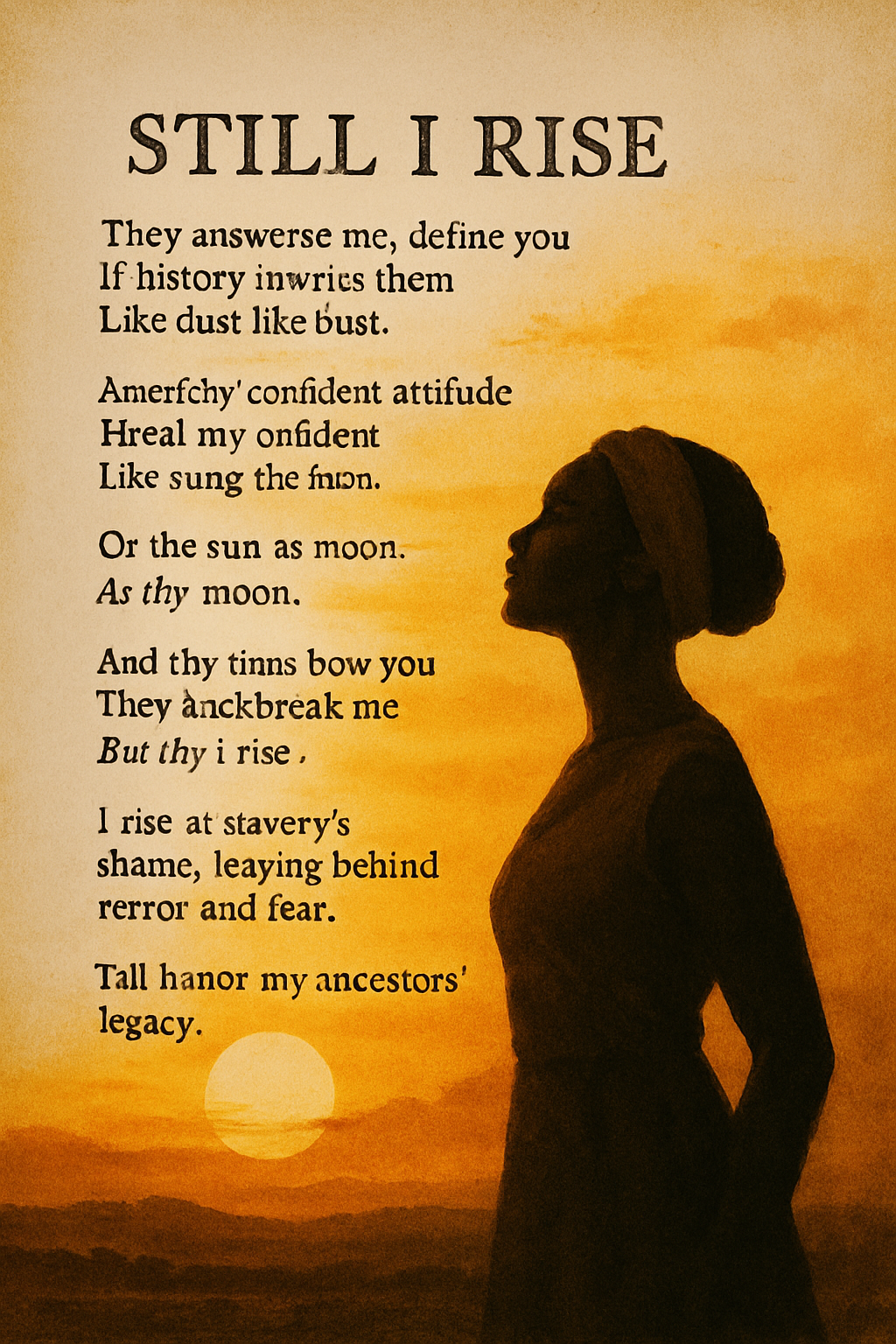
‘Still I Rise’ is a 9-stanza-43-line poem and can be classified or categorised as an example of a lyric poem, because although it is not designed to be sung, it is a poem spoken by a single speaker, in which she expresses her thoughts and feelings. And the poem is both a personal lyric, a channeling of Angelou’s own tough upbringing and experiences, and a poem about a nation developing during the Civil Rights era, in response to writers and activists including Angelou herself. ‘Still I Rise’ is composed largely in quatrains rhymed abcb. The line lengths vary and the number of syllables and beats in each line also varies, giving the poem a sprightly, unpredictable feel. It belongs to a strong spoken-word tradition where poetry is returned to its oral roots: these are words meant to be recited, chanted, declaimed out loud in the living voice. 45 And the shift from more ordered abcb quatrains into a less predictable form in the poem’s final stanza is perhaps best analysed as a broadening out rather than a breaking down: the poet’s passion, confidence, and optimism burst into new life, and can no longer be contained by the conventional four-line stanza form. The form of the closing lines of ‘Still I Rise’ thus enact their meaning: they are rising above the past (embodied by the more traditional quatrain) and becoming something more individualized, spirited, and bespoke. The poem can also be considered an ode to oppressed Black womanhood: The speaker celebrates Black women in mind, body and soul. It is as well a protest poem, protesting against oppression by the colonialist
POETIC DEVICES IN THE POEM
- Repetition : In “Still I Rise,” Angelou’s speaker repeats the refrain, “Still I rise” and, “I rise” to convey the power of Black resilience and set a triumphant tone. The repetition of “Still I rise” and “I rise” set up a stark contrast between the hateful actions of the poem’s “you” and the resilient response of the poem’s speaker. Angelou describes how the poem’s “you” attempts to keep the speaker down. The “you” addressed by the speaker may “trod [them] in the very dirt,” “shoot [them] with your words,” and “cut [them] with your eyes.” These actions are all designed to break the spirit of the speaker. But in response to each of these attempts to oppress them, the speaker repeats the phrase, “I rise.”
- Rhetorical Question
In “Still I Rise,” rhetorical questions appear at the beginning of four of the stanzas. Each rhetorical question in this poem is addressed to the poem’s “you.” Each question asks about the ways in which the speaker offends the addressee. This technique allows Angelou to investigate why the addressee hates the speaker…which also allows her to shine a light on the flimsy reasons behind racism as well. - Symbolism
Angelou uses symbols of wealth and things desired by society to indicate the inherent worth and value of her speaker: She references her speaker’s sexuality to assert that her speaker is just as capable of being loved and desired as anyone else. The poet also refers to “the ocean” as a symbol of a powerful force of nature: It therefore represents the speaker’s power as a force of its own which cannot be controlled by others, just as the ocean cannot be controlled by humanity - Metaphor
Metaphor is used to express the things the oppressor may do to harm the speaker: For example: “You may shoot me with your words”. The use of “shoot”, “cut” and “kill” reinforce the pain caused by racism and prejudice. The guilty and shameful memory of slavery is also alluded to in the metaphor “the huts of history’s shame”: Again, the speaker will rise out of these “huts of history’s shame”. - Parallelism
The repetition of similar wording or phrasing establishes the coordination of key ideas and brings a sense of order to the poem: For example: “Just like moon and like suns,/With the certainty of tides,/Just like hopes springing high,/Still I’ll rise.” The order given to the ideas gives the speaker reliability and the listener confidence that she has the resilience to rise above oppression. - Imagery
The image of “dust” rising from the earth could be considered a Biblical reference, as out of “dust” humans were made and to dust our bodies return when we die. The speaker’s physical, mental and spiritual power are also conveyed by her comparison to “oil wells” and the fact that she dances like she’s “got diamonds/At the meeting of my thighs?”
MOOD/TONE
The poem reflects the mood and tone of assertion and seriousness. Its protest tone sets the tone for empowering the blacks regardless the past and perceptions. The tone is also defiant and resilient, conveying a sense of defiance and resilience in the face of adversity.
LANGUAGE AND DICTION
The language is a blend of formal and informal language which are mostly figurative. The poem employs a conversational tone to create a sense of intimacy and authenticity. Some figurative language employed are 46 imagery, “the sun-scorched earth” and “the wind-swept hair” and simile, such as “like air” and “like dust”. Moreover, the language is simple and directly used to convey powerful emotions and ideas. The diction also incorporates elements of the African American Vernacular English (AAVE), such as “you” instead of, “they”, to celebrate her cultural heritage.
CREDIT TO H.K OCRAN/ LiTTROVE