

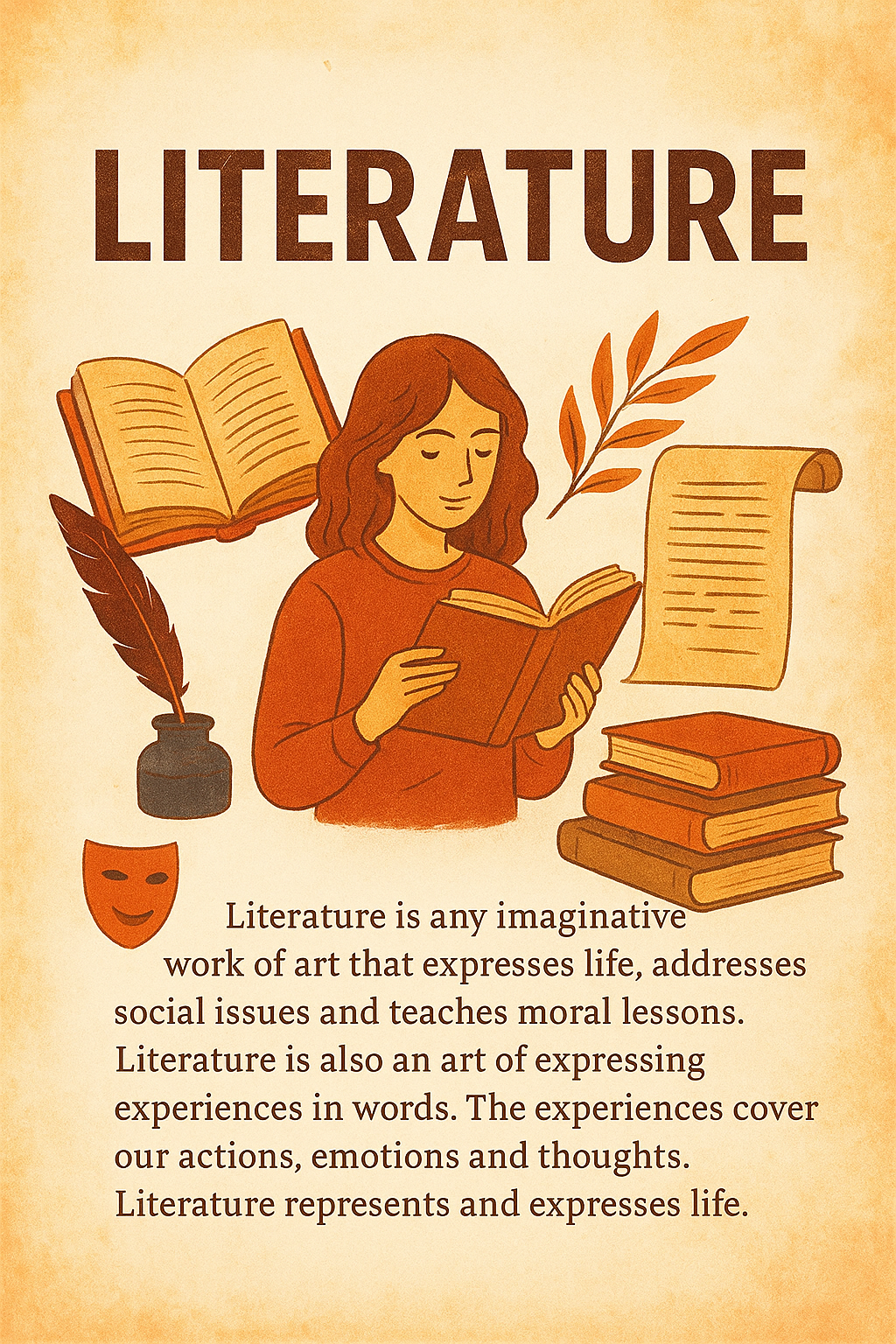
Literature is any imaginative work of art that expresses life, addresses social issues and teaches moral lessons. Literature is also an art of expressing experiences in words. The experiences cover our actions, emotions and thoughts. Literature represents and expresses life. Literature is imaginative, creative, work of art, oral and written. Literature involves the use of language. The scope of literature refers to the areas that literature covers. Literature covers language (Akan literature, Ewe literature, English literature), people (Ghanaian literature, Nigerian literature, European literature) and a period of time (19th, 20th and 21st century literature. For example, the years that William Shakespeare wrote The Merchant of Venice, As You like It, and Romeo and Juliet are different from the years Ama Atta Aidoo wrote No Sweetness Here and Changes). This means literature is categorized based on the year in which it is written.
QUALITIES THAT MAKE LITERATURE A WORK OF ART
Creativity: this is the ability to use words to create works like poetry, novel and drama about life.
Fiction: this is the ability to create literary works out of imagination. Writers imagine characters, actions, plot, conflict and all other elements of poems, drama and novel, and write a good story that aims at teaching moral lessons.
It has aesthetic value: this is because it appeals to human senses of beauty. A poem is said to be beautiful when the writer uses images that appeal to the senses and figures of speech. For example, a drama or novel is described as interesting and beautiful if a writer constructs ideas and blends devices that evoke feelings and teach morals.
IMPORTANCE OF LITERATURE
Literature documents people’s life and experiences, beliefs and values within a specific period of time.
Literature is educative: through literature, people become aware of the occurrences around them.
It teaches moral lessons. Societal values, beliefs from diverse cultural backgrounds are portrayed in literature for people to read and learn from. Literature encourages acceptable behaviors and criticizes evil doers in the society. Literature promotes the culture and norms of people. Cultural heritage and knowledge are passed on from generation to generation through literature.
It helps to develop critical and analytical minds.
It is a source of entertainment. Some people read literature books for pleasure. Some panegyric poems, love poems, folktales, puzzles and riddles do not only appease the mind but to evoke the feelings of joy in the readers and listeners.
It preserves and improves language. Literature promotes language proficiency because the more a person reads, the greater the chance of his vocabulary acquisition.
FORMS OF LITERATURE
Oral literature: it is delivered by mouth. It has no recognized authors. Examples are folktales, myths, proverbs, legends, dirges and riddles. Oral literature is sometimes used interchangeably with folklore. Some examples are:
Folktales: folktales are narrative stories that are constructed from the imagination of people over time. Folktales are fictions that depict the cultural backgrounds of people and teaches moral lessons.
Myths are stories about gods, superhumans and natural phenomenon. Myths give accounts on extra ordinary events/circumstances in a time that is altogether different from that of ordinary human experience.
Legends are stories about personalities and events that are believed to have existed in the history of a particular community. Example, the deeds of great warriors, kings and leaders of a community.
Proverbs are short wise sayings.
Dirge is a song that is used to mourn the dead.
Elegy is a poem that is used to mourn the dead.
Puzzles (nyansapↄ) and riddles (Agya rekor) are examples of oral literature.
Written literature: it is any literary work of art that is documented and has a recognized author.
GENRES OF LITERATURE
Poetry: it is the spontaneous overflow of powerful emotions. Poem is also a work of art that employs language, image, sound and rhythm to present varied issues in life. Poems are written in stanzas or verses. Poems are written on themes like war, love, death and all other experiences of life. Examples are lyric, elegy, epic, sonnet, ballad and ode.
Drama: it is a story told in action. It is a story which is performed by characters on stage before an audience. Examples of drama are The Marriage of Anansewa, Ananse in the Land of Idiots, In the Chest of a Woman and Women of Owu. A drama could be a tragedy or comedy. Some specific elements of drama are:
Dialogue: it is the conversation between characters
Acts and scenes: acts are the major divisions of a play while the scenes are the minor divisions within the acts.
Cast: it is the list of characters’ names
Aside: it is the situation where an actor speaks to the audience without the knowledge of other characters on stage.
Comic relief refers to humorous events that relieve the audience from tension in a tragedy.
Prose: it is a work of art that is written in ordinary grammatical structure and natural flow of speech rather than rhythmic structure. Eg. The Ancestral Sacrifice – Nyantakyi Kaakyire Akosomo, Anthills of the Savannah – Chinua Achebe and A Woman in Her Prime – Asare Konadu. A prose could be a tragedy or comedy.
CHARACTERISTICS OF ORAL LITERATURE
It is performance – based. It depends absolutely on performance for its existence. Oral literature is always accompanied by action. The ultimate quality depends on elements of performance such as dance, song, mime, gestures etc. The actions come with costume and feelings of either happiness or sadness.
The elements, events and actions of the same story are not the same. Eg. The theme, settings and plot of a folktale are essentially moderated to suit and satisfy prevailing circumstances.
Oral literature is socially determined: oral literature is closely watched and criticized by experts and elders in the society because of the major roles that it plays in projecting communal and social values. Elders in the society frown on literary works that promote abusive words, profane words, wickedness, murder and all other social vices that oppose the cultural values and morals of the society.
Credit to MADAM SITSOFE GANU
DEPARTMENT OF ENGLISH LANGUAGE
S. D. A. COLLEGE OF EDUCATION
ASOKORE – KOFORIDUA.