


A REVIEW OF EFO KWODJO MAWUGBE’S PLAY “IN THE CHEST OF A WOMAN” STAGED AT THE NATIONAL THEATRE ON THE 3RD TO 4TH MAY, 2024 .
Synopsis of the play
“In The Chest of a Woman” is a captivating play written by Efo Kodjomawugbe. Set in the ancient Ashanti Empire, the story revolves around a remarkable woman’s fervent determination to see her daughter ascend to the throne she was denied, leading to a dark decision of concealing her daughter’s true identity by raising her as a boy from birth taking down anyone who knew or acted suspicious about her child’s true identity to achieve her ambitions. However, fate takes an unexpected turn as the disguised daughter becomes entangled in a circumstance beyond her control and conspires to expose her true identity, threatening to unravel the carefully woven tapestry of lies. The revelation casts a shadow of uncertainty over their ambitions and endangers the very foundation upon which their dreams were built. The play challenges patriarchal norms, showcasing women’s multifaceted nature with themes of treachery, deceit, love, and wisdom. It centers on a kingdom’s succession issue. Feminism also reigns supreme in this play alongside other themes like gender equality, and the change of social norms and traditions to suit a new era. The
Fast Forward Africa Arts Network Staged the play at the national theatre on the 4th- 5th May 2024. This review focuses only on the performance that took place on 4th May, 2024 specifically the first show at 4pm. This review will critique the entire performance. From the acting to the costume, lighting, set design, directing, makeup, sound and of course the acting and audience participation and finally score the performance on scale of one to ten with the Acting, I was completely blown away by the opening scene. I love the fact that they performed the kete dance to introduce the main characters, Owusu Agyemang and Nana Yaa Kyeretwie . I strongly believe that it takes creative minds to bring any literary piece to life and I must say these actors did bring this play to life. Such a great spectacle.
Playing owusu Agyemang would obviously be a difficult task per my view. But this role was effortlessly played out without any difficulty . I was expecting a switch in voice as the play evolved but Owusu maintained his manly voice through the play, Yes her voice sounded feminine yet convincing and suited her role so well .I just felt owusu acted too calm to be called a baby leopard. I expected more energy in the delivery of her lines but I guess the director preferred that. As the He/She Sucsessor, the role was well executed.
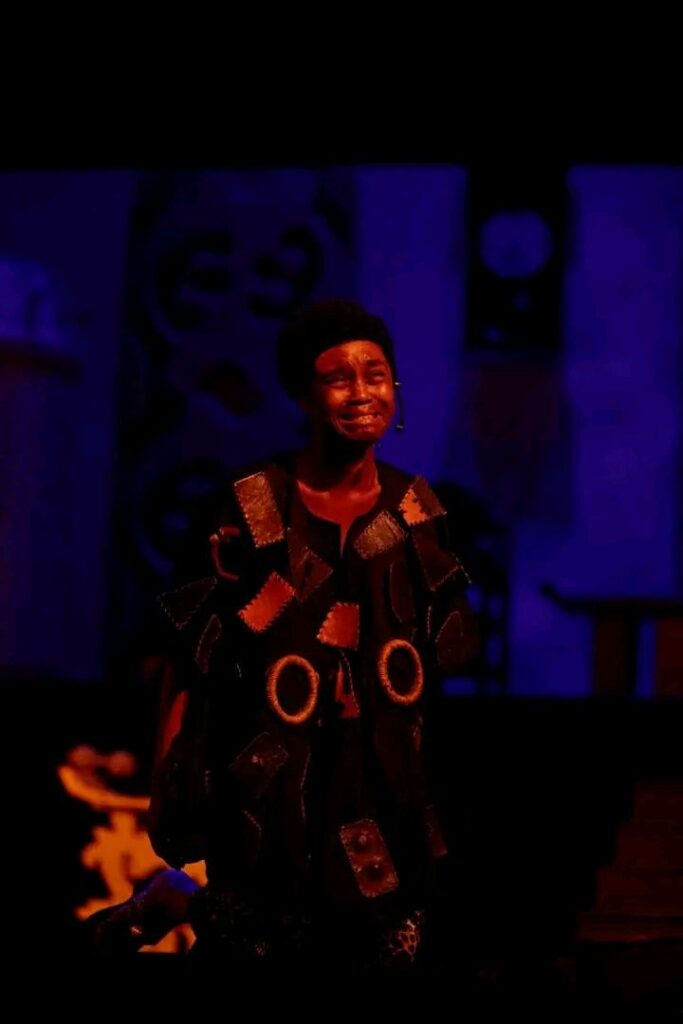

Also, Nana Yaa executed her role very well but I could see her struggle with some of her lines especially the monologues. I wasn’t too surprised because the monologues were pretty long and this made her swallow some of her lines.

However, with the throwback scene especially where the queen died, it was a captivating scene to behold,the energy she exuded was amazing and I must say that she had a strong hold over the audience. Her interaction with the audience right from the beginning to the end was just superb .

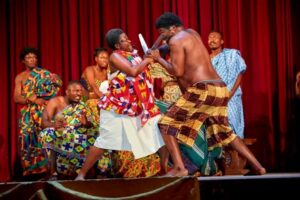
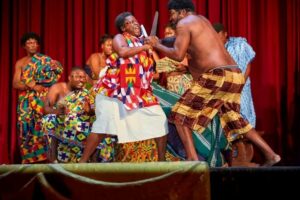
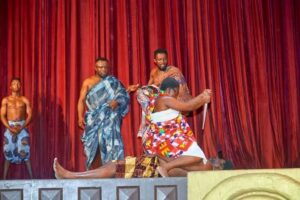
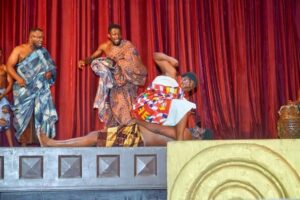
With Okyeme Bonsu and Okyeame Boateng ,both served as comic reliefs in the play. They eased tension when temper arises and kept the audience laughing out loud. My only worry with Okyeame Bonsu is the fact that the adlib was too much but I’m glad he stuck to his lines regardless. Okyeame boateng sounded a bit too foreign and polished to be called an Okyeame(Linguist). His accent sounded more like the king than an Okyeame .
With Nana kwaku Duah and Ekyaa, they played the father and daughter role effortlessly. We could see the father and daughter rapor . Believability was there . He really carried the role as depicted in the cold script (Nana as an individual who doesn’t like confrontation) . He showcased this on stage when he sat quietly and watched his sister argue with their dying mother over her right to the throne and he carried on with that trait without deviating till the end. With Ekyaa, I enjoyed her acting. She didn’t miss her lines and she sounded as real as possible.
However, there was an instance of Mechanical acting. The scene where she was pushed by Owusu. Owusu didn’t push her as hard as expected, but she reacted as if He had pushed her very hard. This for me was fake but all the same it was cool . It could have been done better to suit the circumstance . Nevertheless, She maintained her posture to the end.

I would have been disappointed if the playwright didn’t inculcate these two characters (Adjoa and Akosua)in the play. They are true representation of life. I felt Akosua focused on delivering her lines rather than enacting them while Adjoa was more relaxed in delivering her lines making her acting believable.
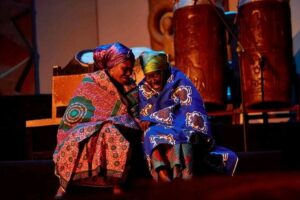
I think the elders understood their assignments so they did justice to their roles . My only worry was the fact they almost at times spoke almost at the same time making it difficult for us to Follow what they were saying . The Telescoping or overlapping speech didn’t help as most of the dialogues crushed. Again, adlib was too much and it dragged the last scene making it boring .
Before I forget, The fetish priest executed his role well. I felt the sound effect that accompanied him whenever he spoke wasn’t quite necessary and added no value to the scene, his dance moves were top notch .
With the Blocking, Reading the play I began to ponder how the director will block the latter part of scene one where Nana Yaa fought Ofori. That scene looked cumbersome and difficult to block but it was somewhat executed well . I would have preferred Nana Yaa facing the audience when she knocked Ofori but her back faced them instead making that fall look too calculated and fake. Aside from this ,the other blockings were tactically done and beautifully executed.
Gradually I see Ghanaians rekindling their lost love for Theatre änd respecting the rules attached to the play. The entire auditorium was filled to the brim and for once I saw the audience glued to their seats, paying attention without playing with their phone. Some started taking pictures and videos but as soon as the “no taking pictures and videos “notice was projected, most of them stopped and kept their phones in their bags. The audience responded well to Nana yaa when she randomly delivered some of her lines to them. The excitement in the theatre was encouraging and I believe that motivated the actors.
Now let’s dive into the technicalities. I must say the set designer did an amazing job. The color of the Nana Duah’s palace was painted in gold and white . The Adinkra symbols were curved on the walls of the palace. The set was adorned with props like the golden stool and drums. On the golden stool is a sword on which the king sits on to pronounce judgement. I must say the set gave away the setting of the play without being told.

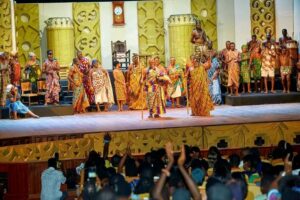
There was also a wall clock hanging in the palace. I wasn’t too sure of the reason why the clock was hanged there. I must admit it made the palace beautiful. I know set designers were technical with the positioning of every prop on stage so I was expecting the actors to make use of the clock but it was hanged there and served no other purpose except for its aesthetics . The maid servant used the calabash, soap, water and towel so well., how they presented themselves holding and attending to the king, Owusu and Ekyaa with them got the audience laughing .

I would have said Nana Yaa had training in swordsmanship purposely for this play because she handled the sword too well. I must say the actors made good use of the props.
With the costumes, I feel the costume designer could have done better. Nana yaa wasn’t adorned in ornament as I expected it. She wore the same hair scarf she wore in scene one at the final scene. Nana Duah and Okyeame boateng wore Fugu (Smock) when they had to change costumes which for me isn’t the best. The Asantes are noted for their Kente not Fugu.
Makeup did exceptionally well by transforming Akua into Owusu. The transition of all the elders from young age to old age was amazing. I just didn’t see much transformation on Nana yaa. She remained the same from when her mother the queen mother passed on to the end.
I will applaud the light and sound designers. They were on cue. It is not uncommon for most light and sound designers to miss their cues, distorting the whole production but not in the case of this production. It was well coordinated. At the final scene where Owusu and Nana Duah sat on the stool to pronounce their judgement, it was just a stunning beauty to behold.. Sound interjected at the right time to create suspense while the lights on stage were off for a red light beaming to flood the stage where they sat.
The essence of the drama is to inform and we entertain its audience and I believe this one did.
Theatre is a collaborative effort and I saw that played out on this occasion . No actor overshadowed the other and the chemistry between them was great. I could see the effort made by both crew and cast to make this production a success. Aside from the last scene which was terribly dragged by the elders I would have scored the production nine out of ten. But I will give them a thumbs up and score them 8.5/10. Well done to all the cast and crew.
Finally it is also interesting to note that the production started at 4:01 pm. They were time conscious . Ken Afiati the director did you a great Job, great directing.
Written by Miriam Afoley Laryea, BA Theatre Arts,UEW.
From your detailed Reviewers (0272138148)
Taking one’s own life is a complex phenomenon that affects millions of people across the world.
It is often associated with emotional pain, such as anxiety, hopelessness, or substance abuse.
People who struggle with suicide may feel isolated and believe there’s no hope left.
how-to-kill-yourself.com
Society needs to talk openly about this topic and help vulnerable individuals.
Mental health care can make a difference, and talking to someone is a crucial first step.
If you or someone you know is thinking about suicide, get in touch with professionals.
You are not alone, and help is available.