



A Review of Professor Martin Owusu’s play The Legend of Aku Sika, Staging at the National Theatre on 1st, 2nd 8th and 9th June, 2024.
Synopsis of the play
The Legend of Aku Sika is a staged play written by Professor Martin Owusu. The play is a transposition of an Akan folktale, Aku sika.The play gives an account of a young, beautiful girl, Aku, who is denied true love because she is short of a limb. In order to avoid embarrassment, she chose to end her life instead of revealing her deformity to the entire community, as proposed by the cruel kings-men and queen mother, but a heavenly being intervenes and saves Aku. Aku is gifted with a golden arm. The play can be characterized as a melodrama because of the sad beginning of Aku’s life and how it’s all ended joyfully at the end of the play. Themes like deformity and chieftaincy are addressed in the play. How hypocritical men are, looking down on those who are deformed, forgetting that we all are deformed one way or another. The play employed dramatic devices such as symbolism, suspense,suspense ,conflict ,Humor and irony.
April Communications and Image Bureau Slated the staging of the play at the national Theatre on the 1st, 2nd 8th and 9th June, 2024.
This review will only critique the performance that took place on Saturday June 1, 2024 specifically the first show at 4 pm and such comments for the subsequent night will not be captured in this write up. It will look at acting, set design, makeup and costume, sound and lighting, and finally score the production over 10.
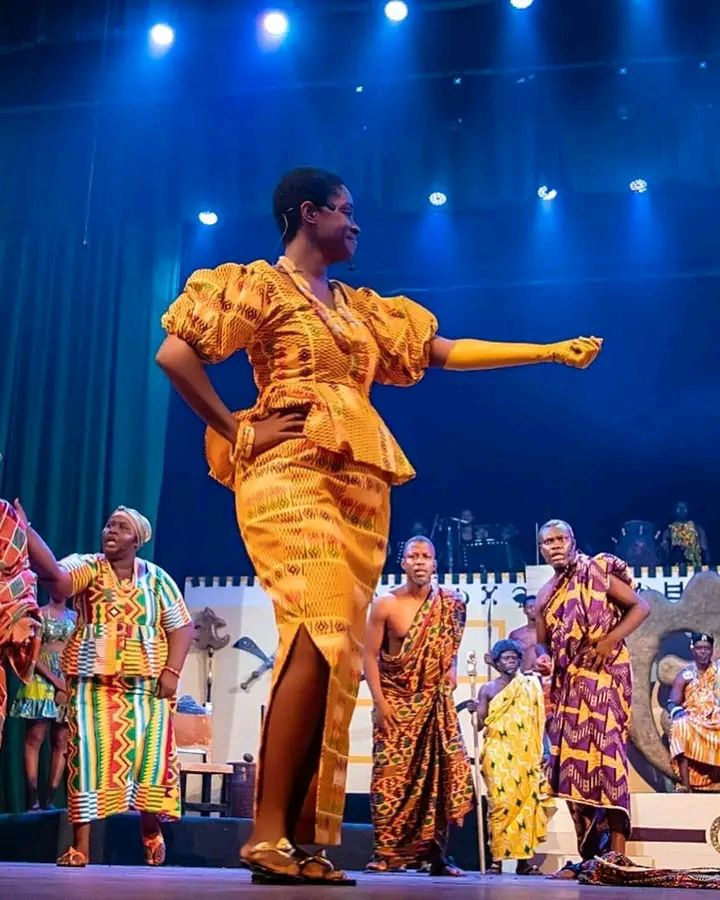
With the actors, the Sages (narrators) and heavenly beings were extended. The written play had just one Sage, but there were six of them on stage. Two were the narrators played by Gadede Segbefia and Andrew Tandoh-Adote and the additional four assisted and complemented the scene with their endless dancing. The voices of the narrators were just breath-taking. They spoke gracefully, depicting their role as wise persons indeed . And not just their narrations, they danced gracefully and calmly to their narration; their facial expression and body language depict the words oozing out of their mouths. The four additional sages had no lines, but their facial expression and discipline in the course of dancing are applaudable.
I was tempted to believe that the director added the midgets to communicate the message that ” disability is not inability”. They did extremely well.

Now to the heavenly being, the Royal, Elder played by Emmanuel Ato Ghartey, and Fate. I believe the director intentionally casts these three for this particular role. They have the strongest and sounding voice I’ve ever heard, yet they are beautiful and pleasing to the ears. Mawuli Semevo who played the role of the Supreme being had a tone or voice that sounded like Supernatural and not mere human. The same applies to Fate which was played by Kwabena Okyere and Asuo played Benjamin Adzika. . Also their voices command and send chill pills across, and I believe all the audiences seated felt the same too. They executed their role flawlessly.


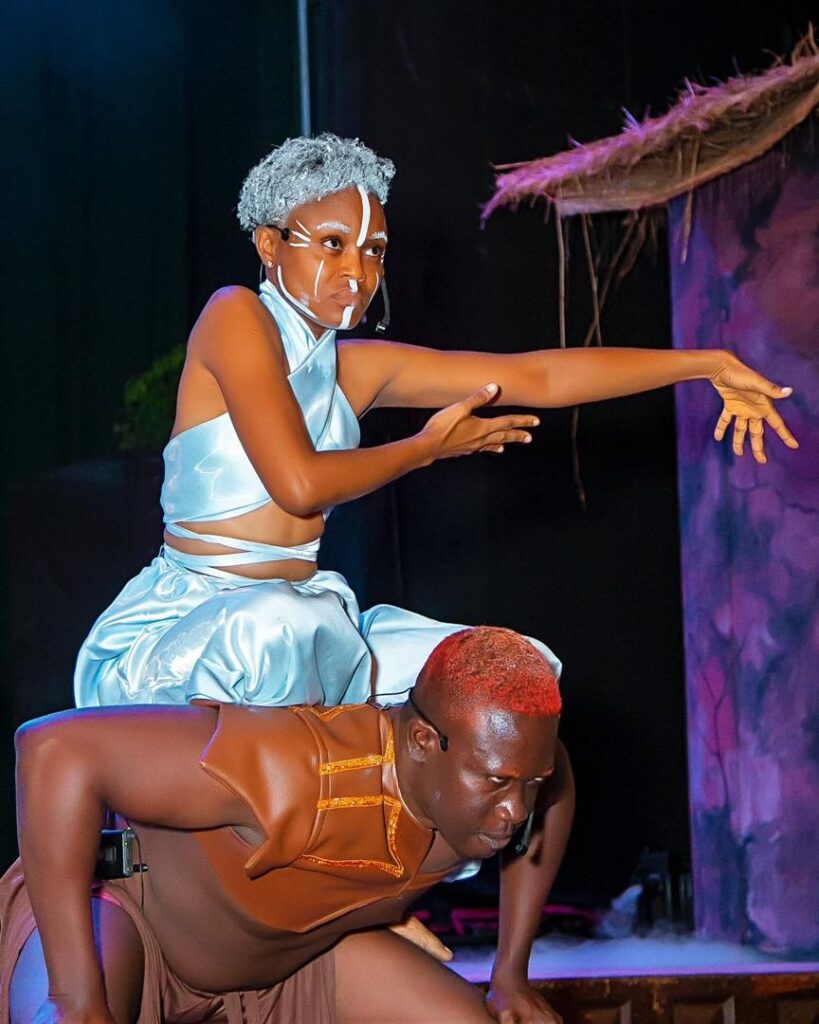
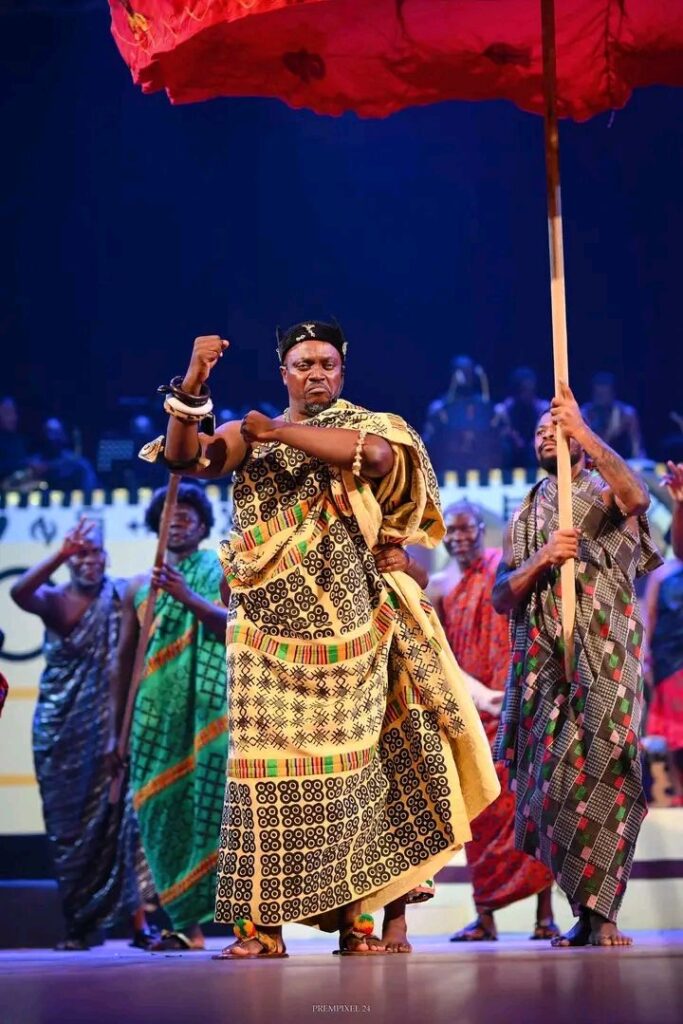
The main characters were the King, Nanayere, Yaa,and Aku Sika. I saw a different King on Saturday. Yes, he was tall and good-looking but spoke like his description by the populace behaving like “commoner” . Daniel kojo Delong who played the role of King didn’t have the same baritone voice as the ones I often see on stage , and I believe that is what best fits this particular king in question per the description given about him as not being too fearful.

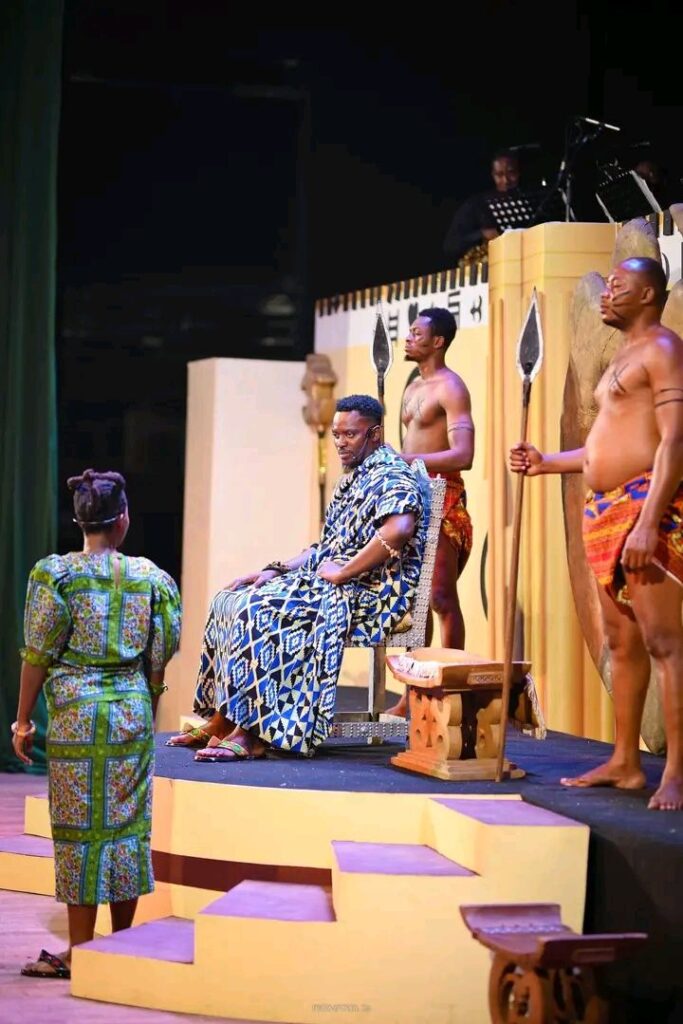
And to Nanayere, I’m glad a chubby person was cast for this role. Her looks complemented the role. Grace Adjetey who played Nanayere carried herself as one who was indeed against her husband from time to time especially with the decision to marry Aku Sika, I believe when casting Nanayare, the director took into consideration these roles, Yaa and Aku Sika, because these three complemented one another so well in both stature and acting. Yaa didn’t play to the gallery; she didn’t try to overshadow Nanayere since both actors characterizations differ. They were both fighters in their own worlds. It was simply beautiful watching them on stage.
The Queen mother also executed her role well. Edinam Atatsi as the Queen mother was believable on stage, her presence was really felt as well.
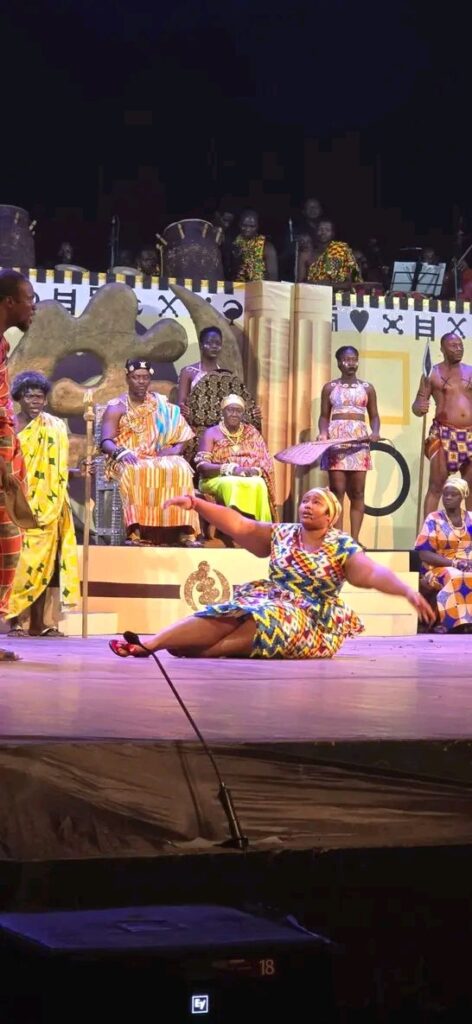
Now to the object of interest, Aku Sika, she fits perfectly well for the role given to her; her amazing voice, inflections and beauty, coupled with her amazing acting skills helped her kill the role. As the eponymous character, I will say she achieved believability with her acting. She was very captivating to watch, she took my breath away. As for her dancing skills, I will score four out of ten, she did well anyways.
Also , The man (Oppong) and Okyeame nailed their roles. In our part of the world, women are mostly noted to be gossips, but trust me, when these men play this role, they always do very well, and I must applaud Oppong for the good work done. That is to say Eldad Wontumi Bediako who played Oppong ate the role and left no cramps. Thankfully, he wasn’t carried away by the attention he got from the audience, so he didn’t play to the gallery. The okyeame play by Rockson Obeng reminded me of an old Akan linguist I met years ago. He spoke like a typical Akan linguist leaving no stone unturned.
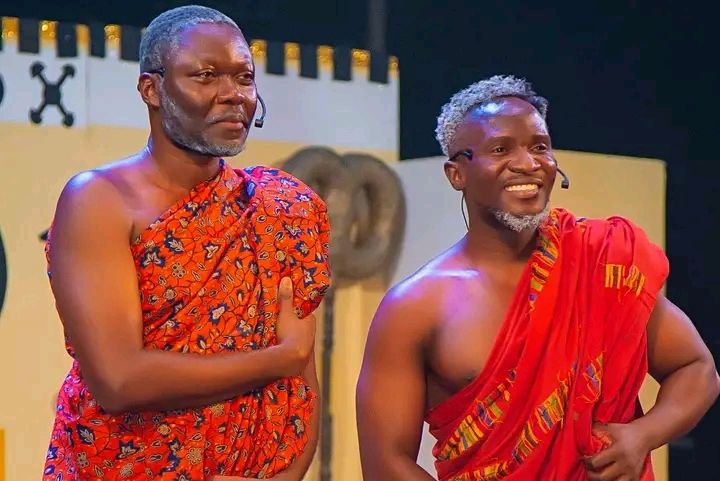
With the elders in this play, I will confess that they weren’t the same as the usual elders I had seen who usually like to adlib. They stuck to their roles as elders, not comedians. Although, they cracked one or two jokes but didn’t get carried away; they delivered their roles as expected. My only challenge with them was the fact that they spoke at the same point (telescoping) making it difficult to hear the message they were putting across. Kwabena okyere nails whatever role he is given and as part of the elder, his facial expressions and gestures were just priceless. Not forgetting Godson Quarcoo, Arnold Asamoah-Baidoo and Elvis Crystal the chemistry between them was great.
The dancers and musicians. The man who played the fontomfrom ( the big drum) was a delight to watch. He played the drums with so much enthusiasm and love that one could easily fall in love with his play. The dance was beautiful to watch. The kete dance is a dance noted for royals, and it’s danced with grace and pride. This is what was depicted on stage. I love how they rhythmically danced and gracefully moved their bodies. The orchestra played all the background music, and it was just amazing and soothing to the ears especially for the Violinist , he did great. He added more life to the Celestial or the heavenly scene.

Again, the introduction of the Asafo Company into the play was excellent. in the original script, there was no such thing as that but with the staging, Naa Ashorkor , the director introduced them to keep the coronation and the place scene very active and true to life.
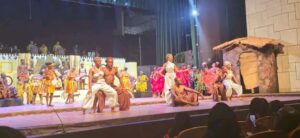
Now, with that spectacle I saw in three main locations in the play, it is prudent that I comment on them as well . The First locale is the heavenly realms, then to the palace and lastly , the riverside. Having multiple sets on a single stage is just a Herculean task for theatre practitioners. Even before I got to the theatre to watch the play, I kept asking myself how the set designer would work that out and present these three different locales on stage, but to my amazement, the set turned out perfect.
A white background with a round ball was hanged representing the earth, I presume, was used for the opening scene, representing the heavenly realms.
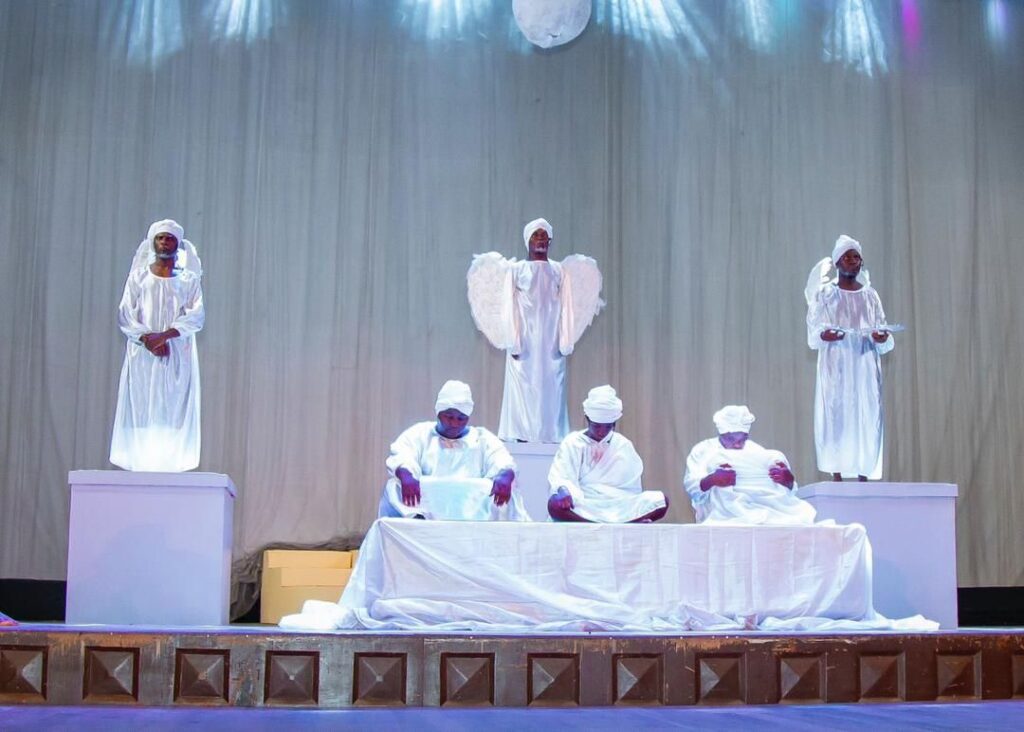
Afia Kunadu Farkye did great with the design of the spiritual angelic scene. It was just beyond believability. At first sight, you will just know, it is suited in the heavens. On the downstage left, Aku and her grandmother’s hut were mounted there. The palace was a beauty to behold. I must commend Henery Nyadia who also artistically designed the Palace set . It was just incredible. The Adinkra symbols were carved on the walls of the palace. This helps the audience identify the type of palace.
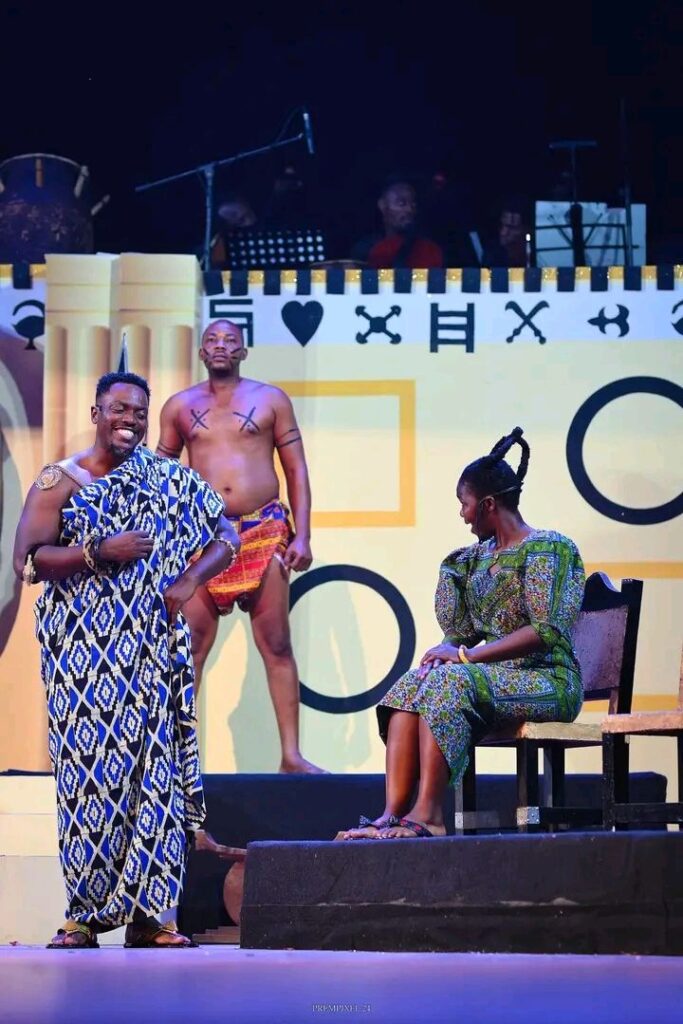
A market scene, which originally was not part of the play, was added to the play. Honestly, I think this scene was added specifically to elongate the play because the play would have still made sense with or without the market scene. Well , usage of the set, I will admit the actors utilized and related with the set only that I wasn’t pleased to see Aku at the market scene since it was already stated that she wasn’t coming out often because of her presumed deformity. Maybe the director had a reason for pushing her into the market scene…. other than that I believe she should not have been there.
I must agree that the actors did make good use of the props provided. It was beautiful to see the king comfortably sit in the palanquin and dance gracefully. Fate carried a hologram which he aided him to tell the destinies of Aku, Nanayere and Aku’s father, and Nana. He handled the hologram so well. The market scene had every prop needed to establish a market, and props were utilized very well.

I had to meet the set designer and ask him how he created a whole waterfall on stage. That is what won my heart for the night . What I call the Wow effect. The box lowered on stage to aid in the restoration of Aku’s hand calls for a standing ovation. However, due to the technicalities involved, there was a little delay with the scene change of the riverside scene when the entire set was backwards to make way for the last scene, but it was worth the wait. The waterfall was beautiful, and the fact that they patiently waited a minute after Aku had come on stage before the water started flowing from the falls was breath-taking. Prince Kojo-Hilton did justice with the creation of the waterfall scene. It was just stunning to watch. The first time theatre witnessed a live waterfall in Ghana, great Job. Prince Kojo-Hilton is a genius.
Light and sound
These key elements are like salt in a pot of soup. The audience doesn’t pay much attention to them, but without them, trust me, the production will be as tasteless as a pot of soup with no salt. The light and sound made the opening scene in the heavenly realms more believable. I didn’t see a delay in both cues, and even if there were, it wasn’t obvious because the magic took my attention that I began to miss the details.
The thunder sound just added to the mood. To together with the lighting and voice, a spectacle was achieved in the healing of Aku’s short limb.
However, in the flashback scene I wasn’t too sure of the flashback where Aku lost her arm projected to us. I wish she had narrated it instead of the video projected to us. The sound at the later part where Aku revealed her golden arm was a cliche. I wish they had maintained a total silence instead of sound to anticipate what was to come, of which, to me, the audience were already aware.
Costumes and makeup
I love the choice of colors for the heavenly beings and sages. I would have been disappointed if the sages wore the same colors as the heavenly being, but I guess the costume designers did their homework well. The supreme being’s feathers were bigger than those of the royal elder and fate, and that, to me, depicted supremacy, which is fine with me.
The play is an Akan folktale, so I wasn’t surprised to see more kente cloth, beads, and ornaments because the Akans are noted for that. Great choice, costume well pulled by Rachel Araba Mills – Roberson.
Also, Nathaniel Kruz did exceptionally great makeup and hair styling. Talk of the golden hands of Aku and transforming some elders to look aged. Great job done. The hairstyle of the Asafo group, Oppong and Okyeame were all under his auspices.
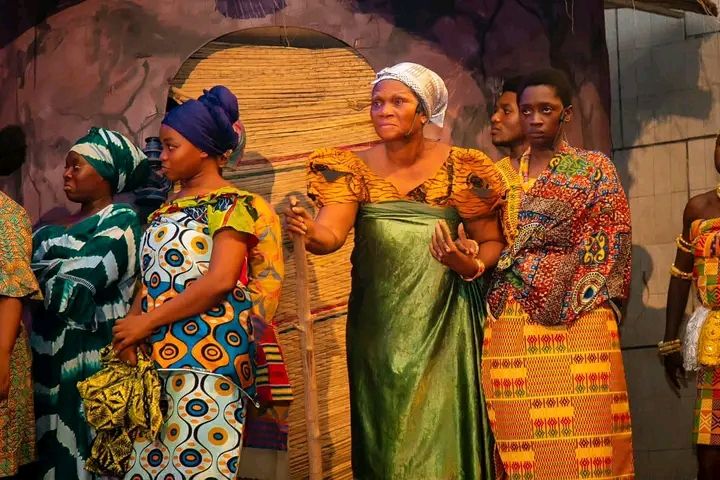
Again, during the coronation scene, it was observed that most of the cast were in black just to depict the fact that they were still mourning the previous King amidst the installment of the new King.
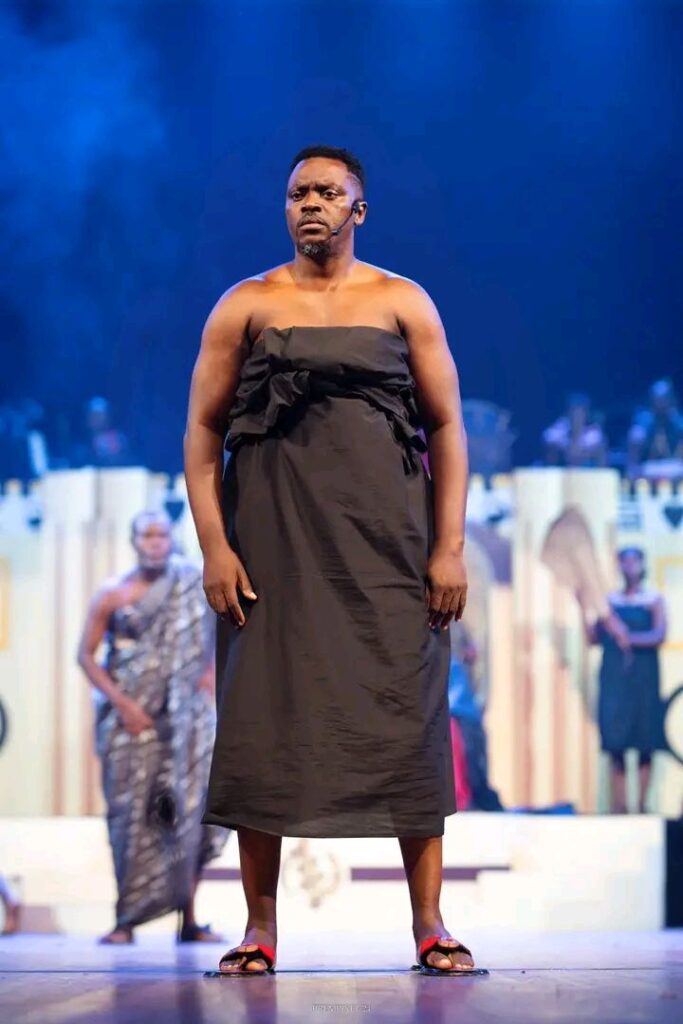
Also , Nanayare’s appearance for the scene wasn’t the best. She dressed more like a commoner than the queen she is. I was expecting to see more adornment of beads and the finest of Kente on her because of her role and how she carried herself. Nana maintained his posture as the king throughout the play, and I believe the costume and makeup aided in that. Anytime he appeared on stage, he looked like the king he was. The makeup artist did a great job on the cast. The makeup on the elders was not exaggerated, and Aku’s hidden arm was not too believable. It was quite obvious she had kept her arm behind her back.
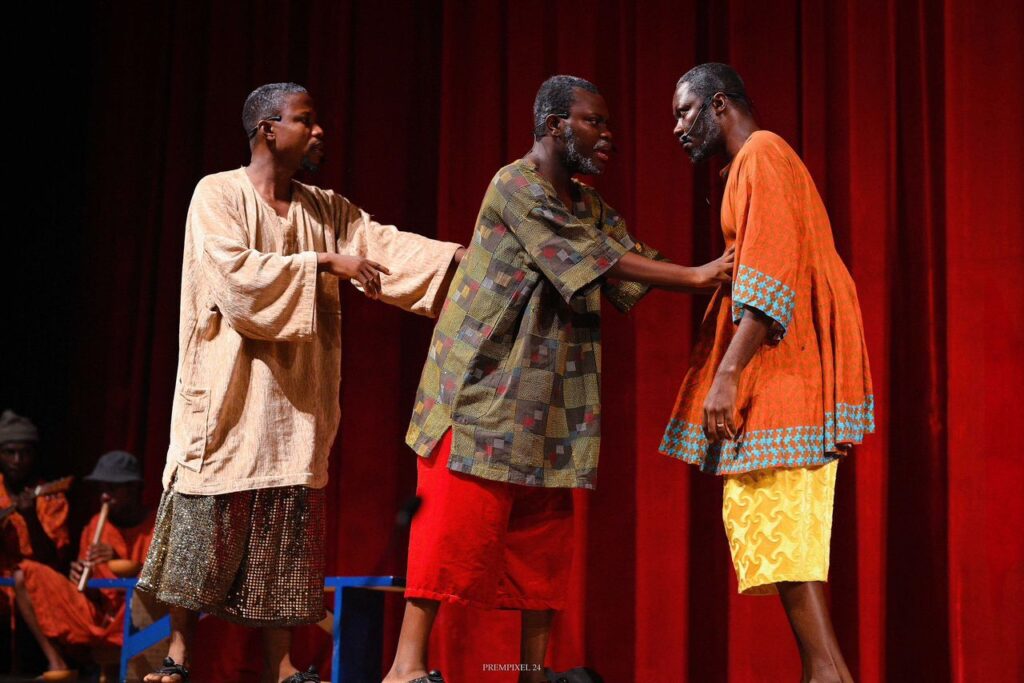
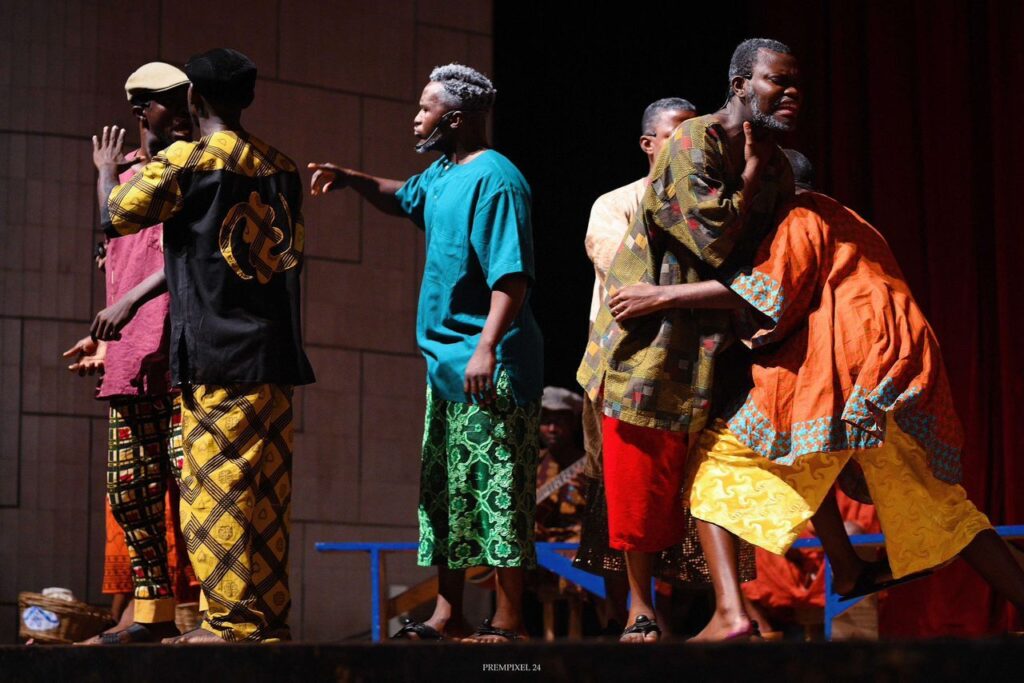
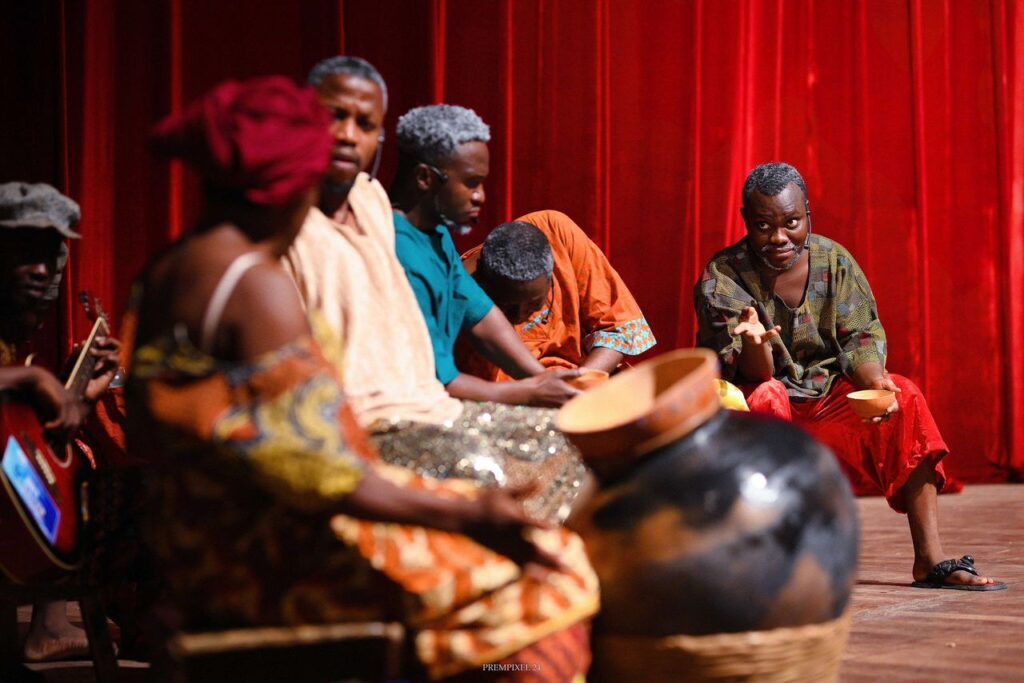
Finally, with the treatment of the play, I wasn’t too placed with the drinking spot scene added to the play. I understand the director used that scene to talk more about the disabled in society and how we should treat them with respect, which the original play does not elaborate much on. My displeasure with this scene has to do with someone trying to fight one of the elders, something that isn’t done and must not be tolerated in a traditional Akan setting. Nevertheless, it seemed to have added life partially to the show.

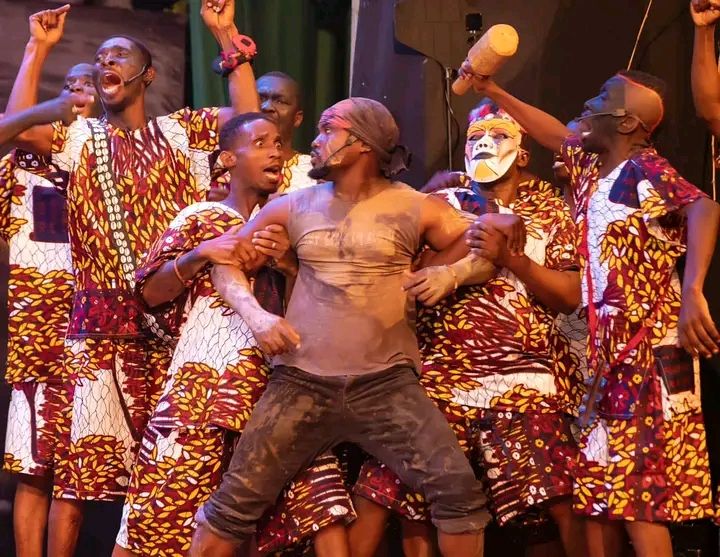
Before I rate this production, I would like to congratulate Naa Ashorkor on her first directorial debut and to all the cast and crew who tirelessly and creatively brought this masterpiece to life. The Assistant Director George Quaye and the Stage Manager Ato Ghartey also deserve accolades. They did extremely well. Great collaboration.
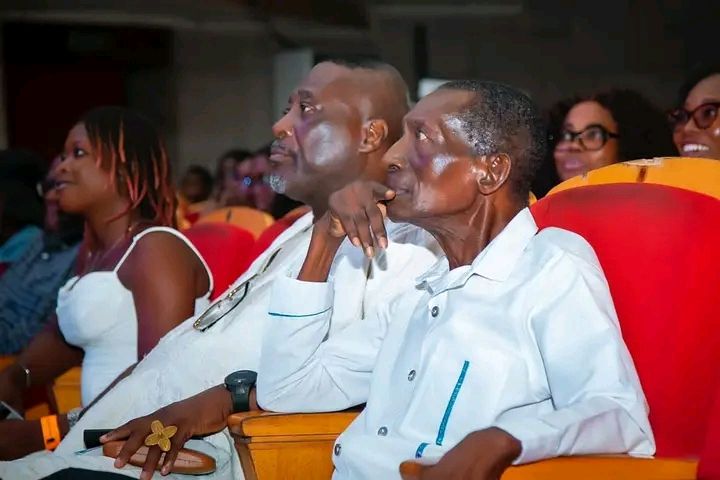
This is really a total theatre presented, since there was beautiful acting to watch, endless music to enjoy and more dance to grace the play. It was not too shocking to find the playwright short of words to describe the spectacle he witnessed while watching the play. Indeed, it takes a creative mind to bring a creative piece to life. I will rate this production 8.5/10.


Written by Miriam Afoley Laryea, BA Theatre Arts,UEW.
From your detailed Reviewers (0272138148)
This is a fairly detailed review. It would have passed as an excellent work but for its shabby language, typographical and formatting errors as well as repetitive expressions. I’d rate it at 6/10. That’s still great for the level of experience of the reviewer, Miriam Afoley Laryea, (BA Theatre Arts, UEW)