


Mansa Musa and the Trail of Lost Gold: The Prelude is a masterpiece directed by a duo i e ,Chief Moomen (The Playwright ) and Dr. Solomon Dartey.
Following the heavy publicity of the event, it was a highly anticipated play, which first made waves two years ago. It was not surprising that the tickets were sold out two days to the main event scheduled on Friday, 24th January 2025 at the National Theatre. It is worth noting that the production is expected to be on a global tour, starting in Africa and moving on to Europe, America, the Middle East, and Asia.
The Playwright Chief Moomen is the Chief Creative Officer of Bambu Heritage Productions, is a renowned Ghanaian performance poet, playwright, and producer. He is best known for WogbeJeke: Our Journey, a theatrical depiction of Ghana’s history from ancient times to the modern era, which was a highlight of Ghana’s 60th Anniversary celebrations. He also noted for his aesthetic performances during the opening and closing ceremonies of the 2018 Women’s Africa Cup of Nations held in Accra.
This review delves into an evaluation of the performance and an analysis of its theatrical elements such as plot, Characters, Set, Costumes, Props, Light and sound , audience reaction or reception and finally rate the production over 10.
On the day of the event, the National Theatre Ghana was extremely charged at 6:00 p.m GMT, an impressive number of audience had already gathered there. When engaged, many expressed their excitement, stating that they couldn’t wait to witness the production. The gates opened at 6:25 p.m., and the show began promptly at 7:38 p.m. Running for a total of 2 hours and 15 minutes, the play included a 15-minute intermission after the first hour, followed by the remaining 1 hour and 15 minutes.
Plot of the play
The play Mansa Musa and the Trail of Lost Gold: The Prelude tells the story of Bamba Kouyate, a young storyteller who isn’t sure about the path he’s chosen. He finds himself on a mission to save his nation from trouble and is sent back in time, hundreds of years, to search for clues about a lost treasure. His best friend Bello goes with him, and they’re later joined by Sibo. Together, they arrive at the court of Susu Sumanguru Kante, who becomes furious when he hears that Sundiata Keita is planning to return and fight him. However, Sumanguru is calmed when Balla Fasséké offers entertainment with Nene, Sundiata’s sister.
Nene secretly helps Sundiata by giving him Sumanguru’s magic, breaking Sumanguru’s power. Bamba, Bello, and Sibo then make their way to Sundiata’s court, where he begins preparing for battle by forming alliances with nearby towns. Nene brings Sundiata the good news that Sumanguru’s magical link has been broken, giving him confidence that he will win. The two kings meet at the Battle of Kirina, where Sundiata defeats Sumanguru. This victory marks the beginning of the Mali Empire, with Sundiata Keita becoming its first Mansa, remembered as the Lion King and the Son of the Buffalo
Acting
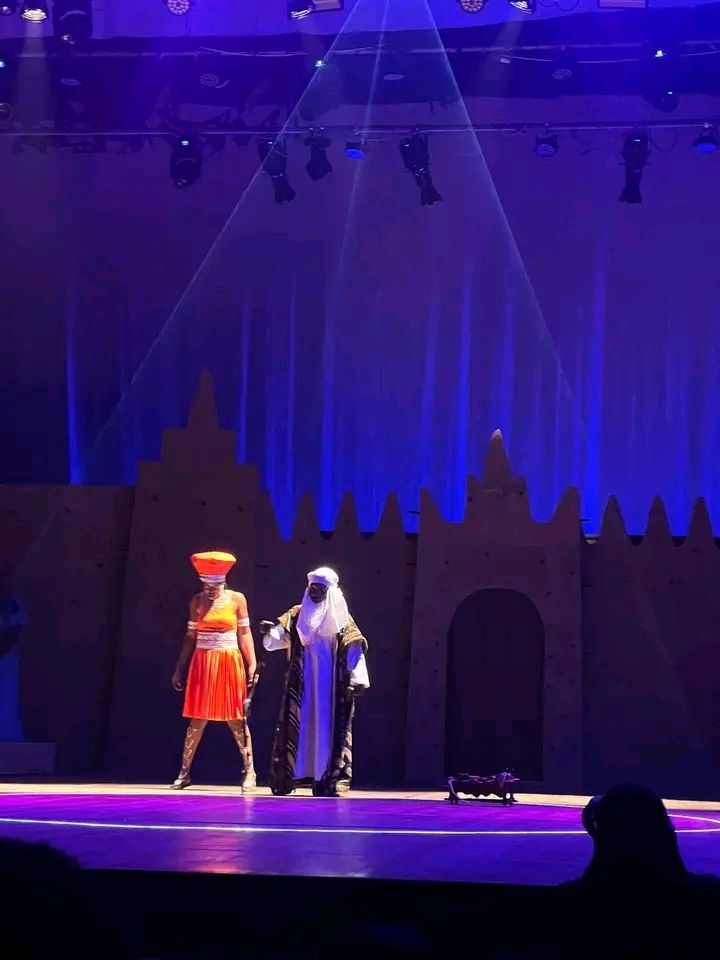
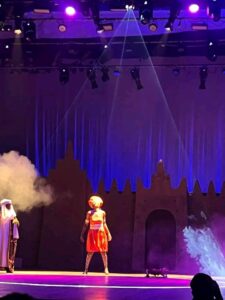
With the acting, the 150-member cast of Mansa Musa and the Trail of Lost Gold: The Prelude delivered an exceptional performance, truly putting on a show that left the audience amazed. The opening scene introduced the griots as the keepers of history, serving as a bridge between the past, present, and future. Balla Fasséké, Diallo Kouyate, and Maryam Kouyate embraced these roles beautifully, with their poetic lines bringing the storytelling to life. As griots traditionally perform with passion and flair, Balla Fasséké (played by Araba Dansowaa) stood out as one of the crowd favorites. Despite being a female cast playing a male role, she was fantastic and incredibly convincing, earning thunderous applause for her performance.
Bamba and Bello, representing the present in the past, also brought a unique touch to the play. Their use of modern slang, such as “GOAT,” and their performances of current songs like “Soldier” by Black Sherif added humor and relatability for the audience.
The standout performer of the night was undoubtedly Susu Sumanguru Kante, played by Daniel Delong. His portrayal was highly believable, and his stage entrance as a godlike figure was both commanding and awe-inspiring. He truly embodied the wicked, intimidating, and fearsome character of the Sumanguru we’ve read about in history.
Again, Sundiata Keita was humble as expected, but his performance could have been more distinct to emphasize his role as the hero of the play. Similarly, Mansa Musa, while his grand entrance and appearance reflected his wealth and power as the richest man of gold, didn’t leave a lasting impression. His scenes felt more like a brief pass-through, and many in the audience didn’t mention him after the show.
Tira Makhang, Sundiata’s general, had a captivating entry. His bold presence, commanding voice, and fearless demeanour truly stood out. His actions and delivery made him one of the most memorable characters of the performance.
As a total theatre, it was interperesed with music, dance and drama. The production was rooted in the African storytelling tradition and would not have been complete without the energetic choir, drummers, and choreographers who brought life to the performance. Their energy was boundless throughout the show. They didn’t just sing, dance and drum—they acted through their performances, creating a powerful synergy between sound and action. The voices were so sweet and harmonious that one could easily mistake them for a group of professional musicians. They also played a crucial role in ensuring smooth scene transitions, adding depth and vibrancy to the play. Kudos to John Edmund Sam , Dr. Ben Amakye-Boateng for their brilliant contribution as music directors for this project. Not forgetting the Choreographers namely: Alex Amertornyo, Marcus Kafui Tay for that masterpiece aesthetically woven.
Set
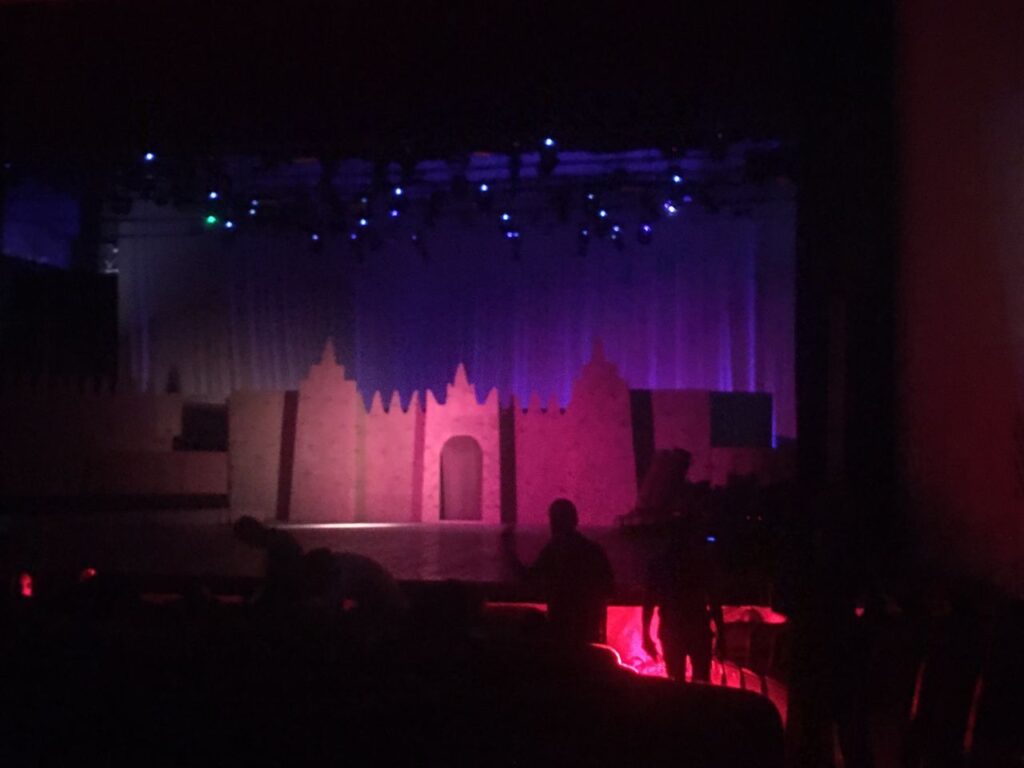
The exposition introduced the passing caravan which set the tone for the production and unveiled the stage for the first time. The setting was breathtakingly grand and well-structured. It featured a beautifully designed space for the choir and drummers, alongside the magnificent palace of Mansa Musa. Sumanguru’s scenes were equally impressive, showcasing a large and imposing palace that exuded authority and power.
Sundiata’s scenes also stood out, with the use of mats and cushions effectively portraying a kingdom in its formative stages—a land yet to be claimed from Sumanguru’s control. Again the market and Bamba’s house were thoughtfully designed, complementing their respective scenes and adding to the overall realism of the production. A great and elaborate set designed by Cromwell N. K Yeboah.
Props
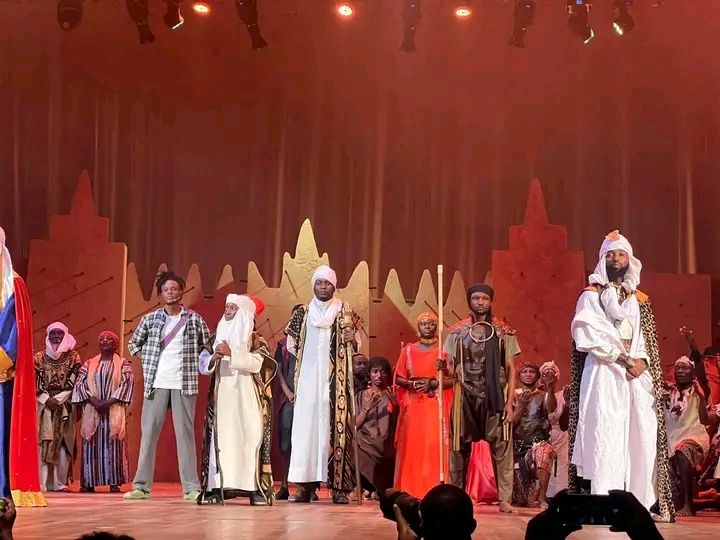
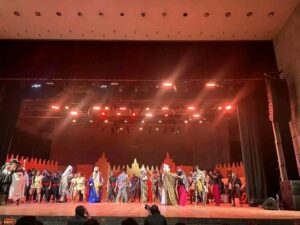
The use of props was particularly effective, especially by the minor characters, who helped enhance the performances. The warriors used axes, shields, and spears, which made the battle scenes feel authentic and intense. The market scene was brought to life through the items displayed by the sellers, making it tangible and relatable as various people and their professions were represented. Additionally, when the announcement of Mansa Musa’s pilgrimage was made, the people’s use of baskets and sacks to collect gold for the journey symbolized their preparation for the upcoming expedition.
The story, which is set in the present but takes us back thousands of years, effectively showcased two different customs and looks, reflecting both time periods—the present and the past. The Props lead (Selorm Kudiabor) did a great job.
Costumes

Bamba and Bello dressed casually, representing how contemporary youth dress. At the market, the characters’ costumes clearly depicted their professions, with sellers, a nurse, and a pastor all represented through their attire. Bamba’s parents’ clothing also showcased the modern Muslim dress culture.
Sumanguru’s costume played a significant role in enhancing his character as a warrior. Likewise, Mansa Musa’s elaborate attire and accessories truly distinguished him from the other characters, highlighting his immense wealth. Sundiata’s costume, however, didn’t stand out as much as expected for the hero of the play. The warriors’ costumes, on the other hand, were fitting for their roles. The drummers and the choir wore an attire which could be associated with both past and present, making them seamlessly fit into both time periods. Lastly, the griots’ distinctive costumes stood out and helped establish their important role in the storytelling. The costumes were well pulled. Great work from the Maud Korsah(Costume Lead)
Light And Sound
The lighting and sound were essential in bringing the production to life. It was pleasing to the eyes, excellent job. The lighting directed the audience’s focus throughout the play. The special lighting effect, which particularly helped the characters transition between the present and the past times, were truly impressive. Richard Dartey who was in charge of Light executed his role well. Again, The sound was flawless as well. Whether it was the drums, the choir, or the actors, the sound was always clear and well-balanced, never once failing to support the atmosphere. It was an intriguing sound effect administered by Richard Oti Oppong and Samuel Annan . Frank Kwakye who was in charge of sound engineering also did well.
Not forgetting the technical director, Margaret Lamptey for coordinating all the technical elements and designing the light for this captivating production.
Audience Reaction
The audience were completely captivated by the performance, responded with energy and enthusiasm. They were filled with a sense of agency to save Africa, yet enjoyed moments of laughter, through Bello’s comic character. Their appreciation was clear, as they cheered, clapped, and even gave a standing ovation at the end of the show.
Overall, Mansa Musa and the Trail of Lost Gold: The Prelude is an exceptional piece of art that every African should experience. It is both educative and entertaining. The prelude, which concluded with the first trilogy, highlights Sundiata as the founder of the Mali Empire, setting the stage for the continuation of the story with Mansa Abubakar and Mansa Musa, and an epilogue. The audience were eager for more, expressing excitement and anticipation for the next part of the story, as they seek answers to the question: Why did we lose our gold?

Overall, I rate this production 9/10 . Brilliant collaboration and a perfect total theatre .
Written by Mabel Kwarteng
(B.A English Education, UEW, MPHIL Student – English Language, UG)
From the Detailed Reviewers (+233272138148)
1. You got the date wrong
2. The pictures for the props are from old productions, not the one you are supposedly reviewing. Please pay attention to details.
3. Confirm the director’s of this particular production well.
4. I will rate it a 10/ 10
Hello. Please, we have rectified the issues raised. Thank you for reaching out.