

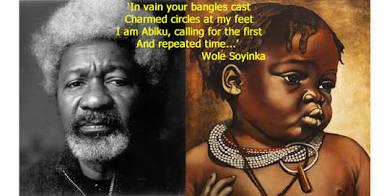
By Obed Yaw Agyei
Background of Poet
Wole Soyinka was born in 1934 in Abeokuta, Western Nigeria. He received his education at University College, Ibadan, in Nigeria and later at the University of Leeds in England, where he graduated with a degree in English Language and Literature in 1958.
A highly versatile artist, Soyinka is a playwright, poet, novelist, actor, and producer. His works are known for their rich imagination and depth. He has published a novel, The Interpreters, along with various other prose writings. His plays have won prestigious awards and have been performed across Africa, Europe, and America. Additionally, his poetry has been widely translated into multiple languages.
Abiku
By Wole Soyinka
In vain, your bangles cast
Charmed circles at my feet.
I am Abiku, calling for the first
And the repeated time.
Must I weep for goats and cowries,
For palm oil and sprinkled ash?
Yams do not sprout from amulets
To root Abiku’s limbs in the earth.
So when the snail is burnt in its shell,
Whet the heated fragment, brand me
Deeply on the breast—you must know me
When Abiku calls again.
I am the squirrel’s teeth,
Cracking the riddle of the palm.
Remember this, and bury me deeper still
Into the god’s swollen foot.
Once and again, ageless,
Though I retch, and when you pour
Libations, each finger points me
Back the way I came, where
The ground is wet with mourning,
White dew suckles flesh-birds.
Evening befriends the spider,
Trapping flies in wine-froth.
At night, Abiku sucks the oil
From lamps. Mothers! I’ll be
The supplicant snake coiled on the doorstep—
Yours the killing cry.
The ripest fruit was saddest;
Where I crept, the warmth was cloying.
In the silence of webs, Abiku moans,
Shaping mounds from the yolk.
Line-by-Line Analysis of Abiku by Wole Soyinka
The poem Abiku by Wole Soyinka presents the voice of the spirit child, Abiku, who repeatedly dies and is reborn to the same mother, defying all efforts to keep him in the mortal world. The poem is rich in Yoruba mythology and symbolism, portraying Abiku’s boastful defiance and the helplessness of his earthly family.
First Stanza: The Defiance of Abiku
The poem begins with Abiku arrogantly declaring the futility of the protective charms placed around his feet:
In vain your bangles cast
Charmed circles at my feet.
These charms are tied in an attempt to keep Abiku alive, as it is believed in Yoruba tradition that spirit children are visited by their kindred spirits, who remind them that the human world is not their true home. The protective bangles are meant to break this connection and anchor Abiku to life.
However, Abiku is fully aware of his immunity to such charms and boasts about his unbreakable cycle of birth and death:
I am Abiku, calling for the first
And the repeated time.
This line reinforces his supernatural nature—he has come before, and he will come again, undeterred by human attempts to hold him back.
Second Stanza: Rejecting Sacrifices and Rituals
Abiku dismisses the various rituals and sacrifices made to keep him in the human world:
Must I weep for goats and cowries
For palm oil and sprinkled ash?
Goats, cowries, palm oil, and ash are traditional sacrificial offerings meant to appease the spirits and prevent Abiku from dying young. However, he sees them as meaningless and ineffective. His rhetorical question emphasizes his indifference to these rituals.
He further mocks his family’s attempts to bind him to life:
Yams do not sprout in amulets
To earth Abiku’s limbs.
This imagery draws from Yoruba agricultural practices. Just as yams must be cut before planting, so too are Abiku children often marked with scars to recognize them if they return. The idea is that these markings, like amulets, will keep Abiku from being reborn. However, Abiku scorns this belief, asserting that nothing can prevent his return.
Even when buried, Abiku insists that his rebirth is inevitable:
You must know him
When Abiku calls again.
This suggests that his family will always recognize him upon his return, despite their attempts to prevent it.
Third Stanza: The Symbolism of the Squirrel’s Teeth
Abiku boldly declares his identity:
I am the squirrel teeth.
The reference to a squirrel’s teeth is symbolic. Just as a squirrel’s teeth can crack the toughest palm nut, Abiku possesses supernatural resilience. He is beyond human control and cannot be tamed by earthly means.
He warns that even if buried deep within the earth—represented by “god’s swollen foot”—his return is unavoidable. His cycle of life and death will continue:
Once… the repeated time.
Not even spiritual consultations, prayers, or libations can change his fate.
Fourth Stanza: Transformation into a Snake
In line 26, Abiku dramatically addresses his mother:
Mother! I’ll be the
Suppliant snake coiled in the doorstep
Yours the killing cry.
In Yoruba belief, Abiku is often associated with the snake, a creature that symbolizes transformation and renewal. By appearing as a snake at his mother’s doorstep, he ensures that she will be frightened and call for help. Unaware that the snake is her own son in another form, she will order its death.
The killing of the snake is symbolic of Abiku’s continuous cycle of death and rebirth—his fate is to die and return, over and over again.
Final Stanza: The Endless Cycle of Death and Rebirth
The last stanza captures the sorrow and inevitability of Abiku’s fate:
The ripest foot was saddest;
Where I crept, the warmth was cloying.
In silence of webs, Abiku moans, shaping
Mounds from the yolk.
The phrase “the ripest foot was saddest” suggests that even at the peak of life, sadness lingers—perhaps a reference to the grief that always accompanies Abiku’s presence. The “warmth was cloying” implies discomfort, as if life itself is suffocating for him.
The image of “Abiku moans, shaping mounds from the yolk” suggests an endless cycle—he emerges again and again, reshaping his existence like an egg being formed into new life.
Literary Devices
Wole Soyinka employs several literary devices in Abiku to enhance its meaning and impact. Some of the key devices used in the poem are examined below:
1. Metaphor
The poem contains metaphors that help define Abiku’s supernatural nature and defiant personality. Examples include:
“I am Abiku” (Line 3) – This establishes Abiku’s identity as a spirit child who repeatedly returns to life. “I am the squirrel teeth” (Line 13) – This metaphor suggests Abiku’s resilience and ability to overcome obstacles, just as a squirrel’s teeth can crack even the hardest palm nuts. 2. Rhetorical Question
Soyinka uses rhetorical questions to emphasize Abiku’s defiance and rejection of traditional rituals meant to bind him to life. An example is found in lines 5 and 6:
“Must I weep for goats and cowries / For palm oil and the sprinkled ash?”
This question highlights Abiku’s indifference to the sacrifices made to keep him in the mortal world, reinforcing his supernatural dominance.
3. Repetition
Repetition is used throughout the poem to emphasize key ideas and reinforce Abiku’s unbreakable cycle of death and rebirth. Some repeated words include:
“Abiku” – Appears in lines 3, 8, 12, 25, and 31, reinforcing the spirit child’s persistent return. “Me” – Found in lines 10 and 19, emphasizing Abiku’s self-awareness and defiance. “I” – Repeated in lines 3, 5, 13, 18, 20, 25, 26, and 30, underlining Abiku’s self-assertion. “You” – Occurs in lines 11 and 18, addressing Abiku’s mother and family directly, stressing their helplessness.
These literary devices collectively enhance the poem’s themes of defiance, inevitability, and the endless cycle of life and death.
Symbolism
In Abiku, Wole Soyinka symbolically portrays two classes of individuals in society: the leaders and the led. Abiku represents the leaders, while his mother and family symbolize the people being governed.
The poem can be interpreted as a political allegory where Abiku’s death signifies the departure of a political leader. The citizens, who have suffered under his rule, rejoice at his exit, hoping for a change in leadership. His administration was marked by tyranny, oppression, and dictatorship, and his departure offers a moment of relief.
However, their hopes are soon shattered when the newly elected leader adopts the same oppressive leadership style. Despite their expectations for change, they find themselves under yet another tyrant. This new leader is merely a reincarnation of the former, sharing the same characteristics and governing methods.
Through this symbolism, Soyinka critiques the cyclical nature of bad leadership, where political figures come and go, yet oppression and dictatorship persist.
Theme of Repeated Death and Rebirth in Abiku
The central theme of Wole Soyinka’s Abiku is the endless cycle of death and rebirth. Despite numerous attempts to break this cycle, all efforts—including charmed bangles, amulets, and sacrifices of goats and cowries—prove ineffective in preventing Abiku from dying young and returning. This unbreakable pattern is emphasized in lines 3 and 4:
Calling for the first
And the repeated time.
Throughout the poem, Abiku boldly asserts his identity, challenging his mother and family. He proclaims his invincibility, insisting that charms and rituals hold no power over him. Life and death cannot bind him—he alone decides when to live and when to die. This defiance is captured in the lines:
Once and the repeated time, ageless
Though I puke;
His inevitable return is certain, forcing his family to recognize him once more:
You must know him
When Abiku calls again.
The traditional belief that burying an Abiku deep in the earth will prevent his rebirth proves futile. His return is inevitable, defying all attempts to break his cycle of existence.
Conclusion
Soyinka’s Abiku presents a powerful and haunting depiction of the spirit child’s defiance against life and death. Through rich imagery and Yoruba mythology, the poem highlights the helplessness of Abiku’s earthly family and the inevitability of his return. His tone is both boastful and tragic, as he asserts his supernatural nature while also being bound to an endless, inescapable cycle.
class 12 major English 2082 board exam paper
Great