


A Performance Review of “Beyond The Walls ” Staged At The National Theatre, Ghana on the 28th and 29th to 30th March, 2025.
Beyond The Walls is a stage play written by George Quaye and directed by Naa Ashorkor. It was Produced by Image Bureau and April Communications Ltd in partnership with the UN Family in Ghana, led by the Joint United Nations Programme on HIV and AIDS (UNAIDS), The play is set in the Nsawam Female and delves into the harrowing experiences of women behind bars, with some victims of circumstances and others caught in a web of betrayal.
Synopsis of the Play
A young Lady from the States comes to Ghana to enjoy the December festivities. She falls in love with a guy who promised to love her forever. On her way back home, her lover gives her a suitcase filled with beautifully folded kente fabric, supposedly for his mother. She is then busted at the Kotoka International Airport for concealing illegal drugs within the fabric . The carefree traveller is convicted of the charges against her.
She is then thrown into the Nsawam Female Prison, where she meets other inmates who advise her to accept her fate. As the drama unfolds, the other inmates also unravel the deep secrets about the various crimes that landed them in prison. As they share their stories, they are plugged into several conflicts as they quarrel, fight and educate themselves about some social issues such as HIV Stigmatization, Lynching, and rejection of new released prisoners, discriminating against the physically challenged, government neglecting the needs of the citizen, “the politics of amnesty”, and many more.

This review will only cover the first show, which was staged on Saturday, March 29th, 2025, at 4pm. It will discuss the following elements: acting, set, props, light, sound, costume, makeup, audience reaction, and finally, score the production over 10.
Acting.
The play is a social drama that challenges societal perceptions of incarcerated women and exposes the emotional and psychological toll of their imprisonment. From what I observed, the actors did justice to the script. The players understood the assignment and delivered as people behind bars.
Lady Jay had a good stage business. Right from the opening scene, we find her busy crocheting and conversing at the same time. I liked the way she shouted “freedom” when she listened to the contents of the Amnesty document. She understood her role and took the audience along when she narrated her experiences as a catholic chorister, and a greedy usher of a church who stole money and was thrown into jail. Jacqueline Ansah who played Lady Jay mastered the role play scene where she acted as a pastor . She achieved believability as she made use of the stage and the props. Not forgetting how she transformed into the prosecutor during the court scene. She handled that role play too well mimicking the same way prosecutors behave and speak. Again, her relationship with the fellow players on stage was awesome. I commend her for teaming up with Funke to condemn the stigmatization of HIV patients.
Also, the new prisoner who joined the inmates was delightful to watch. Her foreign accent cemented her role and made her too odd. Anytime she spoke, it gave her out as the “newbie”in the female prison. Her facial expressions and gestures reflected someone who wasn’t ready to accept her new home. I must admit that her entry was too believable; how she fell on the stage was too frightening. I hope she didn’t injure herself. Anyways, it was artistically done. I particularly enjoyed how she denied having any knowledge of the crime she had been convicted of. Her line “I swear I don’t know” influenced the mood and also confirmed the assertion that most convicted persons claim innocence of the same offenses that landed them in Prison. It was not too surprising to find the other inmates teasing her and pulling her legs. She was interesting to watch and listen to her story of how she was busted with drugs. Great acting there.
And to Yaa Baby herself. Mabel Sena Agbeko handled the role perfectly. She had the stage presence that portrayed her as a senior convict and a bully. The Pidgin English she spoke also gave her a gangster vibe in addition to her smoking habits. She also carried the audience with her when she narrated how a man led her into her 8-year prison sentence. Again, during her role-play scene as a judge, she seemed like an unprepared judge with a heavy stage presence. Her blunder on “hold you for contempt “was very hilarious as it suggested that she was a judge who was ignorant about some elementary legal terms.
In furtherance, Shekina (Araba Dansowaa ) was one of the performers who stole the show. She convinced the audience that she was a hardened, notorious criminal who didn’t care about reformation. Her facial expressions, gestures and the Pidgin English which she spoke truly enhanced her characterization. Araba Dansowaa commanded the stage and appealed to the emotions of the audience in the scene where she condemned the government for neglecting the basic needs of the citizens. Again, her reaction to the news of the presidential pardon was brilliant; her body profile and gesture that she used in delivering her line “I don’t need amnesty” was convincing. Also, she absorbed the audience into the genesis of her life as a street beggar who grew into an armed robber.
Moreover, Adbea also stole the show. She served as a comic relief for the production. She turned her speech disorder into a moment of endless suspense for the audience and the players as well. She had great mannerisms and hated interjections whenever she spoke. She stammered too well, at a point, I thought she had a speech disorder in real life and was typecast for the role. The way she struggled to pronounce her dream job, “News- fore-caster” was very funny and serious. I enjoyed the syllabic pronunciations. She really made herself a laughing stock for the rest of the players. Even during the curtain call, she didn’t stop to amaze the audience with her stammering.
Funke also served as one of the educated performers who stood up for the incarpacitated. Gadede Segbefia, who played the role, was one of the few individuals who stood against HIV Stigmatization and teasing of the inmate who stammered. I also enjoyed her fight scene with one of the inmates. She also had a good stage business to occupy her when she had no dialogues to utter.
Amina (played by Sitsofe) was also intriguing to watch. She was very calm and reserved on the stage. Her facial expressions registered her depression and trauma. Her silence was loud when she didn’t speak and she exited the stage abruptly when she was asked about her cold attitude. Again, she creatively enhanced the surreal effect that served as a flashback and foreboding of her prison journey and how the society lynched and chastised her during her first prison release. She aroused pity in the eyes of the audience when she declined the presidential Pardon that was granted to her. It was very emotional watching her sob and the Prison officer trying hard to influence her to change her decision.
The rest of the inmates such as Nkechi (Efe Favour), Korkor (Dede Gyamaki) Tsotsoo( Pamela Karikari) and the others especially the one who limped on her foot all made the prison scene lively . Nkechi made the scene very energetic as she mocked Adobea`s condition. Tsotsoo also served as a great friend who comforted Amina and gave her hope amidst the trauma. Her chemistry with Amina was very visible as she consoled her.
Also, Korkor`s stage business was captivating when she stigmatized one of the inmates who had HIV. How she rained insults on the patient displayed her ignorance about the transmission of diseases. In her latter scenes, I liked the way she sat closer to the patient when she received enough education.
Also, Another inmate who stole the show was the one who limped on her foot. She was so “annoying” to watch. She placed everyone in suspense as she failed to deliver the content of the paper which she had photocopied. She was very energetic.
I observed that the prison scene was full of conflicts that drove the play. However, I noted some challenges that I had with the prison scene. In the opening scene, there was too much stage business, so one couldn’t focus on one action at a time. I suggest that going forward, the players reduce their stage business until it gets to their turn to display before intensifying their stage business. Again, during the pastor`s role play, some players were masked by their fellow players. This could have also been avoided
Lest I forget, the prison officers also were in charge the whole time. Anytime they entered, their presence was extremely felt. Elaine Alexis Attoh (Warden Addo) , Queen Grace Adjetey (Warden Kpatcha) , Edinam Atatsi (Warden Azu) ,Agnes Panfred (Madam Bawa), and Eyram Duru – (Mrs. Appiah) were very active. Anytime, Queen Grace Adjetey stepped in the yard, the inmates behaved well. Her commanding voice gave her a great stage presence. Again, the Prison officer who broke the news about the amnesty also acted well. She utilized the stage and as she sobbed about the biases of the amnesty. Moreover, Warden Azu`s conversation with her colleagues where they complained about the dwindling value of the presidential pardon was very engaging . Their plan to release the rots to the press was well orchestrated. My challenge with that scene was that I struggled to hear some dialogues especially that of Warden Azu.
Finally, the Officer who offered Amina a therapy to go home was very believable. She handled her lines well and convinced the audience about her role. My little challenge was the blocking. I would have preferred the officer sitting on the floor with Amina while conversing rather than standing. That would have been more appealing and emotional considering the circumstance that Amina found herself.
Finally, Amina`s family added life to the play. The manner in which they sacked their Daughter Amina reflected how the society fails to accept ex-convicts. Those who set Amina Ablaze also heightened the intensity of the issue. The mob were also charged to lynch her to death. Interestingly, only one of them condemned the action.
The technical aspects.
Set & Props
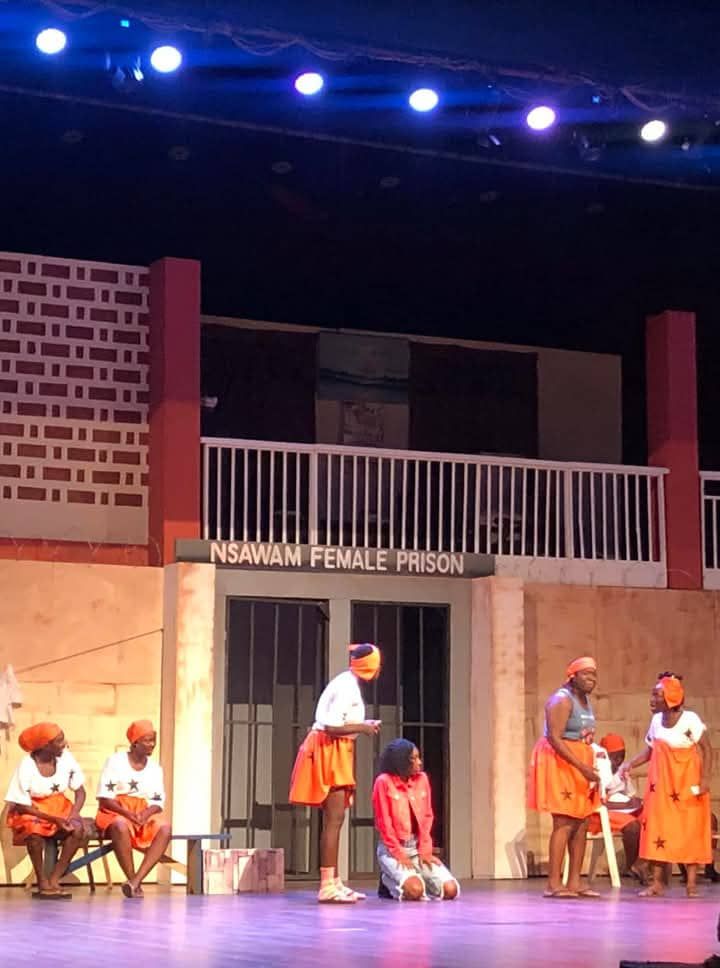
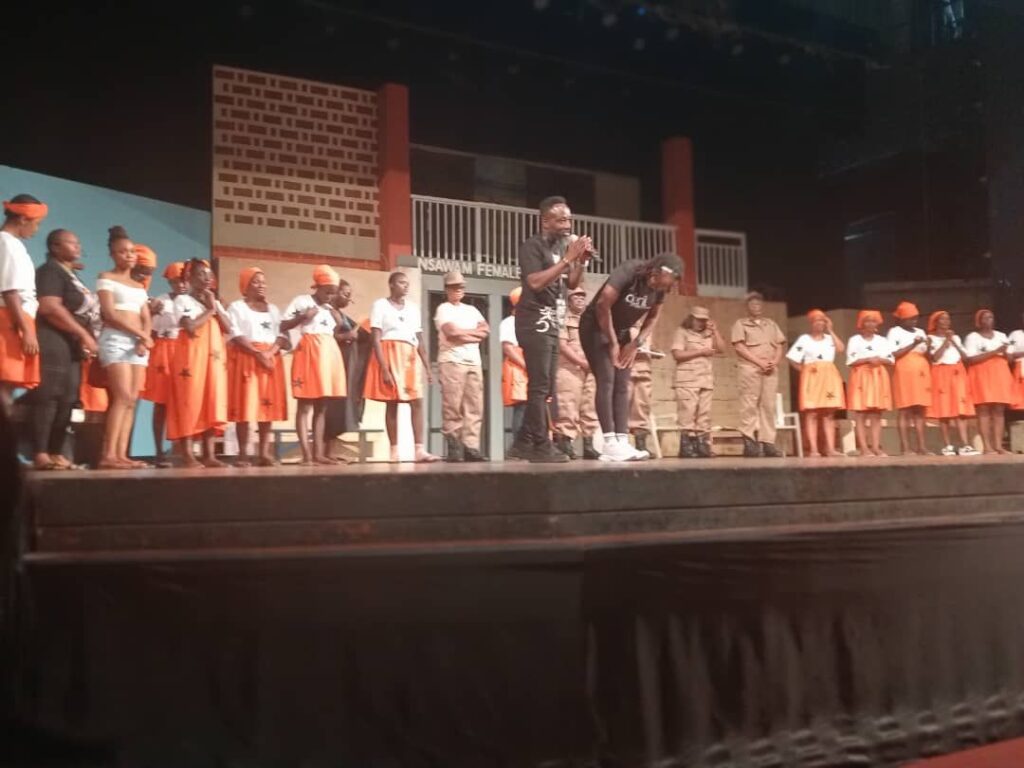
The set was very elaborate. It depicted the Nswaman female prison. The wall and fence created a prison set. The upper room of the story building which was specifically meant for the prison officers to guard the prison was very beautiful. The performers used the set efficiently. The officers watched most of the actions in the prison from the upper room. Also, props such as the bible, Crochet, dumb bells, tape measure, pulpit, cigarette, paper, file, mat cross, anointing oil, castanet, drums, bench, chairs, car tire, food, spoons, gallon, fire, bowl, broom, books, Oware all enhanced the characterization of the various inmates who used them.
Sound
Sound cues for this production were on point. The house music “No woman, no cry “resonated with the plight of a female prisoner. The music played during the role play of the inmate dancing at the club was also good. During the video projection on Amina`s journey, there was clarity in the sound. In all, sound treated this play justly.
Light
With the nature of the play, the light team did well. The lights in the prison scene were good. Great focusing as none of the actors played outside of the light. They used a mirror ball… To enhance the prison scene and turn the place into a club. They also flooded the stage with disco light. Also the prison. Again, the smoke light was used to enhance the mood when Amina had the dream. However, Light failed to spot only the house of Amina`s parents so it revealed the prison scene behind them. This broke the effect.
Costume and Makeup

The convicted prisoners wore orange costumes while the “new bee” or “fresh meat” wore a Pink top and a Jeans trousers. The prison officers also wore their brown uniforms. With the few others who haven’t yet been convicted wearing a dress of their choice. Gadede for instance wore sexy costumes to communicate that she is into women. Also, Amina`s Family were costumed well as well as the mob who lynched Amina. The make up for this play wasn’t that much only that there were some dark marks on the skin of some inmates.
.
Audience.
The audience enjoyed the thought provoking play. Though very emotional, they followed till the end. They were mostly intrigued by the scenes of the Amina, Shekina and Sitsofe (stammer) and Yaa Baby.
I must say the production was massive as it educated, entertained and questioned some of the loopholes in the female prisons and the justice system of Ghana. Image Bureau and April Communications collaborated well to put up this electrifying piece. Kudos to Naa Ashorkor on her second directing debut. I rate this production 9. /10.
Written by Mensah Junior Raphael, BA Theatre Arts, UEW.
From your detailed Reviewers (0272138148)


Adobea the stammer is called Precious Adjoa Madu in real life.