

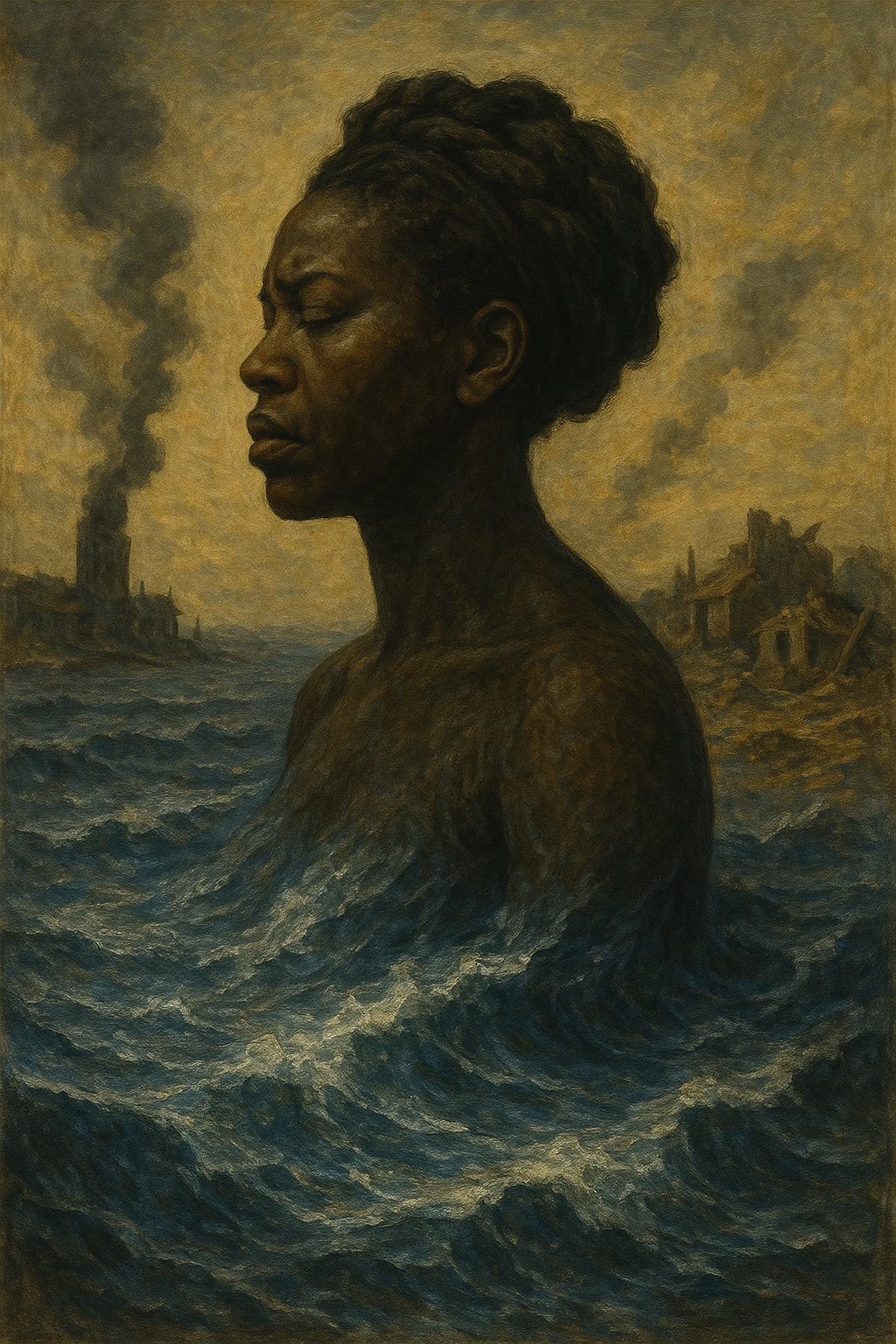
Breast of the Sea By Syi Cheney-Coker
After our bloody century, the sea will groan
under its weight, somewhere between breasts and anus.
Filled with toxins, her belly will not yield new islands
even though the orphans of East Timor wish it so.
The sea is only capable of so much history:
Noah’s monologue, the Middle Passage’s cargoes,
Darwin’s examination of the turtle’s shit,
the remains of the Titanic, and a diver’s story
about how the coelacanth was recaptured.
Anything else is only a fractured chela
we cannot preserve, once the sea’s belly
has washed itself clean of our century’s blight.
Throbbing, the sea’s breasts will console some orphans,
but Sierra Leone won’t be worth a raped woman’s cry,
despite her broken back, this shredded garment,
her hands swimming like horrors of red corals.
But do you, O Sea, long-suffering mistress,
have the balm to heal the wound of her children,
hand to foot the axe, alluvial river flowing into you?
Inspiration and Background
The background of the poem is di-faceted. One, today’s Sierra Leone was the ‘home’ where the emancipated Africans settled upon their return from the Americas as slaves. As such, it has a bloody history of slavery and its unspeakable demonstrations among which is the death of innumerable Africans in the ocean on their way to and from Europe as slaves. Two, it is a reflection on the catastrophic end of the 20th century fraught with international wars and conflicts resulting from the horse race inclination to power and dominance. It first directly alludes to the First and the Second World Wars between 1914–1918 and 1939–1945 respectively; and secondly to the political ineptitude that plunged Sierra Leone into a Civil War between 1991–2002. Before Sierra Leone’s episode, Nigeria had had hers between 1967–1970. And so, there had been series of national crisis fomented by power-drunk juggernauts of nations. The venomous hardship such violence has resulted to, featuring deaths, underdevelopment, and political backlash, serves as the background to the angst recollected in meditation in the poem.
Subject Matter
The “Breasts of the Sea” reads like a non-verbal pondering on the human condition by which a whole century is blighted by series of war, colonialism, imperialism, environmental degradation, destitution and other painful experiences that undermine man’s abuse of intellectual and physical power. The poem is about the relationship between Europe and Africa in that both continents have experienced bloody phases in their histories. It also examines how Europe’s abuse of Africa has intertwined with Africa’s abuse of her own self to show power and freedom are too much with man. Furthermore, the poem is a stark reflection of the devastation and trauma endured by African nations, particularly Sierra Leone, in the wake of war and exploitation. The title, “The Breast of the Sea”, immediately evokes a sense of nurturing and sustenance juxtaposed with the vastness and power of the sea. The “breast” symbolizes nourishment and care, typically associated with motherhood, while the “sea” suggests both a source of life and a formidable force of nature. The title sets a tone of contrast between the nurturing aspect of the sea and the harsh, destructive realities that the poem will explore. It hints at the themes of destruction, loss, and the wounded state of nature and humanity.
Stanza Analysis
Stanza 1
“The Breasts of the Sea” underscores the sea’s mothering and murdering realities as an accommodating body. It opens in an in medias res style (starting a story from the middle rather than the beginning), whereby the poet bursts into a deep sense of loss characterized by the aftermath of war and the plunder of a nation and, on a wider scope, the world. The “bloody century” reminds the reader of the two World Wars that plunged Europe into disarray, involving the Central Powers: Germany, Austria-Hungary, Turkey, Great Britain, France, Japan, the United States, Russia, the Soviet Union, and, to a lesser degree, China. This tragic episode therefore conveys the fact of millions of dead bodies in the sea, which the poet describes as “its weight” (stanza 1, line 2). In the poet’s cogitation on the disparate functions of the sea, the metaphor, “breasts and anus” suggests that the sea is a mother to all of these nations such that it, itself, represents the vastness of humanity. However, man has utilized her for exploration and exploitation alike. Either way, it stands to awaken a memory of benevolence and cruelty. But because she has taken in a great number of impurities which the poet calls “toxins” (stanza 1, line 3), he supposes that the enmity that must have ensued through the years of war will invalidate any fraternity between nations; or that war will continue to engender suspicion and misgivings between nations. And that we continue to live with the indelible impacts of war because, to quote Ernest Hemingway in his acclaimed novel entitled A Farewell to Arms, “There is no finish to a war.” This is the dubiety captured in the metaphor, “new islands” that “her belly will not yield” (stanza 1, line 3) even though the wars ended. It is in furtherance to that that he plays a witty sarcasm on the subservience of Timor-Leste in forgiving her imperialists, which is the significance of “children” in the line 4 of stanza 1. During World War II, Japan dominated East Timor; upon her cessation of 27 imperialism, Portugal colonised her again until East Timor’s declaration of independence from Portugal in 1975. Not long after, tyranny continued upon East Timor when Indonesia invaded her whereupon she was later incorporated as a province of Indonesia. Not until 2002 did the country become a full-fledged sovereign nation. This country becomes for the poet forgiveness personified; however, he indirectly avows that there is no such realism as “the children of East Timor” represent. Another viable, possible interpretation of this line is that East Timor is an Asian country reputable for having the Island that has the most diverse species cohabiting it. Therefore, the metaphor, “new islands” conveys a world of friendly relationship between diverse nations. Again, the “toxin” also suggests industrial wastes with which the sea is polluted since industrial revolution was one great and sudden change that heralded the century. Oil spillage and fossil fuels on the face of the sea, dead matters of human lives, war, political crisis, and environmental degradation are the focus of the first stanza of the poem.
Stanza 2
Still within the stanza, the poet presents a metaphor of the intractable condition of the world, “fractured chela”. A chela is the pincer-like claw of a crustacean. It is impossible for the crustacean or arachnid to carry out locomotion by which it forages if the claws are broken; in other word, its condition can never be helped, that is, “we cannot preserve” (stanza 2, line 10). Visualizing that such a sensitive and indispensable part of the creature, say a crab, is condemned, then the reader is on their way to assessing the intractability of the world’s sickness, which the poet calls “our century’s blight.” The sickness of the twentieth century is the pollutant effect of scientific knowledge, imperialism, colonialism, slavery, war, political barbarism and such like which the poet describes as “blight”, a term which means the sickness of a plant in the visible browning of the leaves and subsequently, death. Now, all these grievous accounts are left to literature which is a body of knowledge that serves as the preservative of the human experiences.
Stanza 3
The last stanza of The Breasts of the Sea focuses on the foster qualities of the sea, since it can wash itself clean of dirt and dump. This is the idea conveyed with the verb, “Throbbing” that opens the third stanza, which suggests the deathlessness of the sea. The “sea’s breasts” consoling “some exiles” is the cessation of suffering for native lands who have agonised at the clamping effect of imperialism. Here, the reader is intimated on the story of Australia as a continent whose aborigines were marginalised though diseases, and conflict with the colonialists who explored it between early 17th century and late 18th century. Great Britain foisted six other colonies on the continent, having dominated it. Following this, the natives of Australia were “shut out” and only after the World Wars ended were they allocated sick portion of their own land, “the tired moon”, that is. It is the same for the Krio (creole) the first settlers of Sierra Leone who were marginalised on their own land by the dominating force that followed her independence. In spite of the consolation, Sierra Leone remains comfortless! The poet’s pessimism about his native land follows that it has been devastated beyond repairs by a venomous war between 1991–2002, visiting untold hardship on women (rape as a major war crime and strategy) and children (who are the most affected), and the vast majority of the masses. Reforms and peace talks will not ameliorate the situation “despite her broken back” and “shredded garment”. These two metaphors suggest the ripping apart of Sierra Leone first by enslavement by Portugal for centuries, and second by war and the jutting consequences of inhumanity; that she is more like someone groping for a lost object in the dark. Unlike the variant suffering exiles who will be consoled by “the sea’s breasts”, Sierra Leone will struggle hard to get back on her feet after the years of degradation. The last section of that stanza runs on to the end which raises a question about the sea having forgotten her ultimate mother function. The sea is personified as a mother who is responsible for raising children. It is also striking that the use of “children” in this line is different from what we have in the first stanza. Here, “her children” suggests the destitute survivor of a plunder, degradation, exploitation of mineral and agricultural resources, the emancipated slaves, and all those who do not have a safe space to tend their destinies. Their “wounds” are both literal and figurative. The former is the visible marks of rapine after the years of pain and human suffering; the latter is psychological and mental. It is the trauma that the survivors may have to live with; the trauma that the world will experience as a result of the destructiveness of wars, and the uselessness of power craze. Again, “the balm” is an ointment applied on an affected spot on the skin where one has sustained an injury. It is here a metaphor for a new dispensation where pains will be 28 forgotten. But the poet is pessimistic, knowing fully well that the abuse of power is almost inevitable; he questions whether the sea will not continue to play host to her children’s turpitude because, as earlier established, the sea is a metaphor for the whole of humanity. We are all connected to one origin.
Themes in The Poem
1. The Devastation of War and Conflict
2. Environmental Degradation and Pollution
3. Historical Memory and the Burden of the Past
4. Human Suffering and Injustice
5. The Futility of Human Endeavors
6. The Intersection of Nature and Humanity
7. Slavery and Colonization
CREDIT TO H.K OCRAN/ LiTTROVE
Wow amazing 😘
Thank you
Found it helpfull
The poem is so deep🥹
Sure. It is