Ambassadors of poverty- A poem by P.O.C Umeh
Ambassadors of poverty are
The corrupt masters of the economy
With their head abroad
And anus at home
Patriots in reverse order
Determined merchants of loots
Who boost the economy of their colonial order
To impoverish brothers and sisters at home
Ambassadors of poverty are
The saviours of the people
Office loafers in the guise of workers
Barons of incompetence
With kleptomaniac fingers
And suckling filaments
Position occupants and enemies of service
Locked in the corrosive war of corruption
With their people’s treasury
And killing their future
Ambassadors of poverty are
The dubious sit tight patriots
Frustrating the corporate will of their followers
The beleaguered,hungry and famished owners of the land
People priced out of their conscience and power
Incapacitated by destitution
Unable to withstand the temptation
Of crispy mints and food aroma
Ambassadors of poverty are
The political elites
In air conditioned chambers
And exotic cars
With tearful stories of rip offs
Tucked away from
Their impoverish constituencies
Lying prostrate
With death traps for roads
Mud for water
Candle for light
Underneath trees as schools
Rat for protein
Fasting as food
And alibi as governance
Ambassadors of poverty are
The rancorous elites In battle of supremacy
For the control of power
And their people’s wealth
Mowing down their own
With white man’s machine
Oiled by the prosperity of black patronage
Counterpoised by deprivations
As the corpses of their able-bodied men
Women and children lie un-mourn
In shallow graves
In their fallow farmlands
Long abandoned
Ambassadors of poverty are
The round trippers
The elusive importers
Of unseen goods and services
Sand inclusive
Who trip the economy down
By tricking form M
For harvest of dollars as import
When their people see neither money nor food
Ambassadors of poverty are
The able-bodied men on the street
Without motives,without vision,without mission
Men fit for the farm
But glued to the city
Hungry and desperate
Constituting willing tools in the hands
Of political overlords
For mission of vendetta
Against political foes
In their fight for power
Ambassadors of poverty are
Those who actions and inactions
Reduce their people’s expectation to nothingness
Those who antecedents
Have lost the spark to inspire
While their people lie in surrender
Having been defeated by poverty
Ambassadors of poverty are
All of us whose in-actions
Steal our collective joy
Because of what we should do
Which we never do
As we bargain away
Our conscience in the market place
Under the weight of poverty
To assuage our hunger
And our master’s will
ANALYSIS OF THE POEM
P.O.C. Umeh’s poem is not only an indictment of the corrupt elite but also a profound socio-political commentary on the cyclical nature of poverty and power in postcolonial African states. Through the refrain ‘Ambassadors of poverty,’ Umeh expands the blame beyond political elites to include the masses and even the passive citizen. The poem insists that poverty is man-made, created through betrayal, selfishness, and collective negligence.
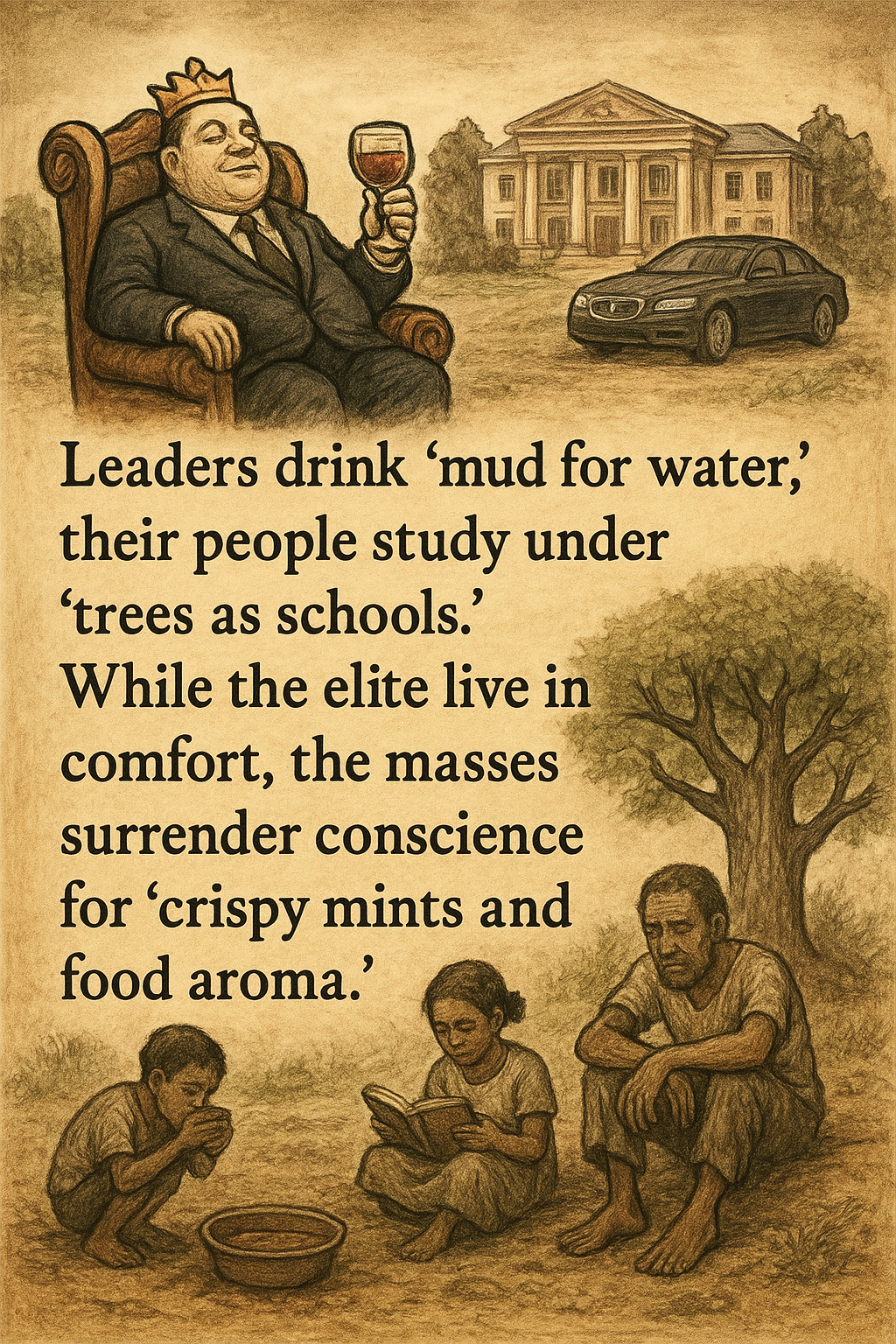
The poem critiques leaders who live in comfort while their people drink ‘mud for water’ and study under ‘trees as schools.’ By juxtaposing luxury and deprivation, Umeh highlights the inequality fostered by corruption. However, he also blames the masses, who surrender their conscience for ‘crispy mints and food aroma.’ This democratic spreading of guilt forces readers to reflect on their own complicity. Poverty persists not only because of corrupt elites but because ordinary citizens fail to demand accountability.
Images like ‘rats for protein’ and ‘shallow graves in fallow farmlands’ are not merely figurative but a reflection of real conditions, making poverty visceral and undeniable. Ultimately, the poem is both lament and call to action, urging leaders and citizens alike to reject complicity in order to end the cycle of poverty.
LITERARY DEVICES
Metaphor: The poem is rich in metaphors, the most striking being the comparison of problems to an “albatross on ourneck.”This metaphor evokes the image of a heavy, burdensome bird hanging around one’sneck,, symbolizing the weight and persistence of problems in life.The metaphor extends to problems being a”second shadow,” highlighting their constant presence and the idea that they are an unavoidable partofexistence. These metaphors serve to deepen the reader’s understanding of the pervasive and suffocating nature of life’s challenges.
Anaphora:The poem utilizes anaphora, which is the repetition of phrases at the beginning of lines. The effect is to emphasize the relentlessness of problems. Phrases like “In our,” “They come,” and “They are” are repeated multiple times, creating a rhythm that mirrors the incessant nature of the problems described. This repetition reinforces the idea that problems are omnipresent, appearing in every corner of life, no matter where one goes or what one does.
Personification: Problems are personified throughout the poem, described as entities that “assault,” “pursue,” and “attack” the speaker. This personification makes the abstract concept of problems more tangible and menacing, as though they are living beings with a will of their own, actively working against the persona. By giving problems these human-like qualities, the poem intensifies the sense of urgency, making the struggle feel more personal and immediate.

Themes in Poem
Inevitability of Problems: The central theme of the poem is the inevitability and omnipresence of problems in human life. The speaker emphasizes that problems are unavoidable and follow us everywhere, regardless of our efforts to evade them. This theme is explored through the metaphor of the albatross and the repetitive structure of the poem, which underscore the relentless nature of life’s challenges.
Empowerment and Inner Strength: Another prominent theme is the power of the human spirit to overcome problems. The poem suggests that while problems are inevitable, the way we respond to them is crucial. By confronting problems with care,love, and inner resolve, we can “tear down their fangs and claws” and neutralize their impact. This theme emphasizes self-awareness and emotional resilience as the keys to overcoming life’s difficulties, the idea that the solution to many problems lies within ourselves.
Diction (Word Choice)
An examination of the diction proved that it was harsh, direct, and satirical. The poet deliberately uses derogatory and biting words to expose corruption and complicity: Pejoratives: “anus at home,” “office loafers,” “barons of incompetence,” “kleptomaniac fingers,” “rancorous elites” → these ridicule corrupt leaders.
Economic/Political vocabulary: “colonial order,” “treasury,” “corporate will,” “importers of unseen goods,” “Form M” → highlights systemic corruption.
Imagery of deprivation: “mud for water,” “candle for light,” “rat for protein,” “shallow graves” → stark images of poverty and suffering.
Religious/Moral undertones: “conscience in the marketplace,” “defeated by poverty” → conveys moral failure.
Tone
The tone is a mix of: Critical / Condemnatory: The poem mercilessly denounces corrupt elites and their enablers. Satirical / Sarcastic: Phrases like “head abroad and anus at home” mock leaders.
Again, Somber / Tragic: Images of famine, death, and surrender show deep grief over poverty.
And lastly, Didactic / Moralizing: It also warns ordinary citizens of their complicity (“All of us whose inactions steal our collective joy”).
Structure of the poem
Repetition: Each stanza begins with “Ambassadors of poverty are…” → anaphora that hammers the theme, like a chant or indictment.
Free Verse: There is no rhyme scheme or strict meter → reflects the rawness of the subject.
Structurally, it’s a political lament in free verse, organized through repetition and accumulation of images to build intensity.