LITERARY DEVICES & NARRATIVE TECHNIQUES IN THE CALABASH OF SAHA
The narrative employs a wide range of literary devices to deepen meaning and enhance cultural resonance. These devices highlight the importance of innovation, perseverance, and community responsibility.
Imagery – Vivid descriptions such as ‘the clucking of the chickens, chatter of the women gathering firewood, and the distant rumble of a tractor’ immerse readers in Karaga, reflecting the authenticity of community life.
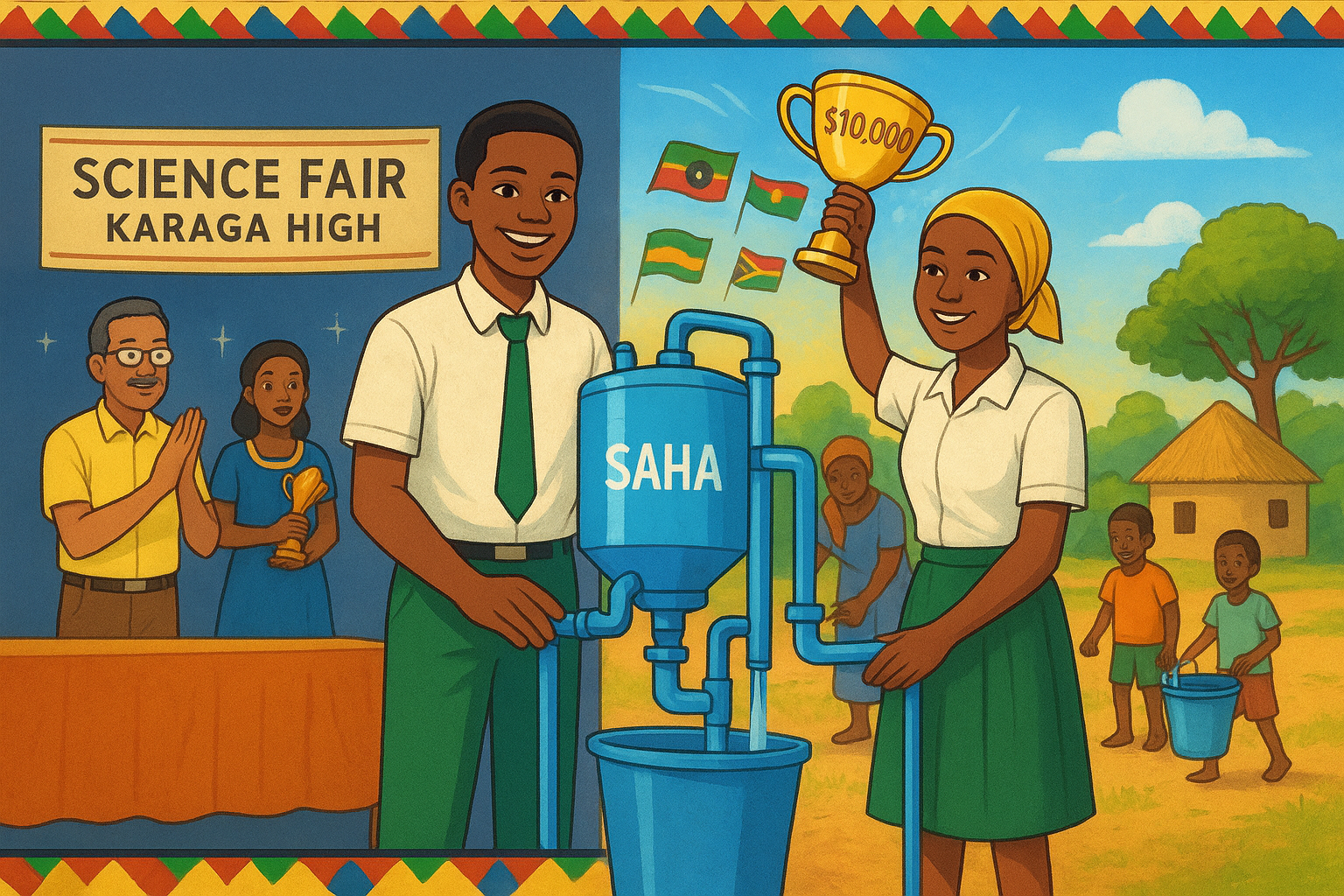
Symbolism – Water symbolizes life and renewal; Saha (Clear Water) represents innovation and progress; light symbolizes knowledge and enlightenment.
Metaphor – ‘Their journey was a shining example’ compares their path to a beacon of light, while ‘a drop of water in the ocean’ underscores the small but meaningful impact of their innovation.
Allusion – References to Ghanaian traditions and proverbs anchor the story in African oral culture.
Personification – ‘The Saha system smiled’ attributes human qualities to technology, portraying it as part of community life.
Repetition – Frequent use of ‘clear water’ and ‘Saha system’ reinforces central themes, echoing oral storytelling traditions.
Foreshadowing – Early victories, such as winning the Science Fair, hint at greater success to come.
Hyperbole – Exaggerations like ‘Their innovation would change the world’ emphasize passion and ambition.
Simile – ‘Abubakar’s mind was like a puzzle’ and ‘Rumors spread like wildfire’ highlight mental struggle and the rapid spread of news.
Irony – The irony of a water-starved community producing a water purification system underscores the theme of resilience.
Synecdoche – ‘Their hearts pounded with anticipation’ uses hearts to represent excitement and emotions.
Onomatopoeia – ‘The Saha system roared to life’ dramatizes the machine’s breakthrough moment
NARRATIVE TECHNIQUES
The storytelling blends modern narrative methods with African oral traditions, creating accessibility for both local and global readers.
Linear Structure – Events unfold chronologically, mirroring the scientific method (problem → experiment → results → solution).
Third-Person Narrative – Offers an objective voice while giving readers insight into the characters’ emotions and struggles.
Summary Technique – Phrases like ‘the weeks turned into months’ condense time, emphasizing perseverance and echoing oral storytelling, where uneventful periods are skipped.
Dialogue – Conversations reveal character traits, motivations, and relationships, especially between Abubakar, Abidatu, and Dr. Iddrisu.
Descriptive Imagery – Contrasts between Karaga and Accra highlight both rural struggle and urban opportunity.
Foreshadowing – Small victories prepare the audience for bigger triumphs, building suspense.
Character Development – Abubakar evolves from doubt to leadership, Abidatu from supporter to equal innovator, and Dr. Iddrisu from mentor to advocate.
CREDIT TO VICTORIA KUKUA STEVENS, Dr. JEMIMA LARTELEY MENSAH,AND VERY REV. EBO EPHRAIM