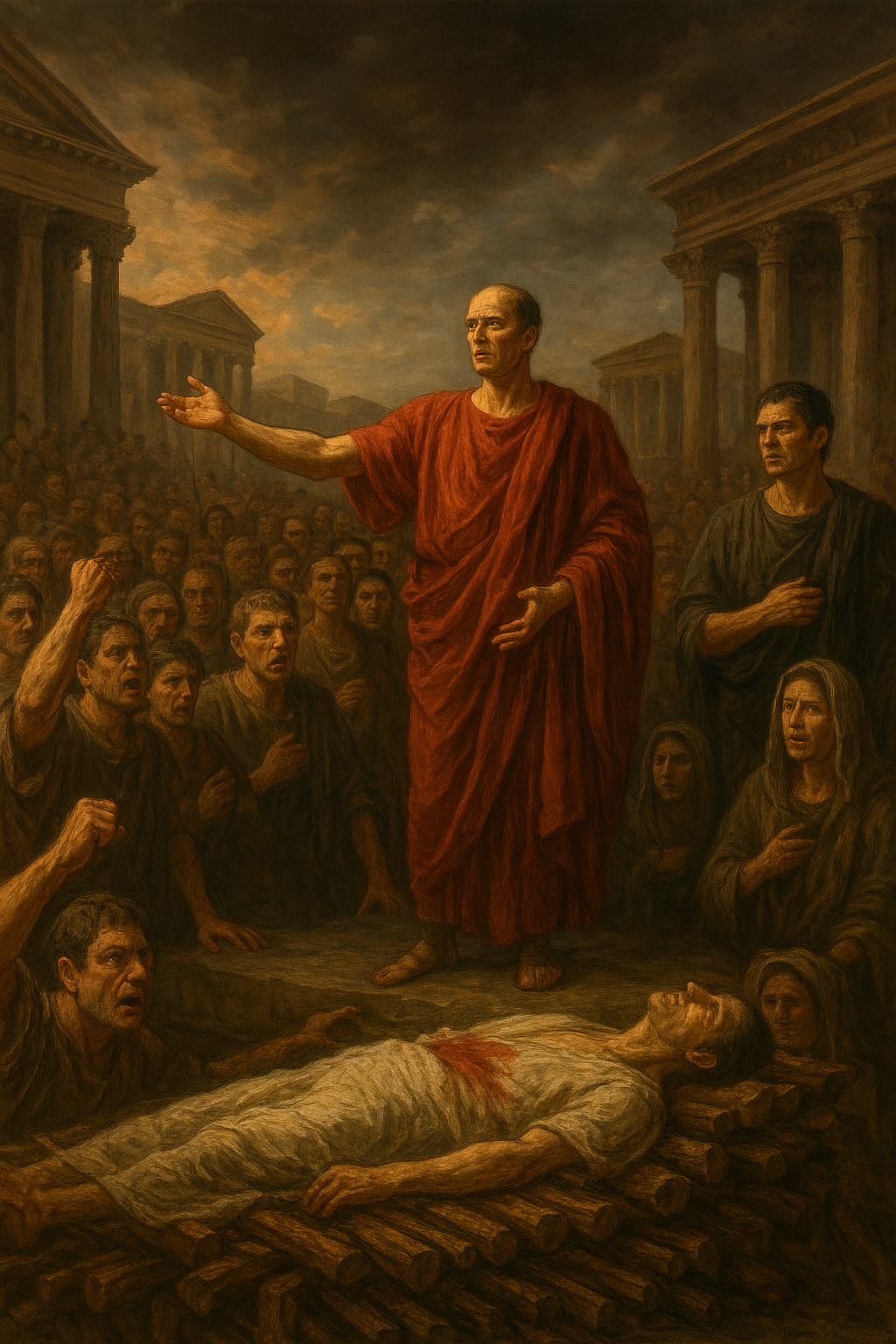
MARK ANTONY MOURNS CAESAR
SUMMARY OF THE DRAMA
Julius Caesar has just been assassinated, with his close friend Brutus among the conspirators. As the plebeians (commoners of Rome) gather in the streets, Brutus addresses them, attempting to justify Caesar’s death. He argues that although he loved Caesar, Caesar was ambitious, and his ambition threatened Rome’s freedom. Therefore, Brutus claims, Caesar had to die for the republic to survive. Brutus even offers his own life if Rome demands it, presenting himself as a man of honour and sacrifice. The crowd, moved by his reasoning, hails him as noble and trustworthy. Brutus then exits, asking the people to hear Mark Antony’s funeral oration.
Mark Antony begins cautiously, appearing to support Brutus’ claim that the conspirators are “honourable men.” But as he speaks, his tone gradually shifts. Through irony and rhetorical skill, he casts doubt on Brutus’ words. Antony reminds the plebeians of Caesar’s past generosity and loyalty to Rome, arguing that Caesar’s actions prove he was not ambitious. He points to Caesar’s refusal of the crown, his victories for Rome, and his compassion for the people. Antony then reveals Caesar’s will, which leaves his wealth and property to the citizens. To heighten the crowd’s emotions, he displays Caesar’s wounded body, symbolising betrayal and injustice.
The plebeians, inflamed by Antony’s words, revolt. They honour Caesar with a funeral pyre but then storm off to burn the homes of the conspirators. Antony, satisfied with the chaos he has unleashed, privately reflects that Caesar’s death has been avenged through his speech. Meanwhile, Brutus and the other assassins flee Rome, setting the stage for civil war.
SETTING ANALYSIS
Geographic Setting: The scene unfolds in the city of Rome, at the Forum where citizens gather for public speeches.
Time Setting: Shortly after Caesar’s assassination in 44 BC.
Context: Rome, though a republic, is at the height of military power. Julius Caesar, having defeated Pompey, holds unrivalled authority. His rise alarms rivals who fear monarchy, leading to his murder. Antony, as Caesar’s loyal friend and ally, must tread carefully: an open attack on Brutus might cost him his life.
Key Features:
The sharp divide between nobles and commoners.
Rome’s political identity: freedom versus tyranny.
The importance of heroes and their public image.
Military and political rivalries that destabilise Rome.
Impact: The Forum setting amplifies the drama. It is a stage for rhetoric and persuasion, where speeches sway the fickle crowd and decide Rome’s fate.
Effect: The environment heightens tension, showing how public opinion can be manipulated to trigger chaos and mob justice.
THEME ANALYSIS
Main Themes
Honour: Brutus argues that he killed Caesar for the honour of Rome, portraying himself as a patriot. Antony, however, undermines this claim by sarcastically repeating “Brutus is an honourable man,” forcing the people to question whether Brutus’ honour is genuine or a mask for treachery.
Loyalty and Betrayal: Brutus claims loyalty to Rome over loyalty to Caesar, but Antony frames this as betrayal ,both of Caesar’s friendship and of the people’s trust. Antony also condemns the plebeians for quickly forgetting Caesar, reminding them that Caesar’s loyalty to them endured until his death.
Roman History and Identity:
The drama constantly invokes Rome’s history , its heroes, its past conflicts, and its future direction. References to Pompey, Caesar’s rival, link the present assassination to earlier struggles for power, reflecting the Romans’ pride in their past and anxiety about their future.
Mob Justice:The plebeians, easily swayed by rhetoric, act as judge and executioner. They first hail Brutus as noble, then violently revolt under Antony’s influence. Their impulsive actions such as burning houses and seeking vengeance show the danger of collective anger. The conspirators’ act of killing Caesar can also be read as mob justice on a smaller scale.
Sub-Themes
Freedom:
Brutus claims Caesar’s ambition threatened Roman liberty, asking: “Is there anyone here who does not know the value of his freedom?” Antony, however, reframes freedom as the inheritance Caesar left in his will, making Caesar, not Brutus, the true guardian of liberty.
Conflict and Intrigue:
The scene highlights betrayal, rivalry, and civil conflict. Caesar’s murder, Antony’s manipulation, and the memory of Pompey remind us that Rome is perpetually caught in cycles of violence and power struggles.
The Power of Rhetoric:The speeches are the heart of the scene. Brutus appeals to logic and republican ideals, winning temporary approval. Antony appeals to emotion, irony, and imagery, stirring rebellion. The plebeians’ shifting loyalties demonstrate how language can control action and reshape reality.
CHARACTER ANALYSIS
Brutus: Presented as a noble republican, he values Rome’s freedom above personal friendship. Yet his honourable image collapses under Antony’s subtle attack. He embodies the tragic paradox of acting nobly but being branded a traitor.
Mark Antony: The true protagonist of the scene. He disguises his intentions, using rhetoric and irony to manipulate the plebeians. His transformation from cautious orator to fiery avenger makes him the moral victor.
Julius Caesar: Though dead, Caesar dominates the scene. His will, body, and legacy drive the action. He represents both Rome’s greatness and the cause of Rome’s division.
The Plebeians: A collective character representing the people of Rome. They are politically naive, easily manipulated, and act as pawns in the struggle between Brutus and Antony. Their violent outburst illustrates the dangers of mob psychology.
CREDIT TO VICTORIA KUKUA STEVENS, Dr. JEMIMA LARTELEY MENSAH,AND VERY REV. EBO EPHRAIM