

THE MEANING OF AFRICAN LITERATURE
This refers to any literary work (oral or written) that promotes the history, language, identity and cultural values of Africans. African literature is mostly written by Africans. Culture outlines the characteristics and patterns of people’s behavior in terms of their language, arts, customs, way of dressing, food and ways of worship. Culture regulates our behavior in terms of how we think, communicate with others and perceive our environment. African culture encourages positive behaviors and discourages negative behaviors. Since cultures differ from one society to the other, writers of African literature distinctively portray and promote their culture in written texts. An African literature on the history of Africa presents the happenings of pre-colonialism, colonialism and post colonialism.
The nature of African literature is in the forms of oral and written literature. African literature expresses the oral tradition, folktales, slave narratives and the developments of Africa.
ORIGIN AND DEVELOPMENT OF AFRICAN LITERATURE
African literature originated from the culture of people living in a society. The development of African literature results from the desire of elders to inculcate the history, customs and cultural values in the present generation so that they can also hand it over to the future generations. The elders create stories (folktales), proverbs, riddles, puzzles, idioms and songs that educate their children on customs, human behaviors and all activities that aim at the progress of a society. Oral literature is a major means of developing and preserving culture till writers from Africa begin to document it. The more Africans use oral literature at occasions like festivals, installing and outdooring of kings and queens, marriage and naming ceremonies, funerals, storytelling times and puberty rites, the more African literature is developed. The origin of African literature dates back to ancient Egypt through their pictorial representations of words.
African literature also develops through our educational system because African languages, history, artifacts, customs, morals and values are taught in schools. African students who receive adequate teaching on African literature respectively write on their backgrounds, culture and religion in order to preserve it for future use.
The presence of foreign religions (Christianity and Islam) in Africa also constitute the development of African literature. African writers highlight the importance of African traditional religion, history and culture in their written texts for future generations to know what constitutes their identity as Africans and to fight the dominance and effects of foreign religion and western culture in Africa. Kings, Queens, Priests and believers of African traditional religion strongly hold on to the culture and customs of Africa as a way of developing, preserving and promoting it for generations yet to be born. In other words, documentation of African literature helps us to develop and preserve it.
African literature differs from one author to the other in the areas of language, history, culture and customs. Example, the culture of a Ghanaian writer is different from that of a Nigerian. Despite the differences, all African literature share similar characteristics (features/components) of:
holding on to their oral literature
presenting themes of freedom and independence, identity and liberation, colonialism in Africa and African cultural values.
BLOCS OF AFRICA
This refers to the groupings (categories) of African literature based on the history of the African country that the writers come from. The history refers to colonialism / slave narratives of Africa. Colonialism is a policy or practice of a country acquiring political control over another country. After colonialism, African writers begin to write in the language of European countries that colonize them. The European countries that colonize Africa are Britain, France, Germany, Spain and Italy. The language for the government, media and schools in a lot of African countries today is the language of their colonial masters. Ghanaian writers use English language because they were colonized by the British. Writers from Tunisia, Algeria and Morocco write in French because they were colonized by France. Burundi and Rwanda were colonized by Germany, Libya is colonized by Italy and Tanzania by Portugal.
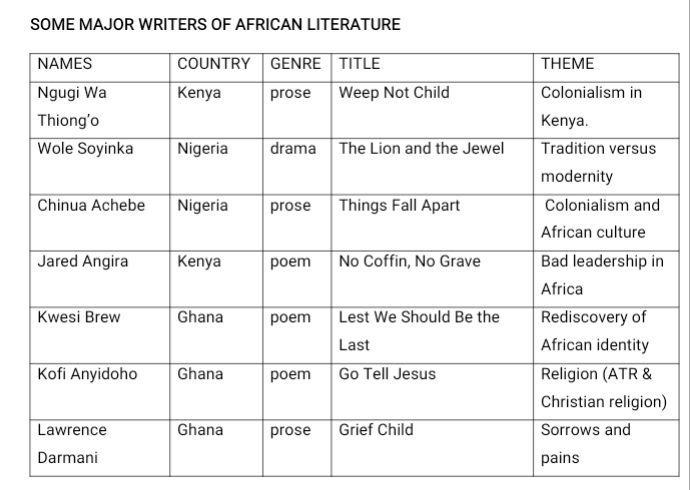
The distinct blocs of African literature are Anglophone bloc (African literature that is written in English language), Francophone bloc (African literature that is written in French) and Lusophone bloc (African literature that is written in Portuguese). Some Anglophone writers are Chinua Achebe, a writer of ‘Things Fall Apart’, Ama Ata Aidoo, the author of ‘Changes’, Ola Rotimi who wrote ‘The Gods Are Not to Blame’ and Wole Soyinka, the author of ‘The Lion and The Jewel’. Leopold Sedar Senghor from Senegal is a Francophone writer. He wrote the poem – I Will Pronounce Your Name. Agostinho Neto is a Lusophone writer. He wrote the poem The Grieved Lands of Africa. Lusophone countries are Angola, Cape Verde, Guinea- Bissau and Mozambique.
The implications of Anglophone bloc to writers: the use of English language is now a key element for the success of an African writer. Presently, African writers are not only known by their natives but by Europeans who once do not have adequate knowledge on the beauty, nature, culture, resources, hard work, wisdom, unity and resilience of Africans. African writers now have the opportunity to increase the population of their readers who will have access to their rich culture, aesthetic skills and wisdom. Previously, language barrier prevents the whites and some tribes in Africa from reading literature that is not written in their language but now a lot of people can read Africa literature that is written in English language.
The implications of Anglophone bloc to classroom practice: it makes African learners’ literate in other languages. It also helps African learners to understand different viewpoints about the world, appreciate their culture and that of others, bridge the gap between their country and other countries, promote unity in a multilingual class and helps learners to engage in wider communications across their regions, culture and with the outside world.
NB: The implications of Anglophone, Francophone and Lusophone blocs to writers and classroom practice are the same just that they do not share the same language background.
On the contrary, Anglophone bloc has some lapses. For example, Africans who are not educated cannot read and understand literary works that are written in English. The continuous use of English (foreign language) can hinder the development of African languages among the younger generations. Language is a way for Africans to establish social relations, maintain and transmit their cultural heritage but the inability to emphasize its continual use and development through speaking and writing will contribute to the loss of African culture.
The policy of British colonization is called the policy of indirect rule. The aim of the British is to use existing tribal structures and traditions of Africa as a means for establishing their rules and regulations while the English officials work behind the scenes and exercise their veto power. The local government of African traditional rulers was subject to the guidance of European officers. For example, chiefs cannot rule their communities based on their own traditions and customs but by the directives from the European rulers. The British for instance give new titles to African leaders like colonial administrators in order to convince them that they are one. The indirect rule gives opportunity to the British to allow African leaders to exercise direct administrative control over their own people and to reduce opposition to European rule. The British realized that their colonies (African countries) are harsh environments of which many of them (the British) could die if they apply the direct rule. This is why the British hide behind the scenes and use the local people to rule their fellow Africans. This leads to the adoption of indirect rule. The indirect rule integrates pre-established local elites and native administrators into the European government. Most African communities in those days are full of illiterates who do not understand government activities and information that are presented on radio. The British therefore use the indirect rule in order to pass government policies to the blacks.
The policy of France colonization is called the policy of assimilation. The aim of France is to assimilate and transform all Africans into “French” colonies into black French men and women. This means France had a goal to eliminate all African cultures and assimilate all Africans into French culture. The aim of this policy is to turn Africans into ‘Frenchmen’ through the process of education. The French dismissed African traditional rulers, introduced French culture in schools and established schools in only French territories.
The policy of Portuguese colonization is called the policy of imperialism. Imperialism is a political strategy where a powerful country explores the political, economic and cultural system of another country. The aim of Portugal is to forcefully establish their authority over their territories of Africa because of economic and political gain. The Portuguese dominate and exploit African colonies like Tanzania and Libya, Cape Verde, Guinea-Bissau, Sao Tome, Angola, and Mozambique. The effects of imperialism lead to cultural suppression, political dominance and exploitation of resources and workers in Africa. The Portuguese sent militant and governmental forces to take over, weaken the local power and develop colonies in Africa.
Credit to MADAM SITSOFE GANU
DEPARTMENT OF ENGLISH LANGUAGE
S. D. A. COLLEGE OF EDUCATION
ASOKORE – KOFORIDUA.