

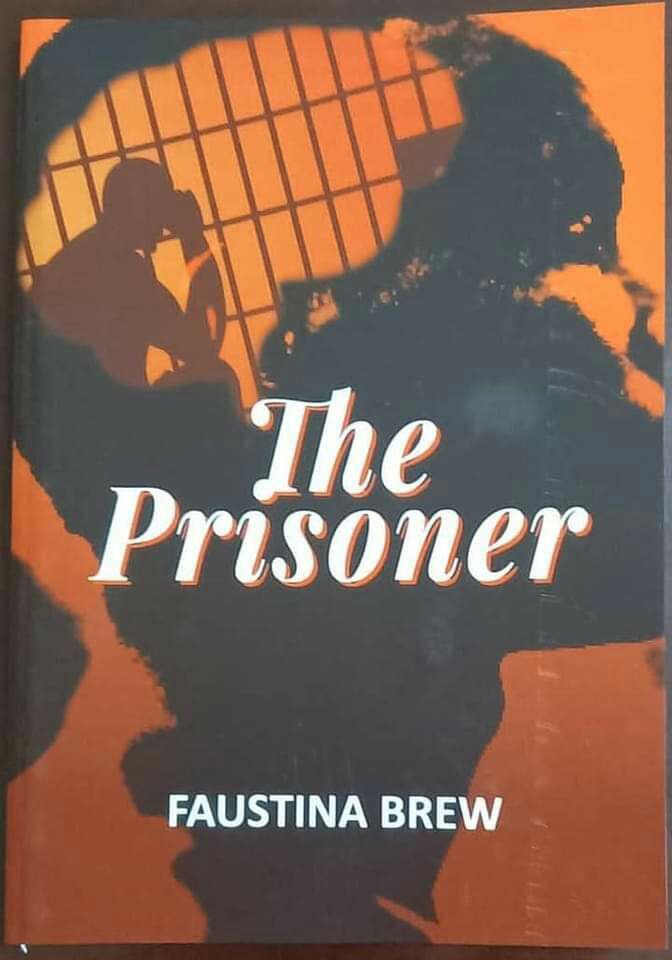
THE PRISONER
CHARACTER ANALYSIS OF THE PRISONER
Playwrights observe society, get insight into what informs the behavior of people and the resultant effects it has on them, and the society. They creatively craft it into plays to either question or inform the society with social reconstruction in mind; whilst also entertaining them alongside.
For this reason, the analysis of a play is very pertinent. Through analysis, one gets to understand the mind of the playwright, or the society he or she is questioning or informing through issues raised and their relatability, and then take a lesson from them. My character analysis of Faustina Brew’s “THE PRISONER” is no different.
I like focusing most of my analysis on characters in Plays because these characters are instruments that playwrights use to project their messages.
Through characters, the play’s themes are communicated, language is exhibited, and the plot is developed. It’s by this motivation that I choose to base my analysis on characters, just as I did previously with MEDEA.
ABOUT THE AUTHOR
THE PRISONER, this is a play written by Faustina Brew. Faustina Brew is a Ghanaian playwright, director, and a lecturer at the Department of Theatre Arts of the University of Education, Winneba. Faustina Brew attained her Secondary Education Certificate from Breman Asikuma Secondary School in 1981, then proceeded to the then Ola Training College(present day College of Education). She furthered at the University of Ghana where she earned Diploma in Theatre Arts,and an MFA(Playwriting) respectively. Brew later acquired her PhD in Performance Practice at University of Exeter, UK: 2016.
SYNOPSIS
The play opens with the chaos in RUPERT PETERS’ living room. While expressing his bewilderment of not doing anything right in his wife, in DIANA’s absence, he receives an unusual visits from VIVIAN, his wife’s fashion designer who had designed her wedding gown. At last, the purpose of the unusual visitation was disclosed , and that was the news of his wife’s sudden death in a car accident. The breaking news, happens to be the thread that tied the whole story.
CHARACTER ANALYSIS
Characters are one of the most important elements of plays. Omit them, and the play loses its identity as such. Characters are created by playwrights as a medium to communicate their messages or story. Characters in THE PRISONER serves no less of this aforementioned functions.
RUPERT PETERS
RUPERT is the father of RUTH, ex husband of VIVIAN, widower to DIANA, and the HUSBAND of VIOLA. He is the close friend of SAINT, and a manager of a company.
RUPERT is the main character of the play; sideline him, and the play won’t develop. His life after the death of his wife DIANA is the central pivot that propels the play.
In the playwright’s note at the back cover of the play, she stated that ‘RUPERT PETERS is entangled in his past…’, and that exactly is what RUPERT stood for in the play. After the death of his wife DIANA, his house knew no peace till his demise. This is not something strange in our society. Some people usually lose their sanity over the loss of a very close relative or a loved one, they get affected so much that some even commit suicide. DIANA’S death wasn’t the only cause of RUPERT’S unrest. His achievements and position at work also compounded issues. There are people who feel the need to be boss in every situation due to their past achievements, this blinds them from seeing drastic change from the past to the present and adapt.
‘Can our past hinder or facilitate our progress?’…the playwright quizzed.
Our past do influence our present life, but the effect is determined by our environment.
In the case of PETERS, he allowed his past shatter him. Why am I saying this? RUPERT PETERS couldn’t get over the loss of DIANA. He also held on to his achievements which eventually led to his divorce with VIVIAN, and his own death.
Charles Darwin once said, it’s not the strongest that survives, but those who are able to adapt to different environments. In the case of RUPERT, he didn’t survive because failed to adapt to the new environment he found himself in after DIANA’s demise; he failed in recognizing the change in environment when DIANA died and VIVIAN became a substitute. Taking reference from Scene IV, in an argument with RUPERT, he bursted ‘…this is terrible, DIANA wouldn’t do this.’ The above statement by RUPERT suggests of his unwillingness to accept his new fate. One may argue that maybe DIANA treated him so special than VIVIAN, but flipping back to the pages of the play, I beg to differ.
In Scene II page 11, MANSA, an Aunt of PETERS made this eulogy of DIANA: Oh DIANA, she was full of life, beautiful, energetic, industrious, and caring.
The same MANSA, together with SAINT also made this confessions on the same Scene at page 18 and 19 about VIVIAN after observing her:
SAINT: She is beautiful.
MANSA: And caring
Comparing both eulogies for VIVIAN and DIANA, it’s few things said that are not intersecting, but such is life. Individual differences…even twins, you won’t get them doing everything the same! This is what RUPERT refused to understand. And it’s common in our world when children lose their biological parents and expect their foster parents to treat them exactly the same as their biological parents when they were alive, but it is sometimes not possible. So then what will you do? Kill yourself? No, adapt! You won’t always get what you want in life, but you can make the best out of what you get.
Beside DIANA’S death, RUPERT’s achievement was a defense mechanism that made his home after DIANA’S death miserable. He thinks highly of himself because of his achievements, thus, he felt that he is always right except in the dream with DIANA which he for once placed his interest second. At a point in time when VIOLA quizzed him who he is, he answered ‘a manager’ whilst also pointing to his awards. Such act was repeated during a talk with SOLOMON on his marriage palaver.
RUPERT also represents people who think providing basic needs is enough to be regarded as caring. In the play, he made two time references on the fact that he gives money for food, and other things needed in the house, and so what should he do again?
Many at times people satisfy the first, third, fourth, and fifth hierarchy of needs propounded by Abraham Maslow, but totally ignore the second which is emotional needs. With this, those who lack it seek for someone to satisfy them; and people who are quick to notice, take advantage of it. That was the case of SAINT in luring VIVIAN and SMITH in luring RUTH.
DIANA
DIANA is RUPERT’s deceased wife. She is the one that made RUPERT conservative.
Social psychologists opine that explaining behaviour in terms of personality may result in attribution error; and that we will often conclude wrongly if we judge the fish forgetting about the water. So, it will be entirely wrong if we judge RUPERT forgetting his environment; which to me includes DIANA.
She represents people in the society who put up with whatever nonsense others do to them in the name of loyalty and love. This attitude empowers the recipients to continue with the habit, and later when those who encouraged those habit are absent, they think others that act differently and do not tolerate such habits are disrespectful, and their character, undesirable. From the dream RUPERT had, it projects that at first he was someone who considered other people’s concern first, but DIANA was not encouraging it. She rather wanted RUPERT to have his way, and it was evident when he wanted a baby girl for RUPERT and not a boy for herself. So why did RUPERT change after her death? The encouraged actions have become a habit then.
RUPERT, even from the time DIANA was alive saw his job as his life, he sleeps late in the night and works on his papers for the next day. It was DIANA who could have prevented him from choosing his work first, thinking too much of books, and being only concerned of material needs, but she failed.
EBUSUAPANYIN/ WƆFA/ 1ST WOMAN/ 2ND WOMAN: The playwright did well to project the relevance of the extended family in an African setting. Africa, most especially Ghana, believes in communalism. We believe that child raising is not only the duty of the parents that gave birth to the child, but also the role of members in the community with extended family being the direct next in line after the nuclear famiy. This was projected when VIVIAN left and RUTH was alone with his Dad. There, even though the family have had a brawl with RUPERT during planning of DIANA’S funeral, it didn’t stop them from going for their granddaughter and training her to be a responsible daughter. This is what our society lacks today, we’ve thrown to the dogs this tradition and have become too individualistic that a 30year old man in today’s Ghana, Africa, doesn’t even know his or her grandparents who are alive, not to talk of granduncles and grandaunts.
SOLOMON:
SOLOMON’s role when omitted from the play will not change the meaning of the play. The play will still have meaning. So then, what’s the relevance of SOLOMON’s role in the play? In my view, he is an opposite figure of RUPERT. Unlike RUPERT who is well educated yet have marital problems, SOLOMON had little education but have no, or less marital problems. This, the playwright makes a statement that book wisdom isn’t enough, we must attain that of the home too. ‘ …book good…but not only book book good…'(pg.46). There people in our society with less educational certificate but things are going on well for them, whilst those who have numerous certificate are struggling with the same thing the less educated people are enjoying. This teaches us that, we shouldn’t focus solely on formal education, but be concern with the informal ones too.
VIVIAN:
VIVIAN is a divorcée of RUPERT, and wife of SAINT.
VIVIAN always wanted RUPERT to do what she likes, but I’m wondering if she also asked herself what RUPERT liked?
In my opinion, VIVIAN represents people who think they have the right to be satisfied with what they like, but do not quiz what the others like, or, maybe don’t care.
VIOLA:
She is the wife of RUPERT, the one who killed him.
She, like VIVIAN, contributed in making RUPERT’s character shined. Aside that, she also represents people who go into marriage not because of love, but money. Of course, she can’t be blamed entirely as RUPERT too married not on the foundation of love, but as a care-of to attain RUTH back.
In a nutshell, if our past will make us progress or retrogress, it depends on us, and also the environment that has shaped us. They are the biggest influences of our mental process, attitudes, and behaviors. If we are able to acknowledge these environments and find a way to live in them, we can maneuver our way through, but if not, we will forever be imprisoned.
By Isaac Nketsiah( BA theatre Arts)