

THE POEM
Digging by Seamus Heaney
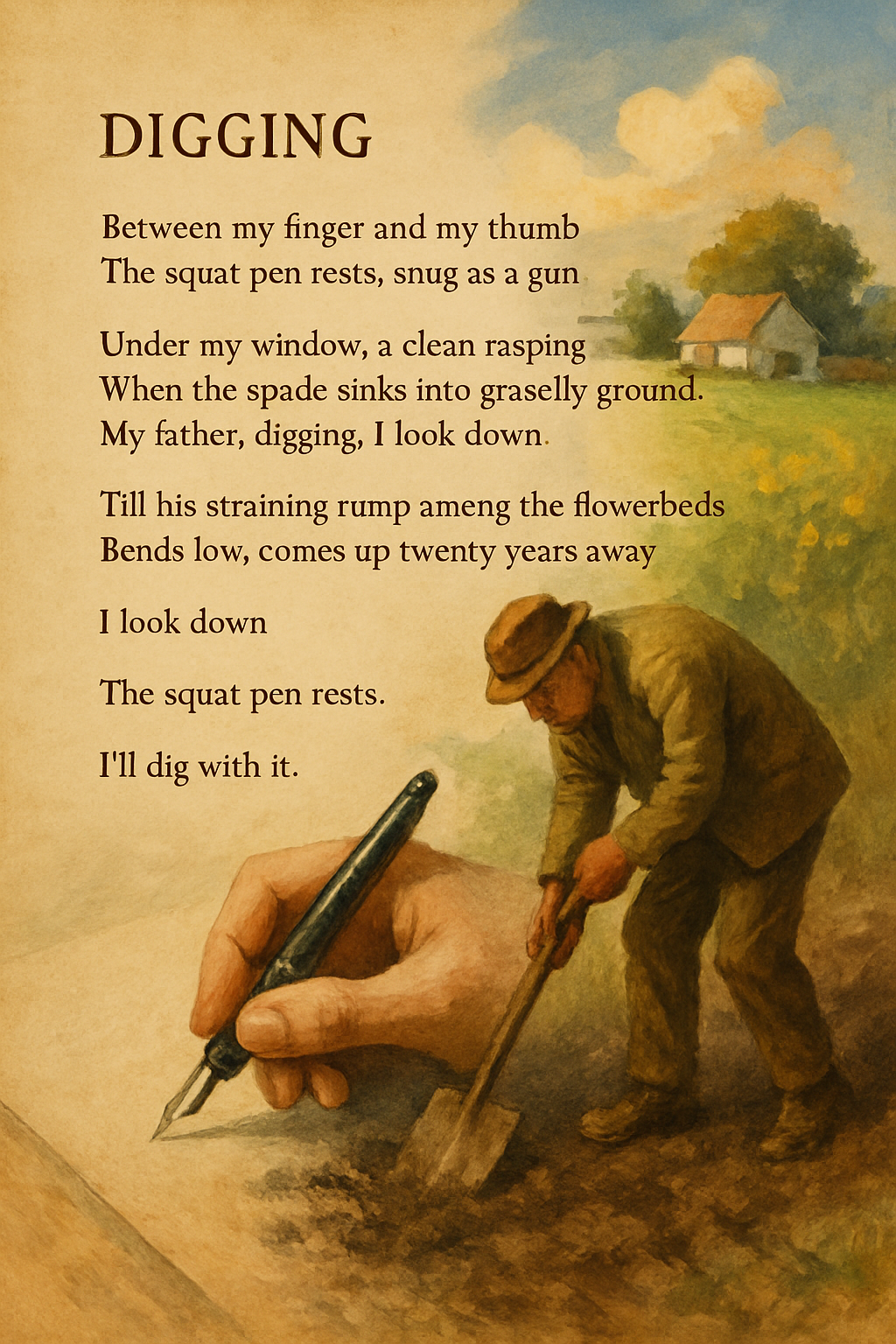
Between my finger and my thumb
The squat pen rests; as snug as a gun.
Under my window a clean rasping sound
When the spade sinks into gravelly ground:
My father, digging. I look down
Till his straining rump among the flowerbeds
Bends low, comes up twenty years away
Stooping in rhythm through potato drills
Where he was digging.
The coarse boot nestled on the lug, the shaft
Against the inside knee was levered firmly.
He rooted out tall tops, buried the bright edge deep
To scatter new potatoes that we picked
Loving their cool hardness in our hands.
By God, the old man could handle a spade,
Just like his old man.
My grandfather could cut more turf in a day
Than any other man on Toner’s bog.
Once I carried him milk in a bottle
Corked sloppily with paper. He straightened up
To drink it, then fell to right away
Nicking and slicing neatly, heaving sods
Over his shoulder, digging down and down
For the good turf. Digging.
The cold smell of potato mold, the squelch and slap
Of soggy peat, the curt cuts of an edge
Through living roots awaken in my head.
But I’ve no spade to follow men like them.
Between my finger and my thumb
The squat pen rests.
I’ll dig with it.
Inspiration and Background
‘Death of a Naturalist’ is a collection of poems and ‘Digging’ is part of that collection that was published in 1966. Heaney wrote this poem in his mid-twenties at the time when he was a young poet. He was residing in Northern Ireland. However, the surrounding area was embroiled in political and sectarian conflicts. Thus, the poem was written during a period of upheaval and violence; mainly known as the Troubles. It lasted from the late 1960s to the late 1990s. The poem ‘Digging’ reflects the author’s rural upbringing and the tradition of manual labour that characterised life in the Irish countryside. The poem becomes one of Heaney’s most beloved works and is widely considered a masterpiece of contemporary poetry. Seamus Heaney was born near Castledawson, County Derry, and grew up on his father’s cattle farm. He was the eldest in a Catholic family of nine children. Heaney grew up as a country boy and looking up to his father who is a farmer. This poem talks about the generation comparison between Heaney and his father. His father is a traditional farmer and Heaney didn’t want to follow his father steps to be a farmer but he desires to pursue knowledge and teaching. As a person who is literate and graduate from university. Heaney has a higher position in the society comparing to his father who is just a farmer. In here Heaney try to draw a line between his job as a writer and his father’s job as a farmer. Its two kinds of different job. The writer sometimes works inside and sitting in one place to find inspiration, it’s not rough job. But it’s very different for the farmer who must work under the sun and use his spade to break the ground; it’s a hard work and need a lot of energy. But although it’s different, it’s still the same. They are a digger. The writer digs with his pen and a farmer dig with his spade. The farmer digs his soil and the writer’s soil is his imagination that bring forth ideas, solutions and action!
SUBJECT MATTER
The poem, “Digging” by Seamus Heaney talks about the difference and similarities between a farmer and a writer. Heaney is a great writer who comes from the family who lives from farming. He was grown up in farming area. But because he is educated, he pursues a different path from his father and his grandfather who works in farm from generations. Heaney wants to emphasize that although the two jobs are very different both of their activities are digging. His father is digging with his spade and Heaney is digging with his pen as a writer. Thus, whatever the endeavor, hard work and diligence in work produce quality and a source of inspiration and livelihood.
STANZA ANALYSIS
Stanza 1
The first couplet of “Digging” begins by using an iambic pentameter and a rhyme. The iambic pentameter, however, is interrupted by the trochee in “snug as,” and the following stanza does not follow the couplet form as the first one does.
Stanza 2
However, the three lines of the second stanza all rhyme; Heaney rhymes “sound,” “ground,” and “down.” The simple, monosyllabic rhymes used in this and the preceding stanzas appear to create the blueprint for the rest of the poem to follow, but Heaney chooses to move away from those rhymes mid-poem, as if their purpose has been served. Since the poem deals with the complex feelings that arise when one breaks from tradition, this choice bears some significance.
Stanza 3
The speaker ends the second stanza and begins the third with the line, “I look down/Till his straining rump among the flowerbeds/Bends low, comes up twenty years away.” This stanza communicates the continuity of the speaker’s father’s digging, but while in the present he digs in flowerbeds, in the past, he was digging amongst potato drills. The goal of digging has changed, but the action itself has not. To make clear the journey we have made through time, the speaker switches mid-sentence into the past tense.
Stanza 4
The following stanza is clearly rooted in the past. The first sentence describes the speaker’s father’s body interacting with the spade, but the speaker’s voice distances the body from the father, treating it as an extension of the shovel. “The coarse boot nestled on the lug, the shaft/Against the inside knee was levered firmly,” the speaker says. By calling his father’s boot and knee “the coarse boot” and “the inside knee,” instead of connecting them directly to his father, the speaker suggests how intrinsic the act of digging is to his father’s nature. Since we the readers know that the speaker is comparing his father’s work as a farmer to his own work as a writer, we can conclude with some certainty that the speaker is thinking of how intrinsic his own trade is to himself. Other characters, though unnamed, also appear in this third stanza. “He rooted out tall tops, buried the bright edge deep/To scatter new potatoes that we picked, /Loving their cool hardness in our hands.” Though the speaker never says who the other people referred to by the first-person plural are, the wistful tone of this sentence suggests that the “we” refers to the speaker and his siblings. The wonder the speaker describes that stems from touching the potatoes comes off as nostalgic and childlike; clearly, the speaker feels a deep personal connection to farming, a connection that stems from his own experiences, not just those of his father and grandfather.
Stanza 5
The fifth stanza returns to the couplet format, though not to the rhymes, of the first stanza. The speaker begins by uttering, “By God,” a moment notably more colloquial than the first several stanzas. This expression seems to burst from the speaker naturally, suggesting that he truly feels impressed by his father’s and grandfather’s skill. By bringing his grandfather into the poem, the speaker makes clear that he is talking about something beyond just the dichotomy between his own career and his father’s. He appears to celebrate the way of life that his father and grandfather, to an extent, shared, and the nostalgia represented in this poem suggests that the speaker’s feelings toward his career as a writer are not cut-and-dry.
Stanza 6
The next stanza is longer than any of those that come before it, and it works to describe the speaker’s grandfather. The speaker asserts that his grandfather cut “more turf in a day/Than any other man on Toner’s bog.” Though the speaker is very firm in his characterization of his grandfather, this assertion has a slightly childlike tone, suggesting that the speaker still sees his father and grandfather through the adoring eyes of a child. Furthermore, the speaker’s grandfather dug for turf, a source of fuel, while the speaker’s father dug for potatoes. The speaker then outlines a day when he brought his grandfather “milk in a bottle/Corked sloppily with paper.” This image evokes the pastoral landscape in which the speaker grew up. The stanza ends with the lines, “He straightened up/To drink it, then fell to right away/Nicking and slicing neatly, heaving sods/Over his shoulder, going down and down/For the good turf. Digging.” The language here moves rhythmically and smoothly for a number of lines, mimicking the movement of digging. This stanza also quietly revives rhyme in the poem. The lines “My grandfather cut more turf in a day/Than any other man on Toner’s bog” rhyme with the lines “To drink it, then fell to right away/Nicking and slicing neatly, heaving sods” with several lines that do not rhyme between and around them. Why the speaker returns to rhyme is not entirely clear, but the return reminds the reader of the speaker’s specific line of work, as a poet. By separating the word “Digging” into its own sentence, the speaker makes the action a mythical gesture. Digging is beyond his own reach, it seems, so to an extent he idealizes it. However, he seems to believe that he can reach the same transcendental place through his own hard work as his forbearers did through theirs.
Stanza 7
The next stanza, the second to last stanza in the poem, reads, “The cold smell of potato mould, the squelch and slap/Of soggy peat, the curt cuts of an edge/Through living roots awaken in my head.” The speaker, using lots of alliteration to evoke the sounds and smells he associates with digging, winds through those sensations and, at nearly its end, pulls the reader back into the present tense, paralleling how those sensations bring the speaker back to the past. “But I’ve no spade to follow men like them,” he continues. This moment could indicate a disheartening direction, but the speaker does not take any time to consider the merits of writing as a skill versus the merits of digging. He seems to consider them absolutely equal. Those “living roots” could be interpreted as a metaphorical reference to the speaker family, his living roots. Of course, he describes them to describe how they are cut through; this, appropriately, seems like a reference to the speaker’s choice to move away from the farming occupation.
Stanza 8
The final stanza begins by repeating the first stanza exactly: “Between my finger and my thumb/The squat pen rests.” But instead of comparing the pen to a gun, this time he simply says, “I’ll dig with it.” One important part of this image is that he says he will use his own tools, his pen, to dig; his point is not that digging is meaningful when it is like writing, but that writing is meaningful when it is like digging. Both actions are sacred to the speaker.
THEMES IN THE POEM
- The theme of Work
- The theme of Inheritance
- The theme of Manual Labour
- The theme of Family
- The theme of Identity and Traditions
Credit to H.K OCRAN/ LiTTROVE