

THE NUN’S PRIEST’S TALE – GEOFFREY CHAUCER
Once, long ago, there dwelt a poor old widow
In a small cottage, by a little meadow
Beside a grove and standing in a dale.
This widow-woman of whom I tell my tale
Since the sad day when last she was a wife
Had led a very patient, simple life.
Little she had in capital or rent,
But still, by making do with what God sent,
She kept herself and her two daughters going.
Three hefty sows—no more—were all her showing,
Three cows as well; there was a sheep called Molly.
Sooty her hall, her kitchen melancholy,
And there she ate full many a slender meal;
There was no sauce piquante to spice her veal,
No dainty morsel ever passed her throat,
According to her cloth she cut her coat.
Repletion never left her in disquiet
And all her physic was a temperate diet,
Hard work for exercise and heart’s content.
And rich man’s gout did nothing to prevent
Her dancing, apoplexy struck her not;
She drank no wine, nor white, nor red had got.
Her board was mostly served with white and black,
Milk and brown bread, in which she found no lack;
Broiled bacon or an egg or two were common,
She was in fact a sort of dairy-woman.
She had a yard that was enclosed about
By a stockade and a dry ditch without,
In which she kept a cock called Chanticleer.
In all the land for crowing he’d no peer;
His voice was jollier than the organ blowing
In church on Sundays, he was great at crowing.
Far, far more regular than any clock
Or abbey bell the crowing of this cock.
The equinoctial wheel and its position
At each ascent he knew by intuition;
At every hour—fifteen degrees of movement—
He crowed so well there could be no improvement.
His comb was redder than fine coral, tall
And battlemented like a castle wall,
His bill was black and shone as bright as jet,
Like azure were his legs and they were set
On azure toes with nails of lily white,
Like burnished gold his feathers, flaming bright.
This gentlecock was master in some measure
Of seven hens, all there to do his pleasure.
They were his sisters and his paramours,
Colored like him in all particulars;
She with the loveliest dyes upon her throat
Was known as gracious Lady Pertelote.
Courteous she was, discreet and debonair,
Companionable too, and took such care
In her deportment, since she was seven days old
She held the heart of Chanticleer controlled,
Locked up securely in her every limb;
O what a happiness his love to him!
And such a joy it was to hear them sing,
As when the glorious sun began to spring,
In sweet accord, My Love is far from land
—For in those far off days I understand
All birds and animals could speak and sing. (Shortened)
Introduction and Background
The most famous work, “The Canterbury Tales”, is written by Geoffrey Chaucer. He was an English poet, civil servant, and author. He is known to be the “father of English poetry”, a poet who contributed most in Middle English during 1387-1400. He was buried in the poet’s corner in Westminster Abbey. His famous works include Book of the Duchess, Troilus, and Criseyde, The House of Fame, and the one we are talking about, The Canterbury Tales. The Nun’s Priest’s Tale is a story that is part of Geoffrey Chaucer’s The Canterbury Tales. It is a narrative formed by a group of pilgrims traveling to Canterbury. About thirty pilgrims get together at Tabard Inn across the Thames from London. They narrate different stories individually suggested by the host Harry Baily during the journey. During the journey, there were many stories told by Knight, Miller, and other pilgrims. After listening to these people’s stories, Harry Baily suggests one of the pilgrims tell a story that is good to ears and not a tragedy. So, after listening to the monk’s story, the nun’s priest is picked to narrate an entertaining story. This is when the nun’s priest tells the story, called “The Nun’s Priest’s Tale”.
SUBJECT MATTER
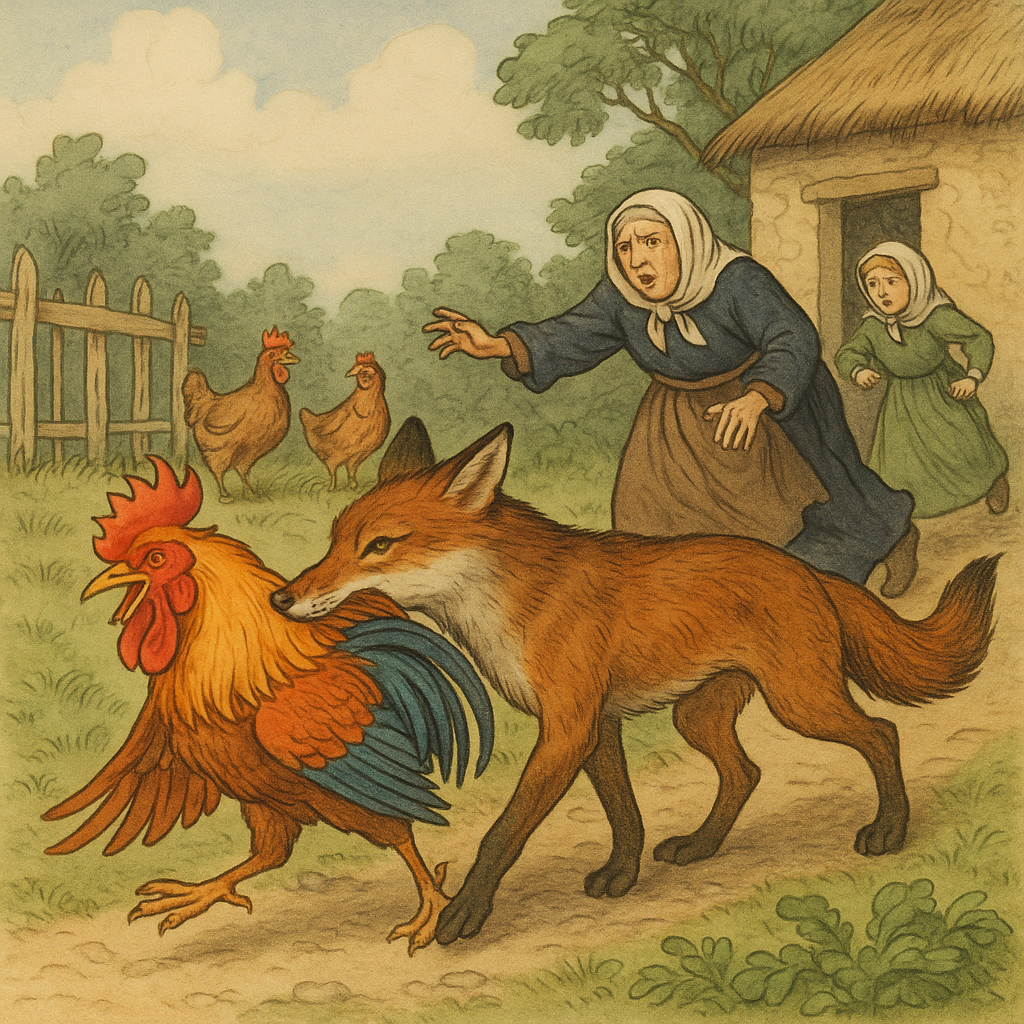
The story begins with a poor widow who lives in a cottage house with her two daughters. She has few possessions, including a sheep, three cows, three sows, and some chickens. Notably, she possesses one chicken which is a rooster named Chaunticleer. The meaning of this name is “sings clearly”. He is a good singer and rooster, which makes him the head of all roosters. His crest is as redder as delicate coral, his beak is as black as jet, his feathers shine like burnished gold, and he has nails whiter than the flower lilies. He is lovely according to his physical attributes, so he has many hen-wives, but his favorite is Pertelote. One night, when his wives were roosting, he had a terrible nightmare in which he was threatened to be killed by an orange-houndlike beast. When he tells his nightmare to her favorite Pertelote, she calls him a coward and believes that dreams have no meaning. He even mentions some factual and text references to support his idea of dreams, as he believes that dreams are a warning signal of things that will occur in the future, but he later gets comforted by Pertelote. Then, he praises the beauty of Pertelote and makes love. First, he feathered Pertelote and then had intercourse with her. But a tragic incident happens in May at night. He sees a fox looking for him and his wife. When he saw the fox coming near him, he started running away from the fox to protect himself. But then the fox gently calls and assures him of his safety. She praises his voice just for the sake of catching cock; the fox tries to manipulate him. After that, the fox catches him and grasps him. After hearing the news of cock, everybody runs to save him. The screams of female chickens were loud and similar to those of humans. Along with them, the other animals also ran after him to save him; Pertelote even burned her feathers. The old woman with her daughters heard the voice but could do nothing but run after it. Meanwhile, Chaunticleer applies the same trick applied to him by the fox. Chaunticleer asks the fox to use her good speaking skills to stop the animals from running after him. Fortunately, as soon as the fox opens her mouth to speak, the Chanticleer gets free.
STANZA ANALYSIS
The Nun’s Priest’s Tale is one of Chaucer’s most brilliant tales, and it functions on several levels. The tale is an outstanding example of the literary style known as a bestiary (or a beast fable) in which animals behave like human beings. Consequently, this type of fable is often an insult to man or a commentary on man’s foibles. To suggest that animals behave like humans is to suggest that humans often behave like animals. This tale is told using the technique of the mock-heroic, which takes a trivial event and elevates it into something of great universal import. Alexander Pope’s poem The Rape of the Lock is an excellent example a mock-heroic composition; it treats a trivial event (the theft of a lock of hair, in this case) as if it were sublime. Thus, when Don Russel, the fox, runs off with Chaunticleer in his jaws, the chase that ensues involves every creature on the premises, and the entire scene is narrated in the elevated language found in the great epics where such language was used to enhance the splendid deeds of epic heroes. Chaucer uses elevated language to describe a fox catching a rooster in a barnyard — a far cry from the classic epics. The chase itself reminds one of Achilles’ chasing Hector around the battlements in the Iliad. To compare the plight of Chaunticleer to that of Homer’s Hector and to suggest that the chase of the fox is an epic chase similar to classical epics indicates the comic absurdity of the situation. The mock-heroic tone is also used in other instances: when the Nun’s Priest describes the capture of the Don Russel and refers to the event in terms of other prominent traitors (referring to the fox as “a new Iscariot, a second Ganelon and a false hypocrite, Greek Sinon”) and when the barnyard animals discuss high philosophical and theological questions. For Lady Pertelote and Chaunticleer to discuss divine foreknowledge in a high intellectual and moral tone in the context of barnyard chickens is the height of comic irony. We must also remember the cause of the discussion of divine foreknowledge: Lady Pertelote thinks that Chaunticleer’s dream or nightmare was the result of his constipation, and she recommends a laxative. Chaunticleer’s rebuttal is a brilliant use of classical sources that comment on dreams and is a marvelously comic means of proving that he is not constipated and does not need a laxative. Throughout the mock-heroic, mankind loses much of its human dignity and is reduced to animal values. The Nun’s Priest’s ideas and positions are set up in his genially ironic attitude toward both the simple life of the widow and the life of the rich and the great as represented by the cock, Chaunticleer (in Chaucer’s English, the name means “clear singing”). The Nun’s Priest’s opening lines set up the contrast. A poor old widow with little property and small income leads a sparse life, and it does not cost much for her to get along. The implication is that living the humble Christian life is easier for the poor than for the rich, who have, like Chaunticleer, many obligations and great responsibilities (after all, if Chaunticleer does not crow at dawn, the sun cannot rise). The Nun’s Priest contrasts the two human worlds of the poor and the rich in the description of the poor widow and the elegant Chaunticleer. The widow’s “bour and halle” (bedroom) was “ful sooty,” that is black from the hearth-flame where she had eaten many a slim or slender meal. Notice the contrast: The term “bour and halle” comes from courtly verse of the time and conjures up the image of a castle. The idea of a “sooty bower” or hall is absurd: The rich would never allow such a thing. Yet soot is inevitable in a peasant’s hut, and from the peasant’s point of view, the cleanliness fetish of the rich may also be absurd. A slender meal (“sklendre meel”) would of course be unthinkable among the rich, but it is all the poor widow has. Likewise, the widow has no great need of any “poynaunt sauce” because she has no gamey food (deer, swan, ducks, and do on) nor meats preserved past their season, and no aristocratic recipes. She has “No dayntee morsel” to pass through her “throte,” but then, when Chaucer substitutes the word “throat” (throte) for the expected “lips,” the dainty morsel that the image calls up is no longer very dainty. The aristocratic disease gout does not keep the widow from dancing, but it’s unlikely that she dances anyway. Dancing is for the young or rich. As a pious lower-class Christian, she scorns dancing of all kinds. In short, the whole description of the widow looks ironically at both the rich and the poor. When the Nun’s Priest turns to Chaunticleer, he begins to comment on the life of the rich in other ironic ways. Chaunticleer has great talents and grave responsibilities, but the cock’s talent (crowing) is a slightly absurd one, however proud he may be of it. (In middle English. as in modern, “crowing” can also mean boasting or bragging.) And Chaunticleer’s responsibility, making sure the sun does not go back down in the morning, is ludicrous. His other responsibilities — taking care of his wives — are equally silly. Part of the Nun’s Priest’s method in his light-hearted analysis of human pride is an ironic identification of Chaunticleer with everything noble that he can think of. His physical description, which uses many of the adjectives that would be used to describe the warrior/knight (words such as “crenelated,” “castle Wall,” “fine coral,” “polished jet,” “azure,” “lilies,” and “burnished gold,” for example) reminds one of an elegant knight in shining armor. The reader should be constantly aware of the ironic contrast between the barnyard and the real world, which might be another type of barnyard. That is, the “humanity” and “nobility” of the animals is ironically juxtaposed against their barnyard life. This contrast is an oblique comment on human pretensions and aspirations in view of the background, made clear when Don Russel challenges Chaunticleer to sing, and the flattery blinds Chaunticleer to the treachery. Here, the tale refers to human beings and the treachery found in the court through flattery. Chaunticleer’s escape is also effected by the use of flattery. Don Russel learns that he should not babble or listen to flattery when it is better to keep quiet. And Chaunticleer has learned that flattery and pride go before a fall.
THEMES IN THE POEM
- The theme of Vanity and Pride
- The theme of Dreams and Prejudice
- The theme of Carelessness
- The theme of Modesty
- The theme of Society’s Views on Women
- Wisdom and Folly
CREDIT TO H.K OCRAN/ LiTTROVE
I love this