A PERFORMANCE REVIEW OF THE STORYTELLER’S TALE STAGED AT THE SCA THEATRE ON THE 17TH -19TH JULY 2025
The play was directed by Felix A. Gyimah, a final-year directing student from the Department of Theatre Arts, UEW, as a partial requirement for his degree. The production was staged for three consecutive nights.
Synopsis of the Play
The Storyteller’s Tale, written by Ernest Kwesi Amponsah, tells the story of a poor but hardworking farmer named Agya Adwuma who lives in a small village. His life takes a dramatic turn when he becomes wealthy and marries a beautiful woman. However, this woman turns out to be a mysterious, talking antelope whose life Agya Adwuma had once spared during a hunting expedition. Years later, Agya loses all the blessings he had received due to his failure to fulfill the wishes of the mysterious antelope.
This review focuses on the final performance on Saturday, 19th July 2025. It critiques all aspects of the production—from acting, costume, makeup, lighting, sound, set design, direction, audience participation—and concludes with an overall rating out of ten.
Acting
Acting involves the use of movement, gestures, and vocal intonation to portray a fictional character, typically through speaking or singing a scripted text for stage or screen. The character names in the play reflected their roles. For instance, Agya Adwuma, in Akan, translates to “a hardworking person.”
The production opened dynamically, with singers, townspeople, and dancers entering from the audience and engaging in traditional Akan games such as Anto akyire oo, followed by lively dances. The Sikyi and Sanga dances added energy and revealed the play’s cultural setting.
Now to the lead performer , The Storyteller, opened on a high note. She engaged with both her fellow actors and the audience effectively, eliciting real-time responses. Constance Nyame embodied the role remarkably, using vocal tone and facial expression to convey age and emotion. When narrating Agya Adwuma’s rise to wealth, her joy was evident in her voice and expression; similarly, during tragic moments, her sadness was palpable. Her body language also contributed to the illusion of old age. However, her vocal projection was weak at times, especially for audience members seated at the back. Also, she broke character while exiting the stage, which slightly disrupted continuity.
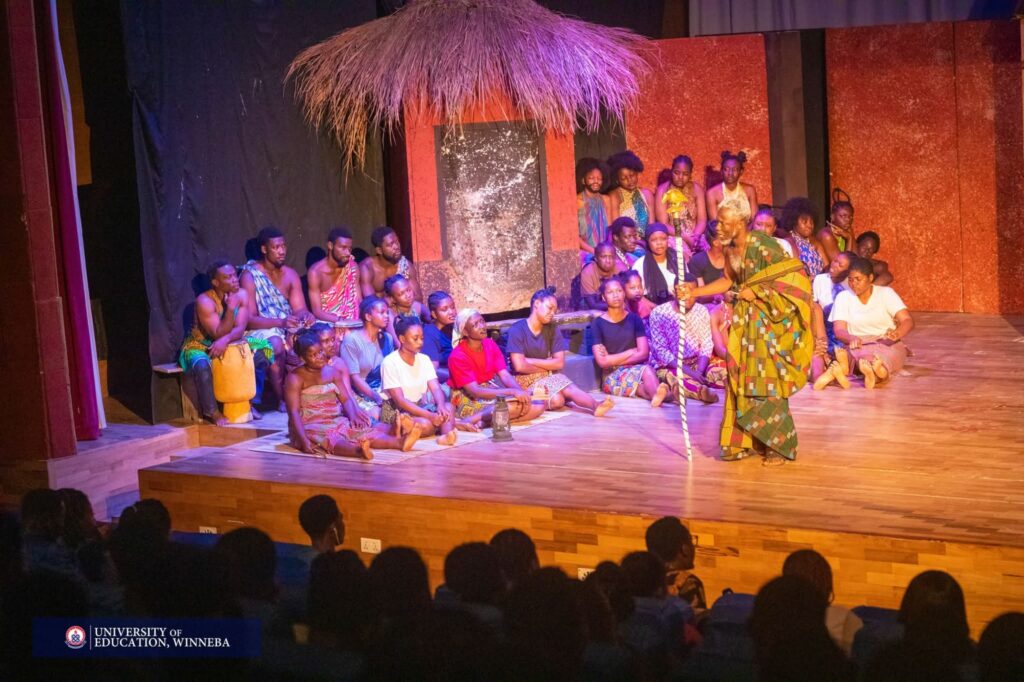
Another performer who stole the show was “Agya Adwuma’’ . His relationship with his family, especially the emotional breakdown when his wife disappeared, was compelling. His bond with Akora Mmusuo, however, lacked clarity. Being best friends, their chemistry should have been more established. James Mckeown Oduro’s performance was otherwise delightful, especially in his scenes with his sister, which balanced sternness with compassion.
‘’Yaa P3 as3m’’ another hilarious character played by Irene Aglo. She brought much-needed humor. Her interactions with her brother and the Mmoguo group (singers) were engaging. She used her nephew to cunningly extract money from her brother and was deeply immersed in the songs and dances.
.
In addition, Eno Yaa, daughter of the Antelope god, was confidently portrayed by Abigail Yignampim. Her love and respect for her husband were well-depicted, despite challenges from her sister-in-law. However, her emotional response to her departure on stage lacked depth..
Furthermore, Akora Mmosuo, played by Bismark Domey, delivered a vibrant performance. His mannerisms and dancing conveyed age and humor. However, he sometimes shouted rather than projected, which affected clarity. His lack of genuine enthusiasm during the fish-eating scene contradicted the dialogue, though he did manage to provoke audience murmurs with his remarks.
Old Oyinka, Agya Adwuma’s son, failed to establish a believable father-son dynamic. His energy was low, and poor projection made him difficult to hear.
The Mmoguo Singers added vitality to the production. Their harmonies and contextual songs (composed by Dr. Samuel Arko Mensah) enriched the performance and maintained thematic alignment. Their enthusiasm for the Storyteller’s presence was particularly heartwarming.
Also, the Antelope god lacked vocal variation. As a deity, his voice should have been more commanding and distinct.
Finally, Small Oyinka showed promise, especially in his touching hug with his father.
Technical Aspects
Lighting
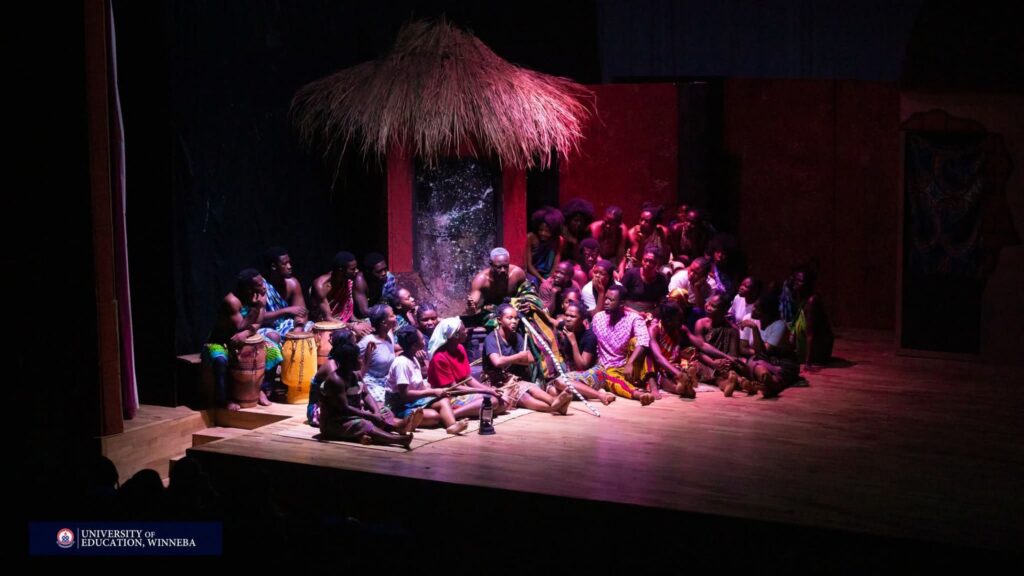
Lighting was well-executed. The fade-ins and fade-outs were effective, especially when the Antelope god transformed into a human. The use of red light during Eno Yaa’s exit emphasized the tragic mood and enhanced the spectacle
Sound
The sound team for the production did exceedingly well. Although the play did not heavily rely on sound effects, the thunder sound during the Antelope god’s entrance was impactful and intensified the scene.
Songs
Also, the songs sung during the production added a lot of depths The songs were:
- Legend of the fish bone
- Anadwo yi yebedi agoro
- What is your worry
- Akobam Car
- They wish I don’t succeed
- Let
my love for you be enough - Children are a gift.
All songs, composed by Dr. Arko Mensah, complemented the play’s storyline and tone.
Costume and Makeup
Costumes accurately reflected the characters’ statuses and roles. The Storyteller’s attire identified her instantly. Agya Adwuma’s costumes visibly tracked his journey from poverty to wealth. Dancers’ costumes allowed for flexibility and movement. The makeup supported character portrayal, though the grey hair used for Agya Adwuma faded later in the show. A special makeup effect transformed a girl into a boy—a creative touch worth mentioning.
Properties and Set
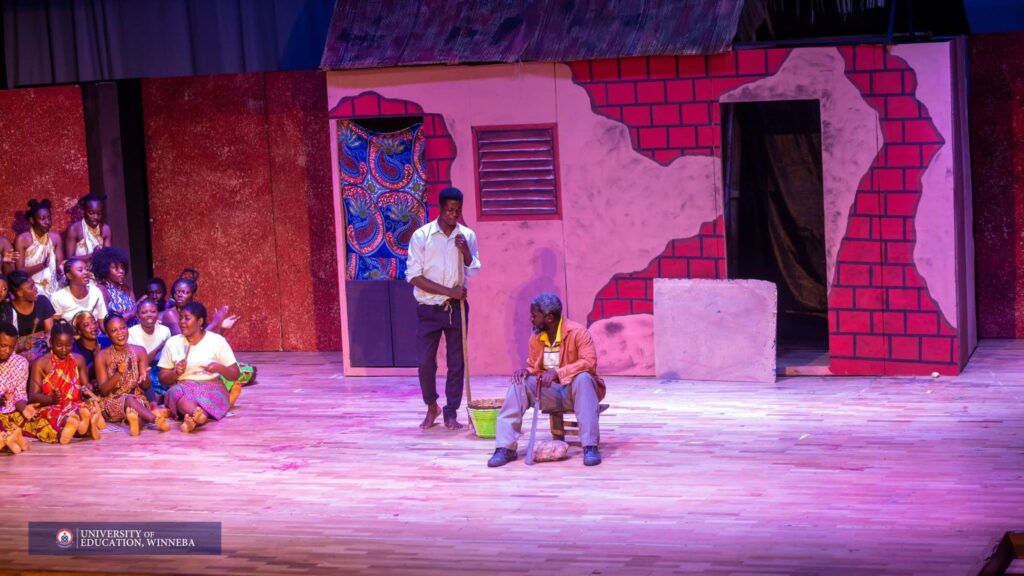
The set design effectively showed Agya Adwuma’s transformation from poor to rich. The initial setup represented a modest home; the later one was richly adorned with curtains, flowers, and chairs. Props such as walking sticks, guns, water pots, and baskets enriched characterization. However, scene transitions were visible, which detracted from the illusion. Some props (like the unused lantern) remained on stage unnecessarily. Notably, the basket used bore Nigerian flag colors, which felt inconsistent with the Akan context.
Kudos to Janet Elisia Rockson for designing and constructing the set as part of her final-year technical project.
.

Audience Reaction

The audience was highly engaged. They responded to the Storyteller’s questions, laughed at comedic scenes (especially Akora dancing), and applauded dramatic moments like the antelope’s transformation. Their energy was a testament to the play’s impact.
Conclusion
The Storyteller’s Tale was a well-executed production with a strong cast, rich cultural references, effective use of technical elements, and enthusiastic audience participation. While there were areas for improvement—such as vocal projection, emotional expression, and set transitions—the performance was still a commendable achievement.
Final Rating: 7.5/10
Written by Gifty Ayamba, BA Theatre Arts,UEW.
From your detailed Reviewers (0272138148)