

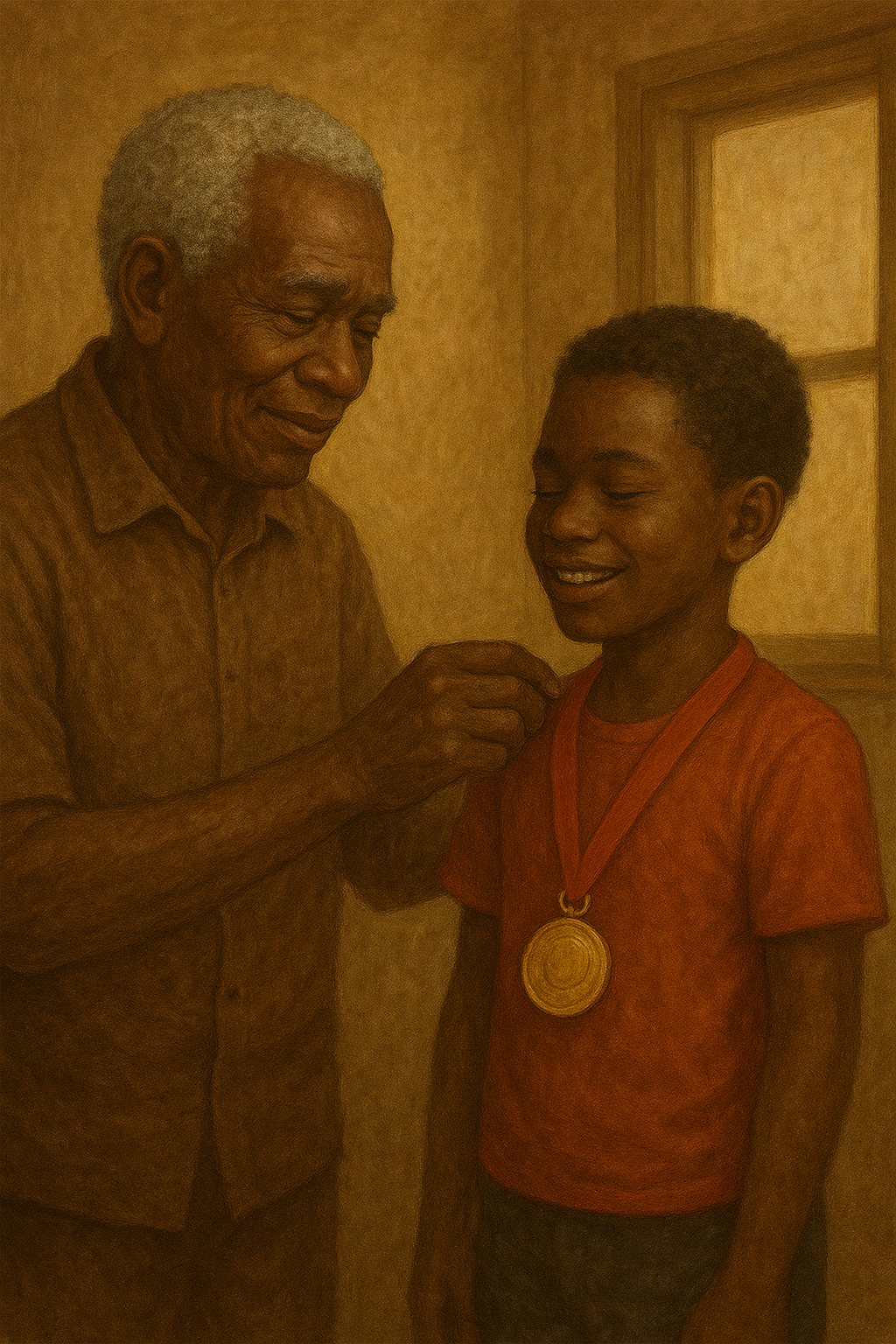
NARRATIVE STYLE
The story “A Medal from Grandpa” employs several narrative styles to effectively convey its themes and emotions.
NARRATIVE TECHNIQUES
First-Person Narrative: The protagonist’s personal account creates intimacy and immediacy, offering firsthand information.
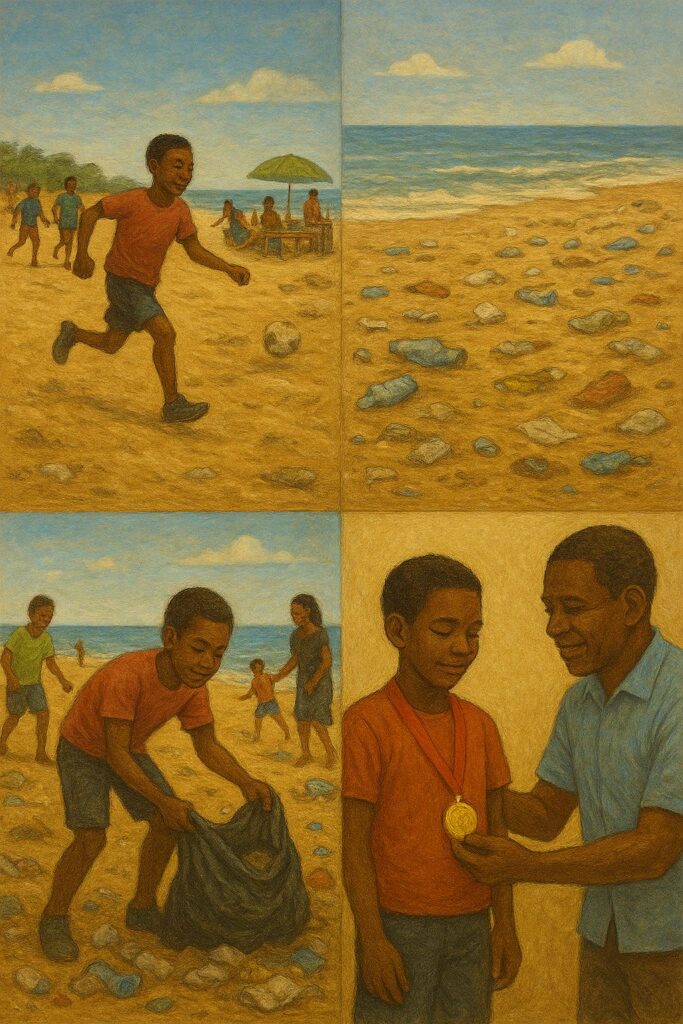
Descriptive Imagery: Vivid descriptions of the beach, trash, and surroundings engage the reader’s senses.
Reflective Tone: The protagonist’s introspection adds depth and emotional resonance, creating vivid scenes.
Summary: Some events are condensed within the narration.
Example: “Hours passed and our labour bore fruit” (p.81) — this summarizes the work done without going into details.
TONE AND ATMOSPHERE
Inspirational: Uplifting and motivational, encouraging readers to take action.
Reflective: A contemplative atmosphere fosters introspection and self-awareness.
Heartwarming: Emotional connections between characters create a sense of warmth.
NARRATIVE VOICE
Authentic: The protagonist’s voice is genuine, conveying emotions and thoughts.
Naïve: The protagonist’s innocence highlights the simplicity and strength of their initiative.
Empathetic: The narrative encourages readers to share the protagonist’s feelings.
NARRATIVE STRUCTURE
Linear Narrative: Events unfold chronologically, building momentum and tension without flashbacks.
LITERARY DEVICES
Metaphor: “The beach is a hopeful paradise” (p.73) — emphasizes its transformative potential.
Personification: Attributing human qualities to nature gives it agency.
“The sea’s peaceful face now looked stern, as if scolding me for thoughtlessness…” (p.78)
“Watching the sun dance across the waves” (p.84)
Hyperbole: Exaggeration to emphasize scale.
“There was huge traffic on the street along Titanic Beach” (p.73) — shows overcrowding.
“Over a thousand people ate and laughed together” (p.76) — conveys noise and liveliness.
Simile: Comparisons using like or as.
“…Labour Day was like watching a hopeful paradise” (p.73) — an instance of allusion to paradise.
“The swimmers shot through the water like speed jets” (p.75)
“Our beach… now shone like a beacon of hope” (p.84)
“Each wave boomed like a loud drum” (p.78)
Onomatopoeia: Sounds reinforce meaning.
“The roaring waves, clanging feet…” (p.73)
“Arms and legs pumping furiously” (p.75)
Synecdoche: Using a part to represent the whole.
“Some legs were jumping with raised hands…” (p.73) — represents whole people.
“A head broke the surface” (p.75) — represents a swimmer.
Oxymoron: Juxtaposition of opposites.
“The memory of fun was now bittersweet” (p.77) — contrasts joy and sorrow.
Litotes: Using double negatives for emphasis.
“But your efforts haven’t gone unnoticed” (p.80) — meaning they were recognized.
Repetition: Reinforces the protagonist’s emotions and highlights character development.
CREDIT TO VICTORIA KUKUA STEVENS, Dr. JEMIMA LARTELEY MENSAH,AND VERY REV. EBO EPHRAIM