


A REVIEW OF “ONCE UPON AN ELEPHANT” STAGING AT THE SCHOOL OF CREATIVE ARTS THEATRE – UNIVERSITY OF EDUCATION, WINNEBA. ON THE 4TH – 6TH JULY 2024.
SYNOPSIS OF THE PLAY
Bosede Ademilua-Afolayan’s “Once Upon an Elephant” tells the story of OLANIYONU, a man who ascends to the throne through the help of the chief priest, despite not being the rightful heir. His reign is characterized by terror and oppression as he becomes consumed by a tyrannical quest for immortality and absolute power.
As part of his rituals for achieving immortality, OLANIYONU rapes the virgin DESOLA, a heinous act that sets in motion his eventual downfall. Driven by an insatiable lust for power, wealth, and fame, OLANIYONU’S tyrannical rule becomes his undoing, leading to his untimely death.
The play explores the corrosive effects of unchecked ambition and the abuse of power, as olaniyonu’s desperate bid for immortality and dominance unravels, with devastating consequences for both himself and his subjects.
The play was directed by Faithful Emmanuel Ogidi, a final-year directing student of the Department of Theatre Arts as his final-year project as a partial fulfillment of the requirement for the award of a Bachelor’s Degree in Theatre Arts.
This review captures only the performance on the 5th of July 2024, therefore, the performance of the previous night and the night after, won’t be included. The actors’ acting, costumes, lighting, sound, makeup, sets, props, and audience participation will all be highlighted in this review.
Acting is the process of portraying a fictional character or persona in a performance, whether on stage, in film, television, or other mediums. It involves the use of various techniques and skills to bring a character to life.
The play starts with SERUBAWON, the chief priest of the town, performing an initiation ritual on OLANIYONU as the new king. The elders ODEJIMI and OGUNDELE are present, though unaware of the true purpose behind the ceremony. SERUBAWON, adorned in his priestly garments and carrying sacred objects, leads OLANIYONU through a series of intricate gestures and incantations. The atmosphere is solemn and charged with anticipation as the ritual unfolds.
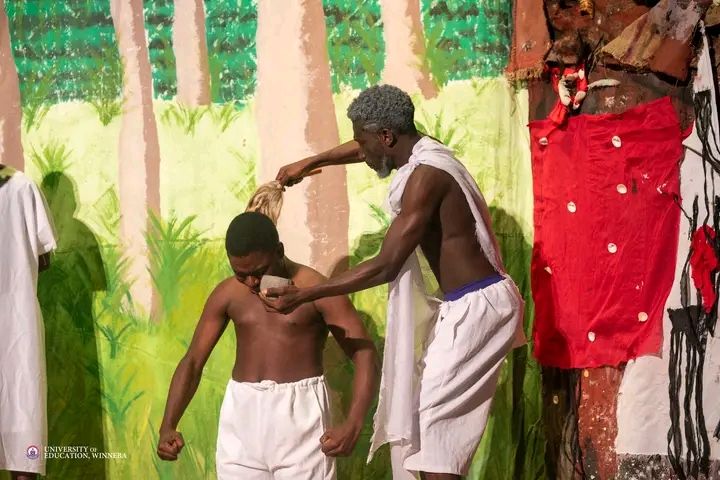
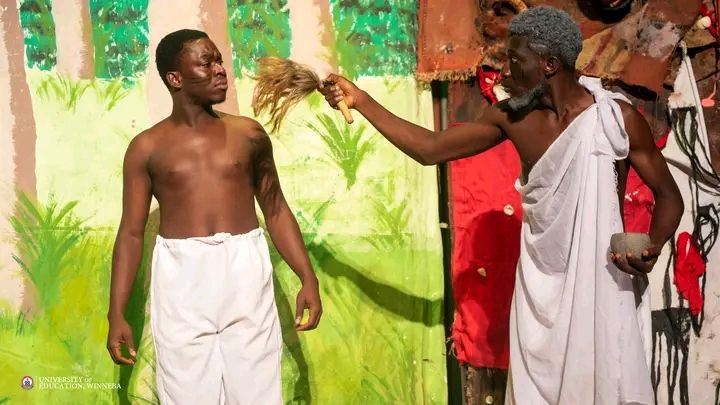
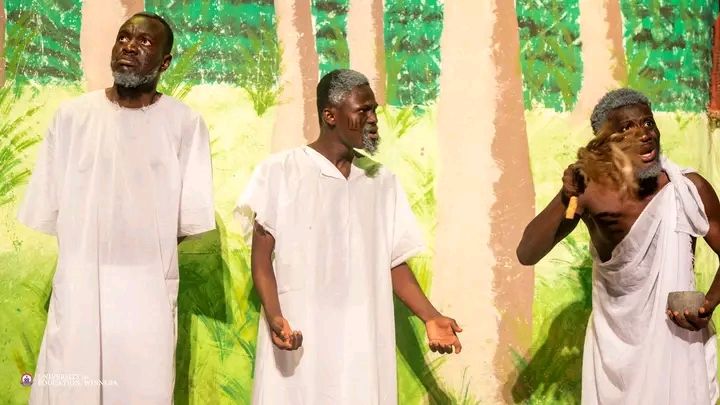
OLANIYONU, kneeling before the chief priest, listens intently to the words spoken, his expression a mix of reverence and resolve. ODEJIMI and OGUNDELE observe the proceedings, their faces betraying a sense of uncertainty, yet they remain respectful observers of the traditional rite.
As OLANIYONU departs, the air at the shrine grows thick with tension. ODEJIMI and OGUNDELE, the two seasoned elders, immediately confront SERUBAWON, the chief priest, their voices tinged with a mixture of disappointment and confusion.
The postures of the three men stooped yet commanding, and the subtle tremors in their speech betray the weight of their experience and the gravity of the situation.
Despite the tension, their familiarity with one another is appreciable, as they navigate the delicate situation with the understanding that comes from a long-standing relationship. The only problem was Ogundele tend to swallow some of his lines.
ODEKUNLE and DESOLA were the picture of a perfect couple, their chemistry was beautiful like that of true lovers. DESOLA’S startled reaction when ODENKUNLE unexpectedly tickled her from behind was well-orchestrated, capturing the playful intimacy between the two.

During the coronation ceremony, OLANIYONU’S voice boomed with power and authority with the rise and fall of his tone as he delivered his speech. His commanding presence demanded respect from his subordinates, exuding the aura of a true tyrant ruler. OLANIYONU’S words left no doubt about his firm grip on the position of Ajanaku, the community’s king.
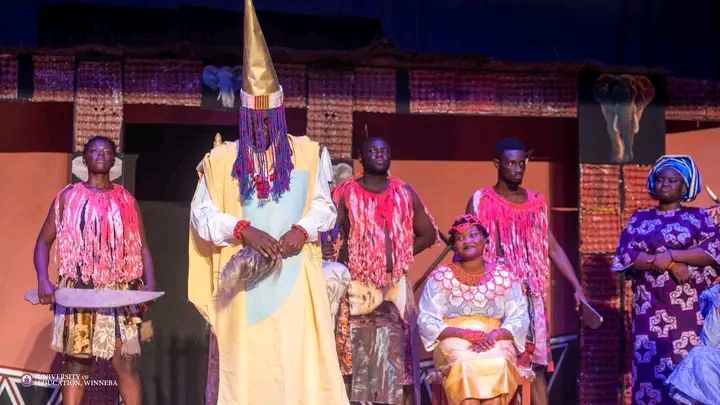
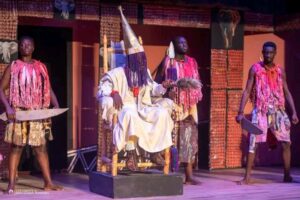
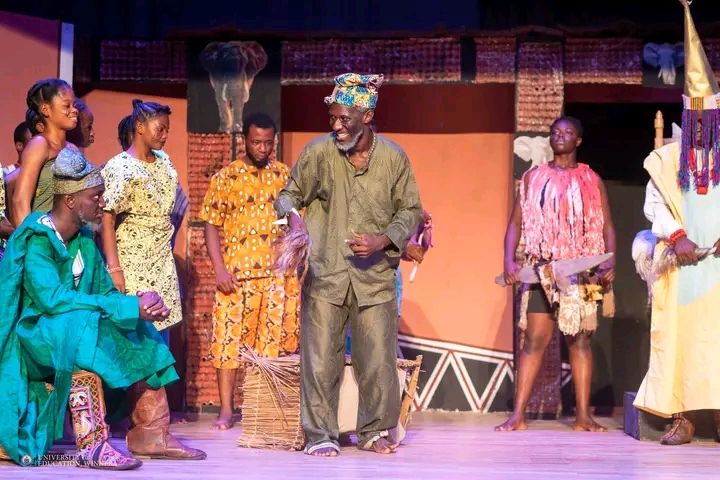
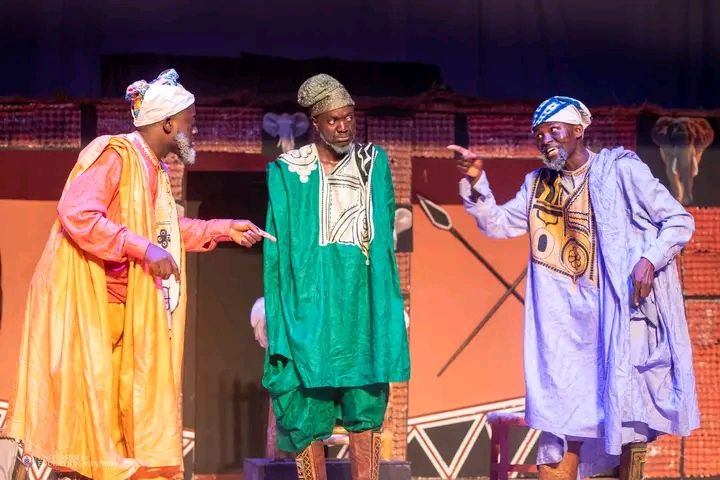
ODEGBAMI, one of the respected elders, made his entrance at the coronation ceremony. His distinct voice and mannerisms immediately conveyed his advanced age and stature. The way ODEGBAMI carried himself and spoke reflected the wisdom and gravitas befitting an elder in the community.
IYA AGBA, an elderly woman who was widely regarded as mad, made a striking entrance at the king’s palace. Despite her reputation, she exuded an unmistakable air of command and authority as she strode through the grand halls. Her movements were surprisingly spry and energetic, defying the frailty one might expect from a woman of her apparent age. The contrast between IYA AGBA‘s energetic bearing and her status as an “old woman” was puzzling to me because only her makeup made her out as an old woman, because her speech and mannerisms were that of a young woman.
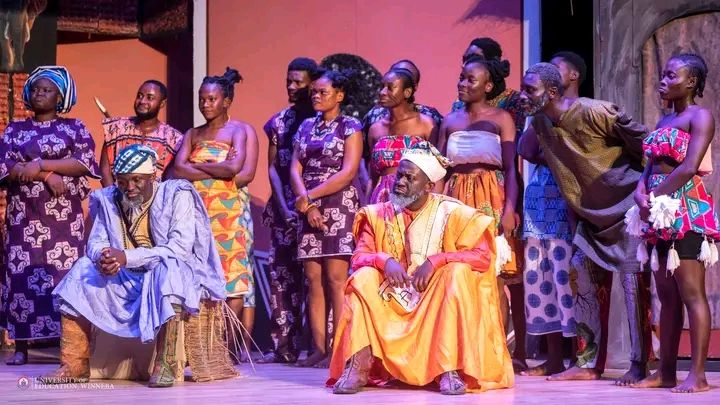
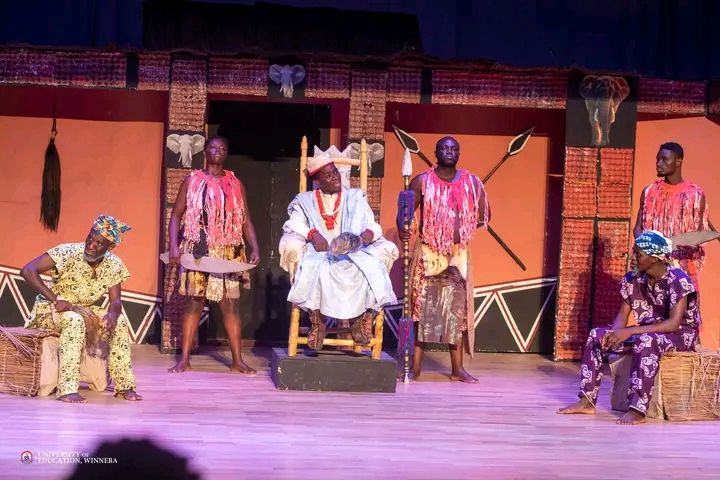
As the wife of OLANIYONU, the newly crowned AJANAKU, OMOYENI ( the queen) carried herself with an air of regal composure, her every move and gesture befitting her elevated status. OMOYENI’S convincing portrayal of a pregnant woman lent a layer of plausibility to her. The subtle swell of her abdomen and the delicate way she carried herself evoked the genuine experience of motherhood. OMOYENI’S espionage activities, as she covertly observed the king’s meetings with the chief priest Serubawon, further showcased her aptitude for stealth and information gathering.
Her being affectionate with the king yet having a secret affair with her lover, displayed her remarkable cunning skill.
IYALE, the wife of ODEJIMI and the mother of ODEKUNLE, IYALE firmly established her position as the embodiment of a dutiful and caring spouse. When her husband fell uncharacteristically silent, IYALE approached him with genuine concern, offering affectionate advice in a manner befitting a loving wife.

In addition to her attentive care for her husband ODEJIMI, IYALE also demonstrated her compassion and resourcefulness when DESOLA fell ill. Recognizing the urgency of the situation, IYALE approached the seemingly reluctant IYA AGBA, pleading with a voice of unwavering conviction for the elderly woman’s assistance. Her ability to persuade the initially unwilling IYA AGBA emphasized her skill in dealing with people.
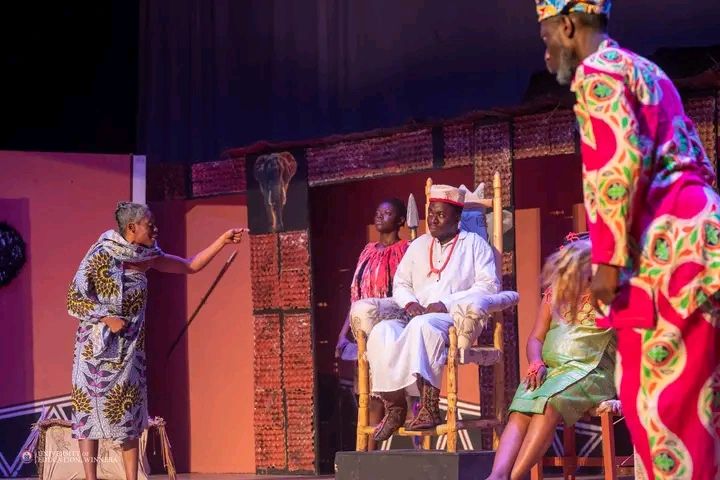
DEMOKE, wife of the chief priest SERUBAWON and the mother of the young DESOLA, DEMOKE exhibited the profound distress of a parent confronted with her child’s anguish. Returning home with her basket in hand, DEMOKE was immediately struck by the sight of her daughter’s tearful countenance, her maternal instincts erupting in a wave of concern.
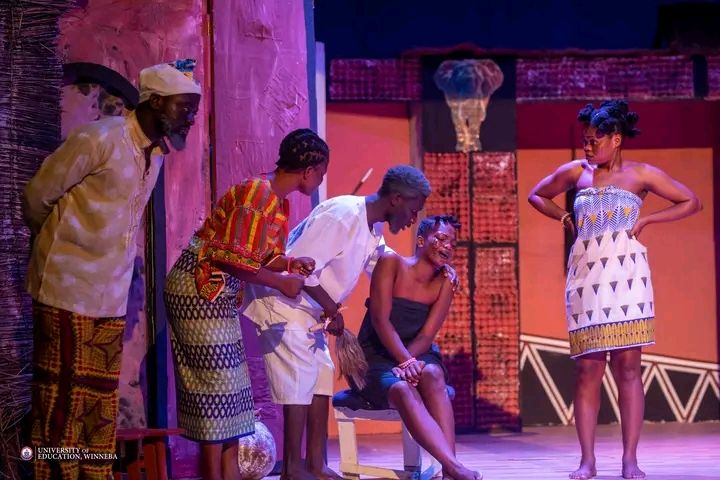
Driven by an innate need to comfort and understand her only child’s sorrow, DEMOKE set down her belongings and approached DESOLA, engaging her in a tender dialogue. The gentle yet persistent manner in which she coaxed her daughter to open up demonstrated DEMOKE’s deep reservoir of empathy as a caring mother.
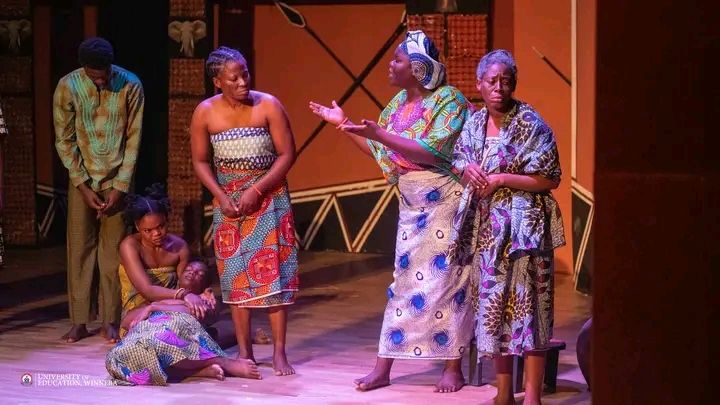
When ODEKUNLE faced the trials surrounding his beloved DESOLA, his longtime companions YERE, LERE, and DELE initially reacted with a measure of mockery, chiding their friend for not defending his loved one with sufficient conviction.
However, this initial reaction soon gave way to a profound display of loyalty and camaraderie. Upon learning that the powerful AJANAKU was the driving force behind DESOLA’S plight, the trio of friends swiftly shifted their stance, rallying together to devise a plan of action to confront the unjust ruler. Their willingness to stand by ODEKUNLE, even in the face of a formidable adversary, signaled the depth of their friendship and the bonds that united them. Among these friends, LERE was not clear in the delivery of his dialogue so it was hard hearing him.
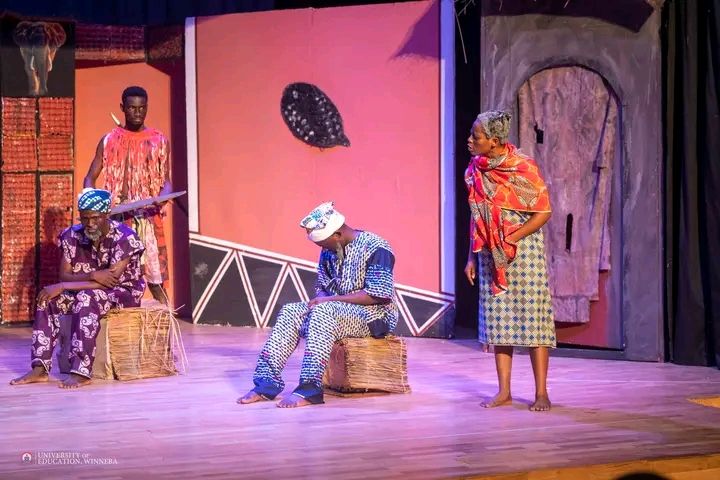
YOSOLA proved to be a true confidante, one who understood the importance of providing a comforting presence in times of turmoil. Rather than offering empty platitudes, she gently coaxed DESOLA to open up to her when she went to her house and found her in tears.
DELANI built a bond with his lover OMOYENI which compelled him to defend her from her brother who attempted hitting her when the truth about her pregnancy came to bare. This act of courage and chivalry on DELANI‘s part not only safeguarded OMOYENI from harm but also conveyed the depth of his character.
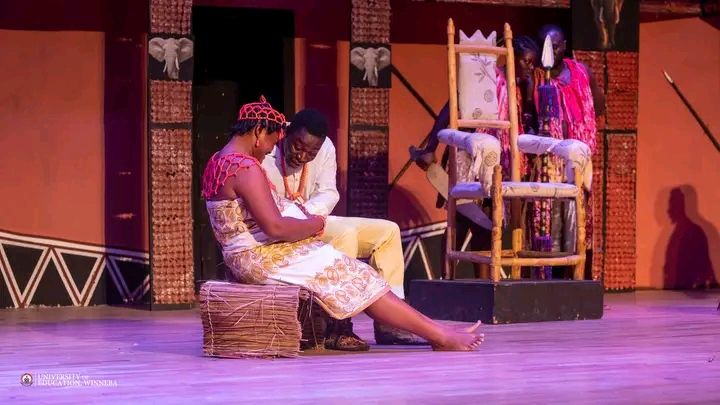
WOMAN I and WOMAN II was a pleasure to watch as they exchanged words with MAN in the palace claiming ownership of a piece of land. They really exhibited the character of women in today’s world as they disrespectfully shut everyone who tried to interrupt them without being on their side except the king.
MAN did exceptionally well with his characterization as an old man seemingly weathered by the passage of time, commanded the attention of all present through his dignified bearing and the resonance of his voice. His very presence exuded respect befitting his status as an elderly person.
MAN I and MAN II engaged in a heated exchange over help with the king since they pay tribute to him and hence felt entitled to be helped when the need arises. Man I’s voice lacked the necessary clarity and projection, rendering his words indistinct and difficult for the audience to discern. Despite the gravity of the proceedings, his muted tone and mumbled articulation failed to command the attention of those present, leaving his arguments shrouded in ambiguity. Also, the way he died after stabbing himself was too mechanical.
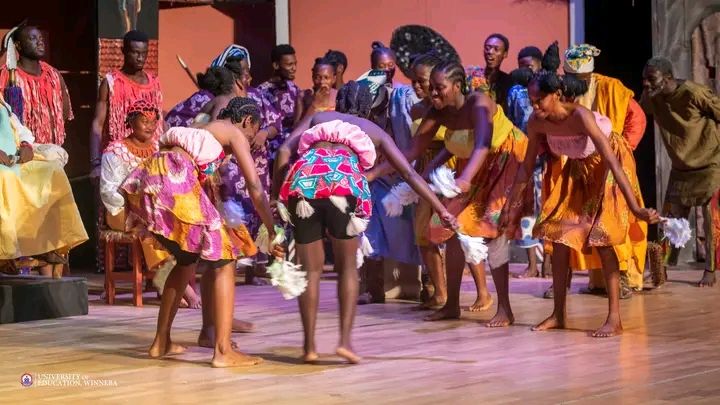
DANCERS
The coronation scene featured a troupe of enthusiastic community maidens, who danced energetically to celebrate the crowning of AJANAKU. Their vibrant performance added a genuine, communal feel to the ceremonial proceedings.
DRUMMERS
A group of young community drummers provided the rhythmic accompaniment during AJANAKU‘s coronation ceremony. These skilled musicians appeared completely engrossed in their performance, their energetic drumming infusing the scene with a palpable sense of joy and celebration.
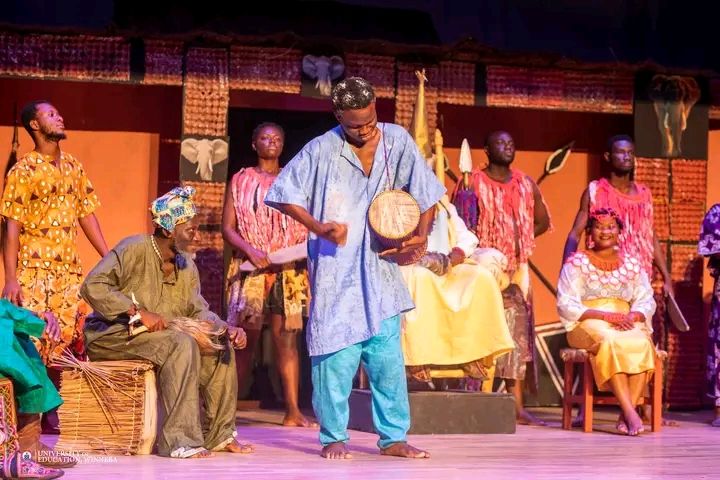
TOWNSPEOPLE
The coronation and festival scenes featured a lively ensemble of townspeople, the very community that AJANAKU was set to rule. These local residents reacted with appropriate enthusiasm and reverence, their vocal and physical responses helping to establish a tangible sense of context and originality.
COSTUMES
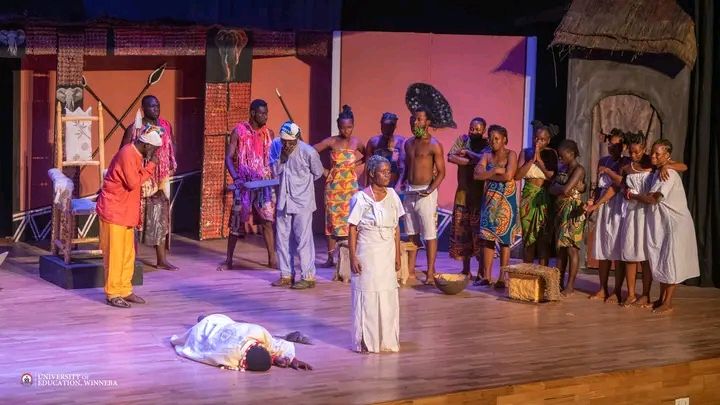
Costumes are garments and accessories worn to represent a specific character, historical figure or theme. Though the play was published in 2014, the costumes worn by the characters evoked an earlier era, transporting the audience to a bygone age. This deliberate artistic choice by the director allowed the production to be firmly grounded in the past.
The regal attire of the king and elders, for instance, immediately signaled to the audience that the play was set in the northern regions of Nigeria. The ornate robes, intricate embroidery, and traditional headpieces worn by these authority figures harked back to a time-honored sartorial tradition, lending an air of gravitas and cultural specificity to the proceedings.
These meticulously crafted costumes served as visual cues, guiding the audience’s understanding of the historical context in which the events of the play were unfolding. The rich fabrics, bold colors, and distinctive silhouettes evoked a bygone era. Though the colors of some of the headpieces did not complement the colors of garments worn. The women with their tied clothes around their body also added a traditional feel to the production.

LIGHTING
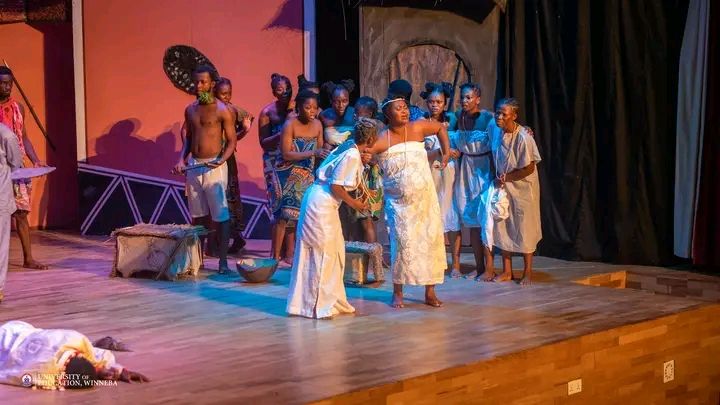
The lighting design was an integral component of the production, expertly setting the mood and atmosphere for the performance. The strategic use of light helped to heighten the mood of key moments of the production. The lighting crew did well aside coming on a few times when the stage hands were still setting up the stage.
SOUND
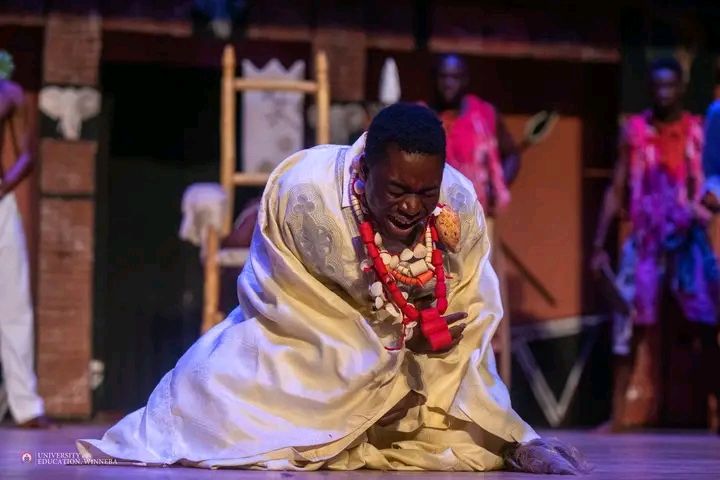
The sound design including the musical score and sound effects, was integrated, enhancing the emotional impact of the performance. The audience were enveloped in the world of the play, with the auditory elements heightening the sense of atmosphere and place. My only challenge is with the last scene where OMOYENI gets into labor, we hear the sound of the baby too early. It could have been delayed to ensure believability.
MAKEUP
The makeup crew tried by transforming individuals into various characters solidifying their authenticity. The beautiful marks on the cheeks of the community members as a symbol of belongingness and the local braids on the women was great. The only problem is some of the men looked funny with the way the whitish substance used to transform them into old men were applied. For instance, In the opening scene, OGUNDELE’s hairstyle featured a striking contrast, with gray hair at the front and black hair at the back. This contrast in hair coloration created a striking, almost zebra-like pattern. Also, they could have made DEMOKE up to signal her advance in age, because she looked just as fresh-faced as her daughter undermining the visual cues of her seniority.

SET
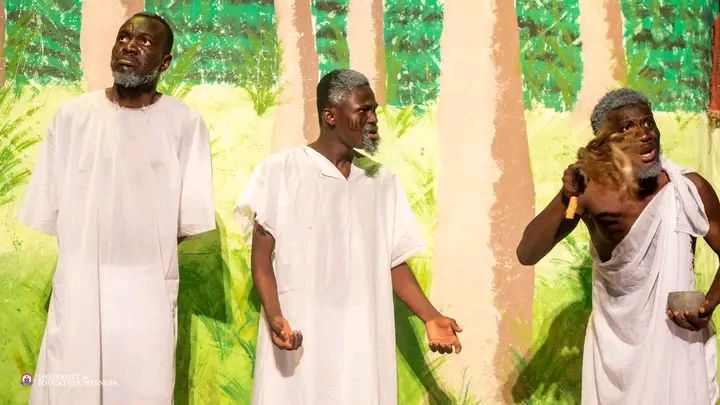
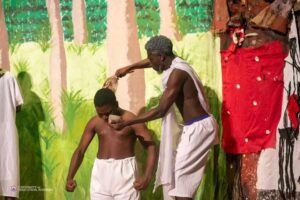
The elaborate set design for the production was the work of Nafisa Mohammed, a technical theatre student as her final year project. Her meticulously crafted scenic elements helped transport the audience to the world of the play, showcasing her emerging talent and technical expertise. The set was both visually striking and functionally effective, creating a versatile and believable backdrop for the unfolding events of the production.
PROPS
The props team played a vital role in the production, carefully selecting and sourcing a variety of realistic, period-appropriate items to be used throughout the performance. These carefully curated props added an extra layer of immersion, enhancing the production’s sense of authenticity.
AUDIENCE
The audience were actively engaged throughout the production, responding enthusiastically to the rhetorical questions posed by the actors. They expressed their excitement and appreciation by clapping and laughing at appropriate moments, fully immersing themselves in the live theatrical experience.
In Conclusion, the production was an unmitigated success, the result of the cast and crew working collaboratively to deliver a truly beautiful and engaging show for the audience. Bravo to the director and thumbs up to all cast and crew. An active audience and critic, I rate this production 8/10. It started at 7:22 pm instead of 7:00 pm.


Written by Abigail Nyamekye Clement (B A Theatre Arts,UEW)
From your detailed Reviewers (+233272138148)