

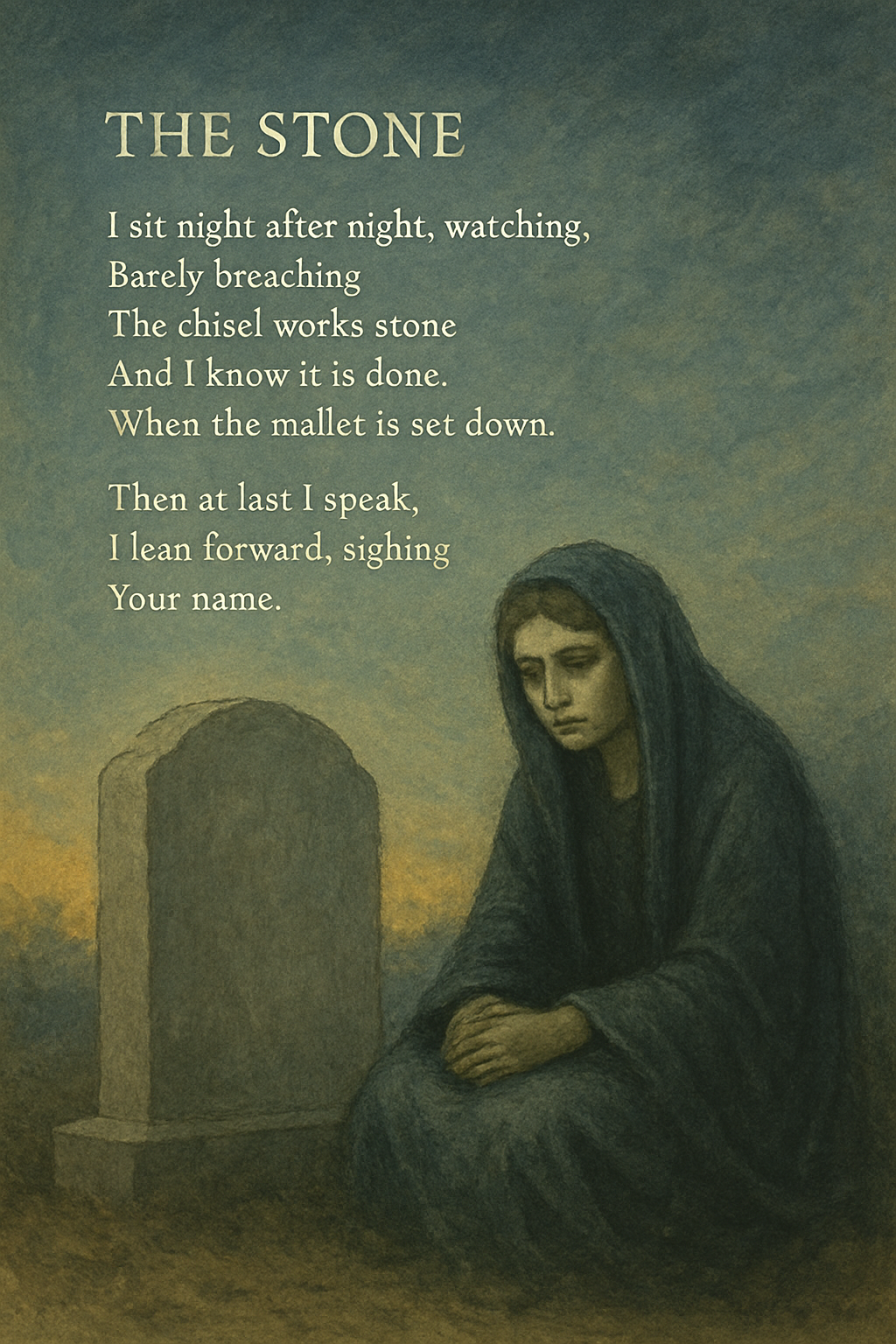
THE POEM
The Stone By Wilfrid Wilson Gibson
“And will you cut a stone for him,
To set above his head?
And will you cut a stone for him—
A stone for him?” she said.
Three days before, a splintered rock
Had struck her lover dead—
Had struck him in the quarry dead,
Where, careless of a warning call,
He loitered, while the shot was fired—
A lively stripling, brave and tall,
And sure of all his heart desired . . .
A flash, a shock,
A rumbling fall . . .
And, broken ‘neath the broken rock,
A lifeless heap, with face of clay,
And still as any stone he lay,
With eyes that saw the end of all.
I went to break the news to her:
And I could hear my own heart beat
With dread of what my lips might say;
But some poor fool had sped before;
And, flinging wide her father’s door,
Had blurted out the news to her,
Had struck her lover dead for her,
52
Had struck the girl’s heart dead in her,
Had struck life, lifeless, at a word,
And dropped it at her feet:
Then hurried on his witless way,
Scarce knowing she had heard.
And when I came, she stood alone—
A woman, turned to stone:
And, though no word at all she said,
I knew that all was known.
Because her heart was dead,
She did not sigh nor moan.
His mother wept:
She could not weep.
Her lover slept:
She could not sleep.
Three days, three nights,
She did not stir:
Three days, three nights,
Were one to her,
Who never closed her eyes
From sunset to sunrise,
From dawn to evenfall—
Her tearless, staring eyes,
That, seeing naught, saw all.
The fourth night when I came from work,
I found her at my door.
“And will you cut a stone for him?”
She said: and spoke no more:
But followed me, as I went in,
And sank upon a chair;
And fixed her grey eyes on my face,
With still, unseeing stare.
And, as she waited patiently,
I could not bear to feel
Those still, grey eyes that followed me,
Those eyes that plucked the heart from me,
Those eyes that sucked the breath from me
And curdled the warm blood in me,
Those eyes that cut me to the bone,
And cut my marrow like cold steel.
And so I rose and sought a stone;
And cut it smooth and square:
And, as I worked, she sat and watched,
Beside me, in her chair.
Night after night, by candlelight,
I cut her lover’s name:
Night after night, so still and white,
And like a ghost she came;
And sat beside me, in her chair,
And watched with eyes aflame.
She eyed each stroke,
And hardly stirred:
she never spoke
A single word:
And not a sound or murmur broke
The quiet, save the mallet stroke.
With still eyes ever on my hands,
With eyes that seemed to burn my hands,
My wincing, overwearied hands,
She watched, with bloodless lips apart,
And silent, indrawn breath:
And every stroke my chisel cut,
Death cut still deeper in her heart:
The two of us were chiselling,
Together, I and Death.
And when at length my job was done,
And I had laid the mallet by,
As if, at last, her peace were won,
She breathed his name, and, with a sigh,
Passed slowly through the open door:
And never crossed my threshold more.
Next night I laboured late, alone,
To cut her name upon the stone.
Inspiration and Background
“The Stone” is a poem of lament and grief. It tells the story of a young woman whose lover is killed in a quarry accident. The poem is written in a spare, understated style, but its imagery is stark and powerful. The speaker, a stonemason, is asked by the woman to carve a tombstone for her lover. As he works, he is haunted by the woman’s grief. Her eyes, which he describes as “grey” and “tearless,” seem to follow him everywhere. The poem ends with the woman returning to the stonemason’s workshop to see the completed tombstone. She breathes her lover’s name and sighs before leaving, never to return. The poem is similar in tone and theme to other works by Gibson, such as Flannan Isle and The Ice-Cart. It is also a product of its time, reflecting the harsh realities of working-class life in the early 20th century.
SUBJECT MATTER
“The Stone deals with an extreme emotional breakdown of a young woman who had lost her lover in a tragic incident while he was at work, at a quarry. This is a very telling poem of love and its depth to which most of us barely scratch its surface. Most often, people use the word “love” so lightly nowadays and toss it about so carelessly that its actual concept is loss. The love she had for her lover was bottomless/infinite. She could not see her life without him in it. The young woman having received the message as she did was in COMPLETE SHOCK! She seemed to be in shock throughout the poem. Sitting night after night, watching, barely breathing as her lover’s name was being carved in his grave stone. Perhaps, waiting to exhale (so to speak) finally, once it was completed and the mallet had been set down, she sighed her final sigh and gained enough strength to finally utter her lover’s name. It was over for her. Life, as she knew it. Living, for her was futile. This fate of life takes several turns. Everything seems to be good until some obstacle just pops out of nowhere. After having a tremendous loss, it left the women lifeless and made her devoid of any expression. The love which once kept her alive turned out to be the reason for her restlessness. She had decided that it was indeed time she leaves this place of uncalled tragedies of parched lives. This, made her witless which made it seem to have no difference of the days after. She couldn’t take a sign of relief until the tombstone was completed. The chill of her hounded grey eyes was finally at peace alongside her lover’s tombstone.
STANZA ANALYSIS
“The Stone” is a poem of lamentation that talks about a young woman whose lover died in a stone quarry. She was stunned by the shocking news of her lover’s death. She is a picture of deep sorrow. The poem has an abrupt opening. In the first stanza, it starts when the conversation is going on between two people. The woman goes to the poet and asks him to cut a stone, to set up on the grave of her dead lover in the opening lines. In the second stanza, it is stated that three days before, a huge rock had struck her lover in a stone quarry. In spite of giving warning and shot fired, he was loitering and full of spirit. Suddenly, a rock fell and he was found under the rock. When he saw the rock, his eyes saw his end. This was an unfortunate thing that he had no control of. In the third and fourth stanza, the poet saw this and he wanted to break this news to his lover. He was afraid and very careful in his words. But before he could utter a word, he saw she was standing like a stone because some poor fellow had already told the news. The fellow wide opened the door and told the news of her lover’s death without knowing the consequence and left the woman lifeless. In the fifth stanza, the poet can guess what would have happened by looking at the woman’s face. The woman stood like a stone; her heart was dead. She didn’t cry nor moan. The boy’s mother was weeping but she didn’t for three days and three nights. She did not stir. She never closed her eyes, from sunset to sunrise. She didn’t cry but her eyes saw everything. In the sixth stanza, the fourth day appears and when the poet came from work, he saw the woman waiting for him at his door and said “And will you cut a stone for him?” and spoke nothing but followed the poet. When the poet sat in the chair, she was just staring at his face. She was waiting patiently. The poet saw her gray eyes which were staring at him and he felt as if the eyes were plucking his heart and sucking the breath from him. The seventh stanza reveals that the poet could not wait any more so he stood and started to cut the stone in a square. As the poet was working, she sat beside him watching everything day & night. When he was cutting the name of her lover, she was watching each stroke but didn’t utter a single word. The stroke broke her silence. Her eyes didn’t move from my hands. Stanza eight and nine gives the description of how she was watching the poet with bloodless lips. Every cut of the chisel gave a deeper cut to her heart. It looked as if death was killing her inside. When the poet finished his work, she breathed his name and with a sigh passed through the open door and never came again. The last stanzas, ten and eleven, indicate that the next night, the poet was working late because he was cutting her name on the stone. She dies in honor of love. Thus, the woman represents the picture of silence and sorrow, it also shows how she was in love with her lover that she could not bear the sorrow of his death and so died after cutting his stone.
THEMES IN THE POEM
- The theme of Immortal love
- The theme of Loss
- The theme of Unforseen Occurrences
- The theme of Grief
Credit to H.K OCRAN/ LiTTROVE