

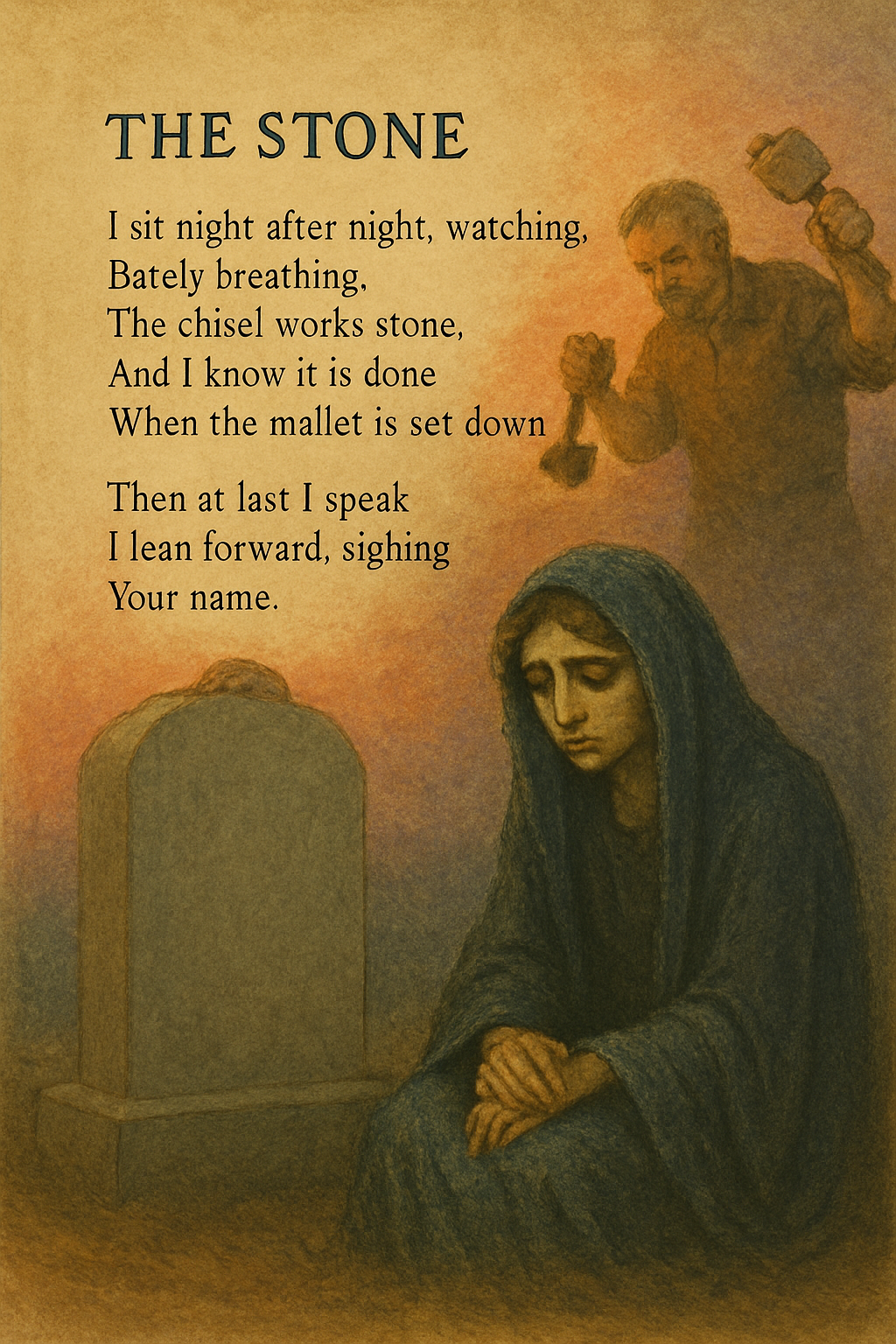
STRUCTURE OF THE POEM
The poem is lyrical, with 11 stanzas and 97 lines with irregular rhyme patterns. It has both internal and terminal rhymes with layers of Anaphora that create the effect of not just emphasis, but tension as they are generated in the poem. It is both of the descriptive and narrative forms. The enjambed lines underscore the fluidity of emotions with which the speakers speak, especially, the bereaved. Again, the poem is in a dialogue form and captures the conversational moment of the poet and the bereaved. The poem is also written in the first-person omniscient point of view and details the experience of the speaker with the bereaved. It also 55 56 employs the “In media res” narrative style, as the lines seem to begin from the middle of event instead of the beginning.
POETIC DEVICES IN THE POEM
1. Metre (Lines 1, 2, 3)
Lines:”And will you cut a stone for him,
To set above his head?
And will you cut a stone for him—”
The metre here is iambic tetrameter, meaning each line contains four iambs (an unstressed syllable followed by a stressed one).
Example:
And WILL you CUT a STONE for HIM (four beats).
This metre contributes to the rhythmic and solemn tone, echoing funeral chants and emphasizing mourning.
2. Rhetorical Question (Lines 2, 4)
Lines:”To set above his head?
A stone for him?” she said.
These rhetorical questions are not asked to receive answers but to express grief and disbelief. The repetition underlines the speaker’s emotional numbness and fixation on memorializing the deceased.
3. Symbolism – “Stone”
The stone symbolizes death, finality, and grief. It’s both the literal cause of death (falling stone in the quarry) and the medium of memory (gravestone). It also symbolizes emotional numbness, as both the woman and her emotions are described as “stone-like”.
4. Metaphor (Line 97 and others)
Line 97:”The two of us were chiselling,
Together, I and Death.”
This is a metaphor comparing the speaker’s carving of the gravestone to Death working alongside him, emphasizing how each strike of the chisel deepens the woman’s mourning. It shows that death’s presence is lingering, not just physical but emotional and spiritual.
“A woman, turned to stone” (Line 39) – equating emotional shock to literal petrification.
5. Anaphora (Lines 6 & 7, 12 & 13)
Lines 6 & 7:”Had struck her lover dead—
Had struck him in the quarry dead,”
Lines 12 & 13:”And still as any stone he lay,
With eyes that saw the end of all.”
Anaphora is the repetition of a word or phrase at the beginning of successive lines. In lines 6–7, “Had struck” repeats to emphasize the shock and repetition of the fatal blow.
Lines 12–13, while not strict anaphora, use parallel structure to stress the motionlessness of death.
6. Assonance (Line 25 and others)
Line 25:”She could not weep.”
Assonance is the repetition of vowel sounds—in this case, the long “ee” sound in “weep”, which is echoed in other words like “sleep” (line 27), creating a mournful, echoing tone that reflects sorrow and emotional stasis.
7. Personification (Lines 15 and 89)
Line 15:”And still as any stone he lay,”
Line 89:”Death cut still deeper in her heart:”
In Line 15, the stone is indirectly personified, equated with the lifeless body that lies still.
In Line 89, Death is personified as an active partner, “cutting” into the woman’s heart as the narrator carves the stone, intensifying the emotional trauma.
8.Transferred Epithet (Line 15)
Line 15:”And still as any stone he lay,”
“Still” typically describes motionlessness, but it’s used here as an epithet for the stone, transferring the emotion of death to the object, emphasizing his lifelessness.
9. Simile
Line:”And like a ghost she came;”
This simile compares the woman to a ghost, indicating her emotional detachment, pale appearance, and silent, haunting presence—as though she, too, is among the dead.
10. Alliteration (“her heart…”)
Line:”Had struck the girl’s heart dead in her,”
Alliteration of “h” in “her heart” (and possibly in “had”, “heart”, “her”) creates a harsh, breathy sound, mimicking a gasp or cry, and emphasizing the emotional death she suffers.
11. Polysyndeton
Line:”And so I rose and sought a stone;”
Polysyndeton is the deliberate use of multiple conjunctions (“and”) to slow the rhythm and convey emotional weight or reluctant determination, reflecting the speaker’s burden in carrying out this symbolic task.
12. Rhyme (Internal and External)
External rhyme: Occurs at the end of lines. Examples:
“And will you cut a stone for him,
To set above his head?”
“And will you cut a stone for him—
A stone for him?” she said.
(“him” and “him” = repetition rhyme)
Internal rhyme: Found within lines. Example:
“A flash, a shock,
A rumbling fall…”
(shock/fall = near rhyme with strong rhythm)
The rhyme, both full and slant, supports the somber, lyrical quality of the poem, echoing the repetitive nature of grief.
MOOD/TONE
The tone of the poem is conversational and revealing. It reveals sorrow and heartbreak. The mood and tone are tragic and regretful – a lamentation. Again, the poem presents a mood that is sorrowful and reflective as well.
LANGUAGE AND DICTION
The language is formal and lyrical, with a focus on descriptive imagery and symbolic expression. The diction is precise and evocative, contributing to the poem’s haunting and introspective atmosphere. The language is as well metaphoric. For example, “stroke”, “chisel cut” that is compared to “death’s” power creates a striking image of mortality.
Credit to H.K OCRAN/ LiTTROVE