

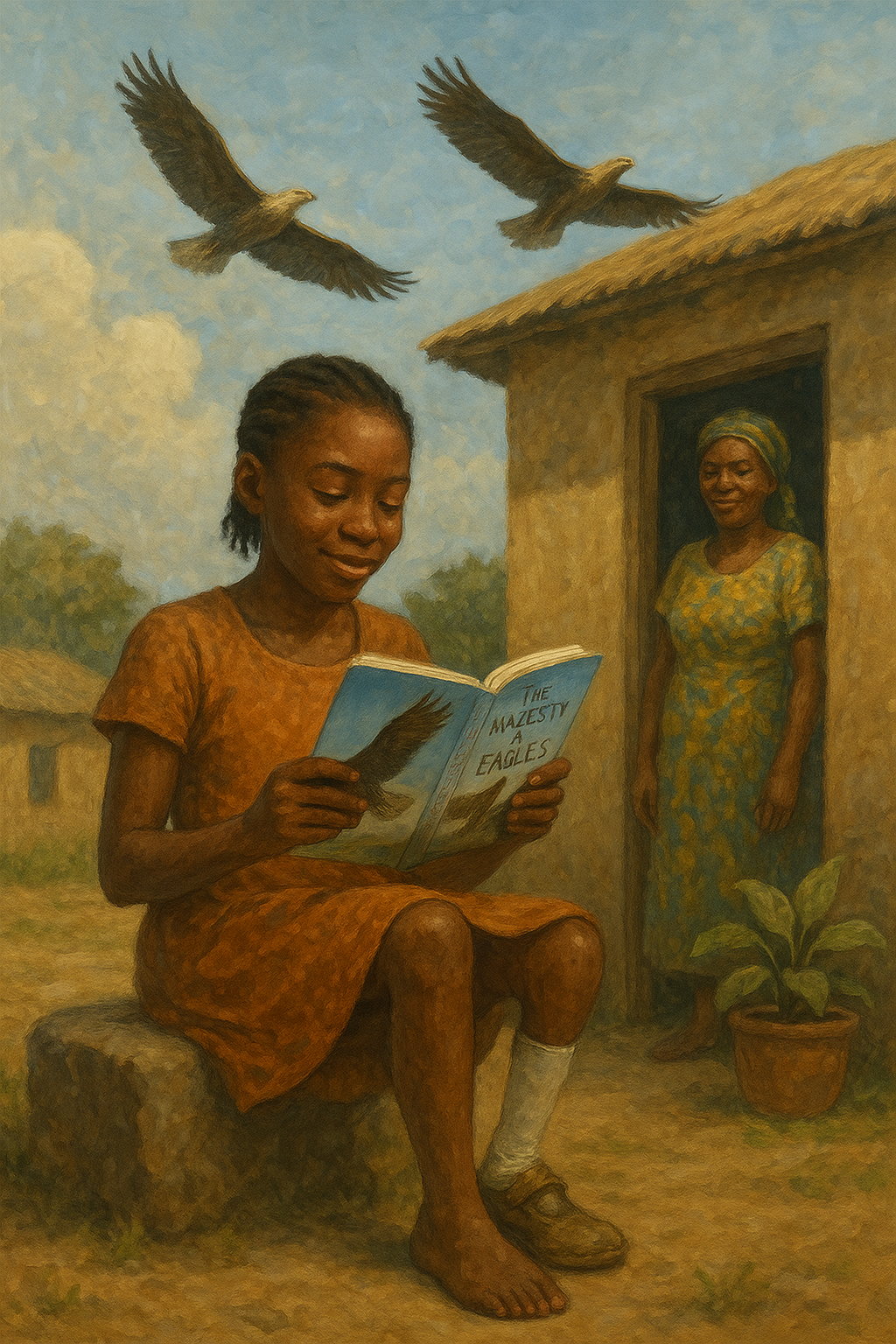
SETTING ANALYSIS
Primary Settings
Maame Tutuwa’s Home
Cozy and nurturing atmosphere.
Warm relationships with Auntie Ama and her father. It has a Cultural significance: Ghanaian traditions, food, and clothing.
Symbolizes comfort, security, and identity.
School – Classroom: Site of Maame Tutuwa’s transformation and growth.
Math Class: Specific setting for her academic triumph.
Corridors and Library: Represent expansion, exploration, and discovery.
Symbolizes personal growth, challenge, and self-discovery.
Additional Settings
Bookstore: Where Maame Tutuwa meets Akua and discovers the eagle book.
Outdoor Environments: Implied through eagle imagery and Maame Tutuwa’s outdoor observations.
Cultural Elements: Ghanaian culture and traditions woven throughout, reflecting the country’s vibrant atmosphere and daily life.
Cultural Significance
Authentic representation of Ghanaian experiences and environments.
Use of food, clothing, and social interactions to root the story in its cultural setting.
Impact of Setting on the Story
Settings shape Maame Tutuwa’s character development and growth.
Influence her relationships and interactions with others.
Provide context for her transformation and self-discovery.
Enhance the story’s themes and symbolism.
Narrative Techniques in the story
Flashbacks: Although the story has a linear plot , some references were made to Maame Tutuwa’s past struggles.
Foreshadowing: Eagle imagery hints at her future empowerment.
Symbolism: Eagles represent freedom, strength, patience, and focus.
Imagery: Vivid descriptions of settings, emotions, and experiences.
Pacing
Gradual build-up: Growth and confidence develop steadily.
Climax: Solving the math problem marks a turning point.
Resolution: Reflection and newfound confidence.
Point of View
Third-person limited — focused on Maame Tutuwa’s thoughts and emotions.
Intimate narrative allows readers to experience her inner world.
Tone
Reflective — contemplative and introspective.
Hopeful — uplifting and inspiring.
Warm — nurturing and supportive.
Literary Devices
- Imagery
“The warm glow of the lanterns” — creates a cozy atmosphere.
“The aroma of steaming jollof rice and grilled chicken” — evokes sensory experience.
“The eagle’s wings beating effortlessly” — symbolizes freedom and strength.
Symbolism
Eagles: Freedom, strength, patience, and focus (e.g. “Her struggles had been like the eagle’s patient hunt”).
Flying: Empowerment and rising above challenges (e.g., “Her triumph, like the eagle’s soaring flight”).
Metaphor
“…her radiant smile dispelling the evening’s gloom” — compares her smile to a bright light.- Simile: The title of the story ” fly like an eagle ” employs a simile.
Also, “Many thoughts swirled in her mind like a flooded river” — compares her overwhelming thoughts to a flood. Again,
“Loneliness wrapped around her like a dark cloud” — compares her emotion to a physical sensation. Finally, “Isn’t the eagle just as free as the birds in the flock?” — compares the eagle’s freedom to other birds.
Personification
“Maame Tutuwa’s stomach growled in anticipation” — stomach given a human trait.
“Maame Tutuwa’s hand shot up by itself” — hand given independent action.
“The sky no longer seemed to be mocking…” — the sky is given a human attitude.
“The words danced across the pages” — words given human action(dancing).
Repetition
Eagle imagery and symbolism used throughout to emphasize her growth and transformation.
Hyperbole
“The book transported her to vast savannas, rugged mountains, and serene forests” — exaggerates the immersive reading experience.
CREDIT TO VICTORIA KUKUA STEVENS, Dr. JEMIMA LARTELEY MENSAH,AND VERY REV. EBO EPHRAIM
Contact +233272138148/0542983304 for bulk purchase of the Beacon of Light and commentary . A copy is selling at GHC 65