

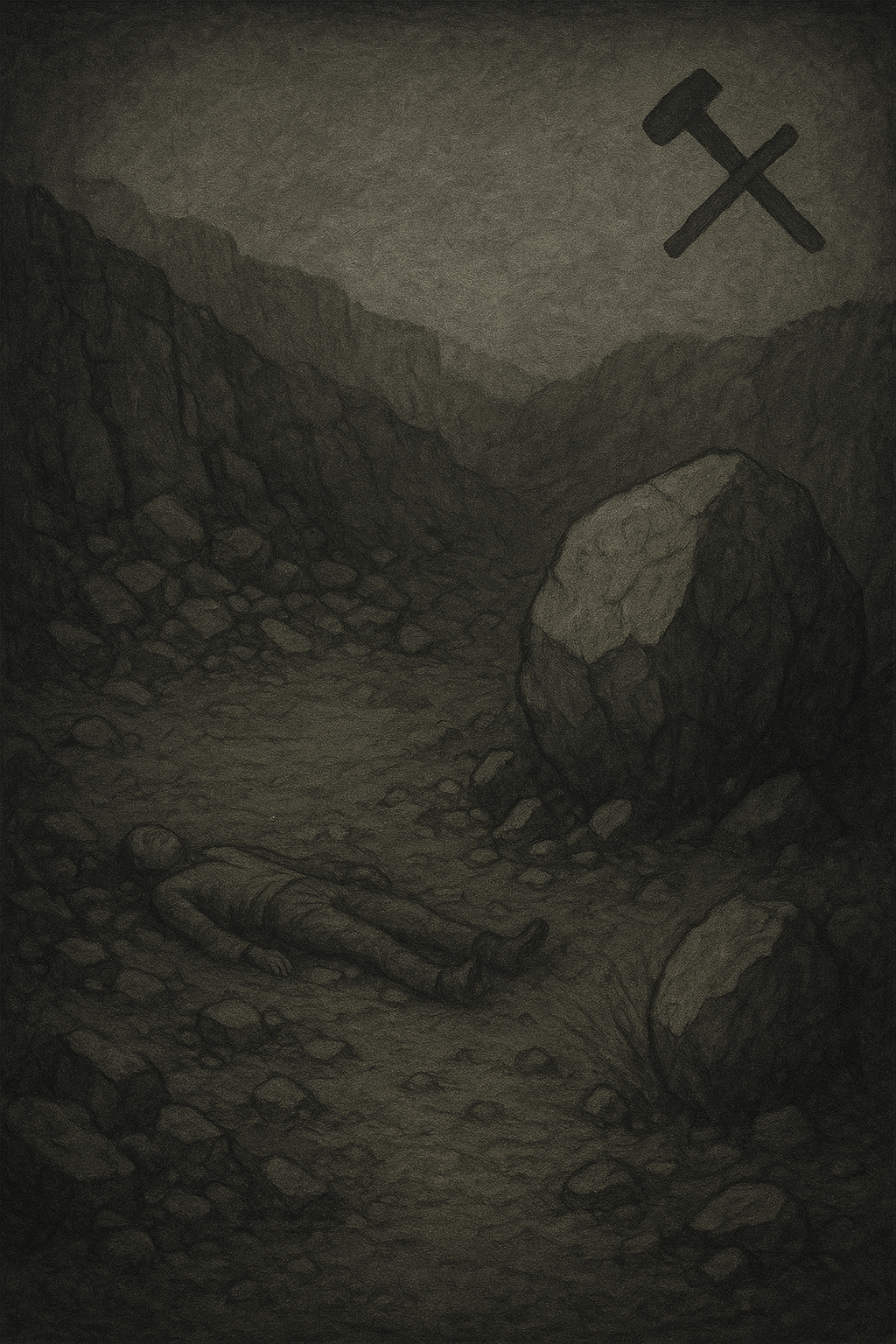
“The Stone” By Wilfrid Wilson Gibson
And will you cut a stone for him,
To set above his head?
And will you cut a stone for him—
A stone for him?” she said.
Three days before, a splintered rock
Had struck her lover dead—
Had struck him in the quarry dead,
Where, careless of a warning call,
He loitered, while the shot was fired—
A lively stripling, brave and tall,
And sure of all his heart desired . . .
A flash, a shock,
A rumbling fall . . .
And, broken ‘neath the broken rock,
A lifeless heap, with face of clay,
And still as any stone he lay,
With eyes that saw the end of all.
I went to break the news to her:
And I could hear my own heart beat
With dread of what my lips might say;
But some poor fool had sped before;
And, flinging wide her father’s door,
Had blurted out the news to her,
Had struck her lover dead for her,
52
Had struck the girl’s heart dead in her,
Had struck life, lifeless, at a word,
And dropped it at her feet:
Then hurried on his witless way,
Scarce knowing she had heard.
And when I came, she stood alone—
A woman, turned to stone:
And, though no word at all she said,
I knew that all was known.
Because her heart was dead,
She did not sigh nor moan.
His mother wept:
She could not weep.
Her lover slept:
She could not sleep.
Three days, three nights,
She did not stir:
Three days, three nights,
Were one to her,
Who never closed her eyes
From sunset to sunrise,
From dawn to evenfall—
Her tearless, staring eyes,
That, seeing naught, saw all.
The fourth night when I came from work,
I found her at my door.
“And will you cut a stone for him?”
She said: and spoke no more:
But followed me, as I went in,
And sank upon a chair;
And fixed her grey eyes on my face,
With still, unseeing stare.
And, as she waited patiently,
I could not bear to feel
Those still, grey eyes that followed me,
Those eyes that plucked the heart from me,
Those eyes that sucked the breath from me
And curdled the warm blood in me,
Those eyes that cut me to the bone,
And cut my marrow like cold steel.
And so I rose and sought a stone;
And cut it smooth and square:
And, as I worked, she sat and watched,
Beside me, in her chair.
Night after night, by candlelight,
I cut her lover’s name:
Night after night, so still and white,
And like a ghost she came;
And sat beside me, in her chair,
And watched with eyes aflame.
She eyed each stroke,
And hardly stirred:
she never spoke
A single word:
And not a sound or murmur broke
The quiet, save the mallet stroke.
With still eyes ever on my hands,
With eyes that seemed to burn my hands,
My wincing, overwearied hands,
She watched, with bloodless lips apart,
And silent, indrawn breath:
And every stroke my chisel cut,
Death cut still deeper in her heart:
The two of us were chiselling,
Together, I and Death.
And when at length my job was done,
And I had laid the mallet by,
As if, at last, her peace were won,
She breathed his name, and, with a sigh,
Passed slowly through the open door:
And never crossed my threshold more.
Next night I laboured late, alone,
To cut her name upon the stone.
The poem captures personal loss in its rawest and most haunting form. The young woman’s lover dies suddenly in a quarry accident, and from that moment, her life becomes a mirror of death itself.
Suddenness of Loss
The death is abrupt: “A flash, a shock, / A rumbling fall . . . / And, broken ‘neath the broken rock, / A lifeless heap.” This shows how fragile life is, and how love can be snatched away in an instant. The shock leaves the girl emotionally frozen.
Loss as Emotional Death
The girl does not outwardly weep or wail. Instead, she turns inward: “A woman, turned to stone.” The death of her lover also symbolizes the death of her own spirit. Though alive, she becomes lifeless, unable to sleep, weep, or move. Her grief is expressed not in tears but in silence and paralysis.
The Burden of Memory
She compels the stonecutter to carve her lover’s name, watching every stroke in silence. Each strike of the chisel is a physical act of remembrance, but also a wound that deepens her grief: “And every stroke my chisel cut, / Death cut still deeper in her heart.” This shows that loss lingers, and the act of memorializing the dead often reopens pain instead of closing it.
Shared Loss
The narrator, too, suffers under the weight of her gaze. Her grief consumes not just herself but those around her: “Those eyes that plucked the heart from me, / Those eyes that sucked the breath from me.” Loss spreads like a shadow, affecting more than just the one who grieves directly.
Finality of Loss
The climax comes when the stone for the lover is finished, but the woman disappears and never returns. The final lines reveal that the narrator then cuts her name on the stone implying she too has died, unable to survive her grief. Loss here is total: it takes not only the quarry worker’s life but also his beloved’s spirit and, eventually, her body.
In conclusion, the poem portrays loss as more than the death of one person. It is the destruction of love, joy, and human connection. The girl’s transformation into silence and eventual death shows how unbearable grief can consume life itself. In the end, loss is shown not only as absence, but as a force that turns the living into the dead in spirit and sometimes in body.
Written by
Obed Yaw Agyei