

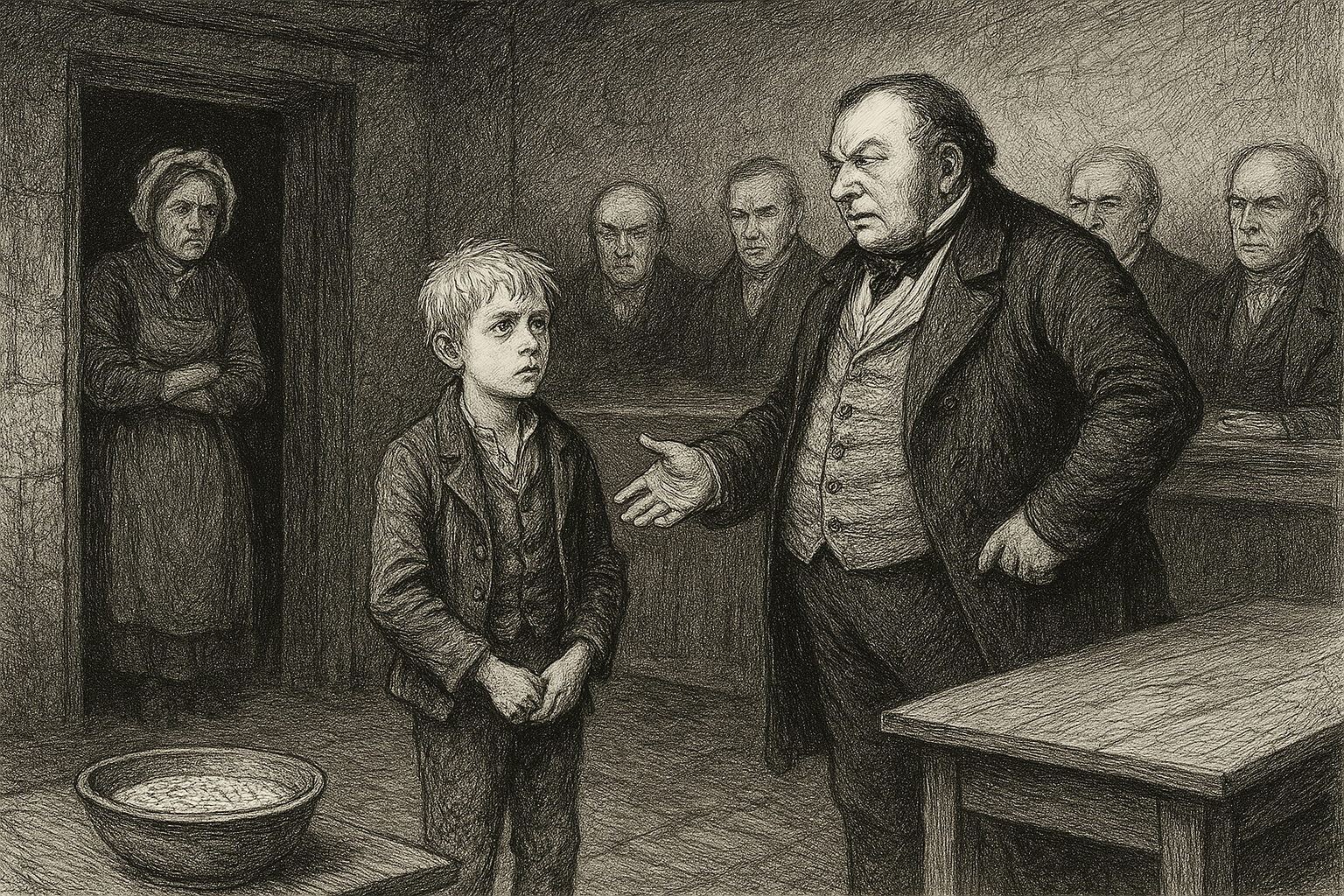
Summary of Oliver Asks For More
This passage, drawn from Chapter 2 of Oliver Twist by Charles Dickens, highlights the harsh conditions of 19th-century juvenile workhouses. Oliver and other unfortunate children live under the care of Mrs. Mann, a stingy and hypocritical woman who pretends affection while exploiting them. Even on Oliver’s ninth birthday, he is locked in a cellar instead of being celebrated.
Mr. Bumble, the pompous parish beadle, reveals that Oliver’s parents are untraceable and therefore he is treated as an orphan. He takes Oliver to a new workhouse where the boy is inspected by a board of officials. These men are cold, proud, and indifferent to Oliver’s suffering. Determined to discourage paupers from relying on public aid, they keep the children in perpetual hunger.
In a moment of desperation, Oliver is chosen by his peers to ask for more porridge. His timid request shocks the authorities and lands him in grave trouble. The board immediately declares that Oliver must be apprenticed out, essentially discarding him from the institution. The chapter closes with a hint of future events, encouraging readers to follow Oliver’s journey.
Plot Structure:
Exposition: Oliver’s background and conditions.
Rising Action: Mr. Bumble transfers him to a new workhouse.
Climax: Oliver asks for more porridge.
Falling Action: Authorities react with outrage.
Resolution: Oliver is prepared for apprenticeship, foreshadowing new struggles.
Setting Analysis
Primary Setting: The unnamed rural parish workhouse in England.
Context: Reflects Victorian social conditions, especially the Poor Laws, which treated poverty as a moral failing rather than a social problem.
Key Features: Harsh living conditions, hunger, rigid hierarchy, and lack of compassion.
Impact: The setting emphasizes Oliver’s vulnerability and isolation. His act of defiance (asking for more) is shaped by this oppressive environment.
Symbolism: The workhouse itself symbolizes an unjust system where greed and hypocrisy reign over charity and morality.
Themes in the story
Main Themes:
Kindness to the unfortunate: Dickens criticizes the cruelty of the workhouse authorities and appeals for compassion toward the poor.
Greed and deception: Mrs. Mann pretends to care while hoarding resources for herself.
Moral responsibility: Dickens emphasizes that caretakers of children should model virtue and empathy.
Power and hypocrisy: Authority figures exploit their positions, embodying the corruption of Victorian institutions.
Character Analysis
Oliver Twist:
Initially portrayed as weak and helpless.
Shows courage when he dares to ask for more.He serves as a symbol of innocence against systemic cruelty.
Mrs. Mann:
Greedy, deceitful, and hypocritical.
Flat character representing false charity.
Mr. Bumble:
Pompous and self-important.
Represents the pride of petty authority.
Mr. Limbkins:
Cold, unbending chairman.
Symbolizes the unfeeling cruelty of institutional leaders.
Workhouse Master:
Minor character but functions as a foil to highlight Oliver’s bravery.

CREDIT TO VICTORIA KUKUA STEVENS, Dr. JEMIMA LARTELEY MENSAH,AND VERY REV. EBO EPHRAIM