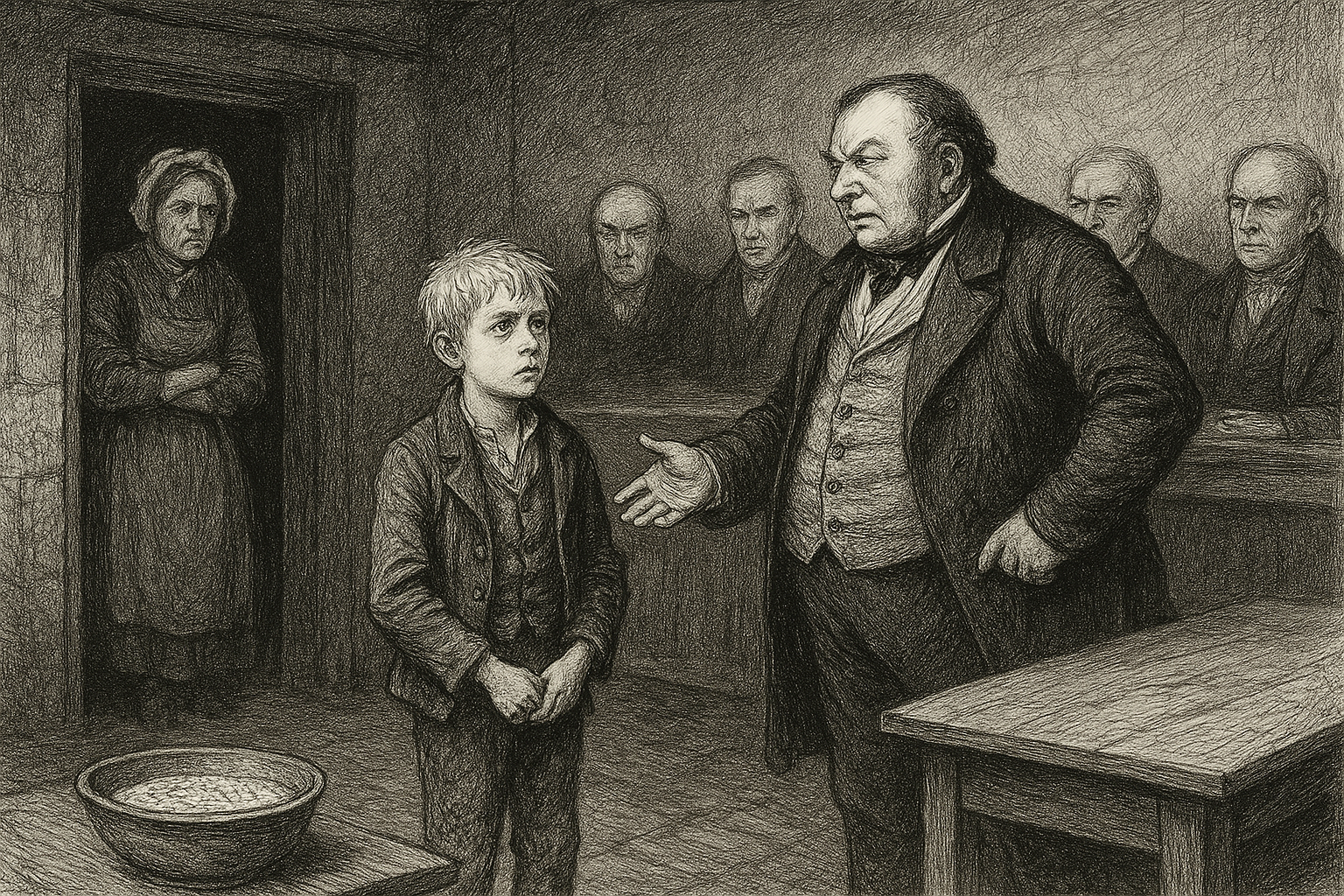

Narrative Structure
Character-centric: Focused on Oliver’s suffering, courage, and innocence.
Linear progression: Moves from exposition (Oliver in Mrs. Mann’s workhouse) to climax (the request for more) and falling action (decision to apprentice him).
Narrative Techniques
Satire: Dickens exposes the hypocrisy and cruelty of officials with biting irony.
Pathos: Oliver’s suffering evokes deep sympathy in readers.
Repetition: Used to highlight the pompous nature of officials (e.g., “official capacity for official business”).
Imagery: Vivid descriptions make characters memorable, from Oliver’s pale thin frame to the round red face of the chairman.
Indirect characterization: Traits are revealed through speech, actions, and interactions rather than explicit authorial judgment.
Tone
Satirical: Dickens ridicules the cruelty and hypocrisy of the system.
Didactic: The passage delivers a moral lesson about kindness, responsibility, and justice.
Point of View
Third-Person Limited: The narrator primarily follows Oliver’s experiences, emphasizing his innocence and vulnerability while exposing the callousness of adults around him.
Literary Devices
Alliteration: “slow starvation”. The /s/ is repeated and it emphasizes the boys’ suffering.
Imagery: Oliver’s frail appearance and the polished bowls emphasize deprivation.
Euphemism: “saved most of the money for herself” softens but satirizes Mrs. Mann’s theft.
Exclamation: Shows hypocrisy and shock (“Bless him!”, “For more!”).
Irony: The so-called caretakers are crueler than strangers.
Allusion
“There is an old story of another wise person who had a theory that a horse could live without eating” – it references a familiar story or folk tale without naming its source directly. By alluding to this tale, the writer draws a parallel between the old “theory” and the situation in the text, highlighting the impracticality or folly of the idea.
Hyperbole
“Mrs. Mann gave him a thousand embraces “- it exaggerates the number of embraces to emphasize Mrs. Mann’s overflowing affection.
“ their tiny bowls never needed to be washed, because the boys polished them with their spoons until they shone again” – The exaggeration emphasizes how desperately hungry the boys were .
Simile
“ Like the man who experimented with his horse, and like Mrs. Mann who experimented with the children” – It compares Mrs. Mann’s treatment of the children in the workhouse to a man experimenting with his horse.
CREDIT TO VICTORIA KUKUA STEVENS, Dr. JEMIMA LARTELEY MENSAH,AND VERY REV. EBO EPHRAIM