

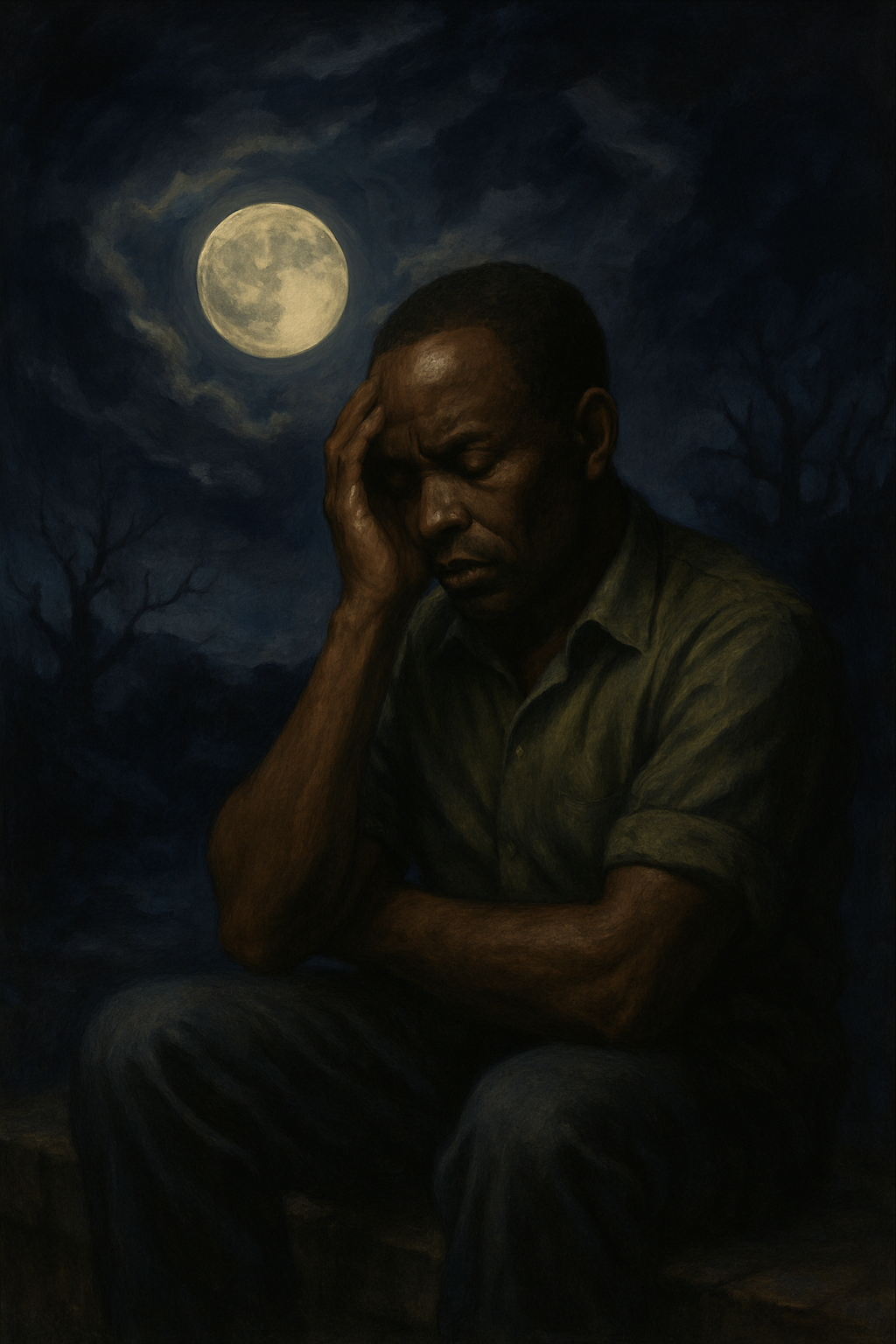
THE POEM – Night – Wole Soyinka
Your hand is heavy, Night, upon my brow.
I bear no heart mercuric like the clouds,
to dare.
Exacerbation from your subtle plough.
Woman as a clam, on the sea’s crescent.
I saw your jealous eye quench the sea’s
Fluorescence, dance on the pulse incessant
Of the waves. And I stood, drained
Submitting like the sands, blood and brine
Coursing to the roots. Night, you rained
Serrated shadows through dank leaves
Till, bathed in warm suffusion of your dappled cells
Sensations pained me, faceless, silent as night thieves.
Hide me now, when night children haunt the earth
I must hear none! These misted cells will yet
Undo me; naked, unbidden, at Night’s muted birth.
Inspiration and Background
Wole Soyinka’s poem “Night” is a deeply introspective piece that delves into the themes of oppression, vulnerability, and the overwhelming power of the night. The night is personified as a heavy, almost oppressive force, which the speaker must endure, but which also brings a mysterious and unsettling beauty. The poem’s imagery and tone reflect a struggle with inner darkness, the weight of existence, and the inevitable submission to forces beyond one’s control. In that breath of description, we can allude to the poet’s cultural background to draw a more vivid and pellucid association of meaning. In his Yoruba folklore, there are maxims that imply that night is a precarious time. Such include “night knows no dignified fellow” and “An evil deed is schemed for the night; whoever dares to launch their stratagem at day will not go unscathed”. These two sayings show that night is designated as a time for wicked operations. And this is what “night children” (stanza 3, line 1) suggests: manifold devilry. By extension, this fact is substantiated by the exposé of Jesus Christ’s about the appearance of tares among wheat – that such evil is done while man sleeps. Extensively still, Yoruba folk belief maintains that man’s existence spans three phases: morning (childhood/youth), afternoon (middle age), and night (old age). In this vein of thought, there is usually the supplication that night comes off as the most pleasant. When we ponder the intercourse of these two paradigms, we obtain a paradox – the very texture of the poem’s rhetoricity. In literature, foregrounding occurs when the everyday meaning of a word is dislocated from it. That is, a common word becomes extraordinary by suggesting a deeper sense relationship that is removed from its ordinary denotation. It is that a common word assumes an unfamiliar meaning which will create a rich and comprehensible evolution of ideas. An example is the common word ‘road’ ultimately creating the mental picture of journey from which we can begin demystifying its use in the context it has appeared. Such is the case with the poem “Night”. We simply cannot presume that the ultimate address of the poet terminates at the episodic mischiefs and devilry of night as a time of the day when it is dark. Rather, we can deduce that, even as the word is personified, the poet is speaking of a phenomenon of human existence. That is, the poem uses the literal idea of night to lyricize the anxiety of ageing!
SUBJECT MATTER
Wole Soyinka’s poem “Night” is a deeply introspective piece that delves into the themes of oppression, vulnerability, and the overwhelming power of the night. The night is personified as a heavy, almost oppressive force, which the speaker must endure, but which also brings a mysterious and unsettling beauty. The poem’s imagery and tone reflect a struggle with inner darkness, the weight of existence, and the inevitable submission to forces beyond one’s control. The poem is a powerful exploration of the psychological and emotional weight of darkness. The night in this poem is not just a time of day, but a pervasive force that dominates and overwhelms the speaker, bringing with it feelings of vulnerability, fear, and submission. Through rich and evocative imagery, Soyinka captures the tension between the beauty and terror of the night, and the deep, often unsettling impact it can have on the human psyche. The poem ultimately reflects a struggle with inner darkness, the inevitability of facing one’s fears, and the complex emotions that arise in the stillness and silence of the night.
STANZA ANALYSIS
Stanza 1
The poem begins with the speaker directly addressing the night: “Your hand is heavy. Night, upon my brow.” This opening line immediately sets a tone of oppression and burden, as if the night is not just a time of day but a force pressing down on the speaker, both physically and emotionally. The use of “heavy” suggests a sense of exhaustion or weariness, and the “brow” symbolizes the mind, indicating that the speaker is mentally burdened by the night’s presence. The speaker contrasts their own emotional state with that of the night, stating, “I bear no heart mercuric like the clouds, to dare / Exacerbation from your subtle plough.” Here, the “heart mercuric” suggests something volatile and changeable, like mercury. Unlike the clouds that can shift and adapt, the speaker feels unable to resist the “subtle plough” of the night, which slowly and methodically exacerbates their inner turmoil. The night’s influence is subtle yet powerful, digging into the speaker’s psyche in a way that is both insidious and unavoidable.
Stanza 2
The next lines introduce a vivid and striking image and simile: “Woman as a clam, on the sea’s crescent / I saw your jealous eye quench the sea’s / Fluorescence.” The night is compared to a jealous woman, closing in on the sea and extinguishing its light. The sea’s “fluorescence,” which represents life, movement, and vitality, is dimmed by the night’s “jealous eye.” This suggests a struggle between light and dark, between life and the suffocating force of the night, which seeks to dominate and subdue. The “clam” metaphor implies something closed off and protective, yet also vulnerable and exposed to the night’s influence. Also, the metaphor of the sea here shows the ruthlessness of a social reality whereby even the most promising of human quota meets a tragic compensation. Put clearly, he has experienced how “night” as an unquestionable authority has terminated the dreams, ambitions, and future of acquaintances far and near. This is substantiated with the use of “crescent” to suggest the dimming of hope. Most probably then, this poem must have been composed under a climate of fear in response to the oppressive and draconian rule of the mid/late 1960’s Nigeria when it was published. Certainly, in that respect, there were several cases of execution, assassination and other dehumanizing treatments meted out to those who dared to confront the destabilizing, political episodes of that period.
Stanza 3
Stanza three is enjambed with the preceding stanza. It effectively and technically continues the flow of thought carried from the illustration presented earlier. But it peaks it with a more reverential consciousness: “And I stood drained/Submitting like the sands, blood and brine/Coursing to the roots” (stanza 3, lines 1-3). This imagery suggests vanity, a prominent awareness associated with the meaning of life, however purposefully it takes shape in the name of ambition, career pursuit, and other privileges true to living a conscious existence. All this is subject to fate. And as the folklorist background of the poet provides, there is always rest to wish for to consummate our accomplishments. But that is a mystery given to happenings beyond human comprehension – 16 resulting from our actions and inactions. But in essence, they result from the catastrophic imposition of forces we cannot placate. The poet-persona continues to corroborate his sense of anxiety with another of night’s visible mischiefs.
Stanza 4
The fourth stanza continues on the idea left off in the previous. The poet testifies to night’s severance of unsolicited catastrophe. “Night, you rained//Serrated shadows through dank leaves” (stanza 3, line 3 – stanza 4, line 1). These lines suggest the poet’s closeness with the unbearable events that befell loved ones whether distant or immediate. Furthermore, night is personified for the effect of exploring details of the sorrow, rejection and atmosphere of melancholy it visits upon an ambitious beginning. Here, “dank” is relevant for one of its implications which means “highly potent”. The paradox here is the intensity of night’s gloom at the prime of life. The severance of this ugliness is carried through to the subsequent lines: “Till, bathed in warm suffusion of your dappled cells/Sensations pained me, faceless, silent night thieves” (stanza 4, lines 2-3). These lines suggest growth and experience. To be engulfed in night’s “dappled cells” is to have survived a share of life’s threatening struggles imposed by the state-of-the-nature forces which are the “silent night thieves”. Let us recall that a literary text may bear insinuations of a certain social event. In that vein, the many violations of human rights through death penalties and other atrocious power panoply in mid-1960’s Nigeria were consequent of her failed democracy since independence! This reaches its zenith with the bloody civil war which claimed lives in innumerable numbers yet. Before that very drama, serious ethnic rivalry had been the order of the day with ideological conflicts among the champions of independence. Wole Soyinka was privy to the foregoing as a revenant whose literary afflatus spanned the need to overhaul the foundational issues of social, economic, and political security for the vulnerable citizens of Nigeria. In that bid, his interference earned him unjust arrests including his twenty-two-month incarceration during the pogrom. He lost friends, colleagues, and close allies to the trying period. This poem therefore details a recollection of losses and an awareness of his susceptibility.
Stanza 5
In the fifth and last stanza, the poet suddenly remembers that a glimmer of possibility hangs about his destiny still. However, even that is strictly hoped for, as he wishes for an end devoid of personal regrets. He hopes for freedom from the ravages of tormentous untimeliness. We can suggest that “night children” (stanza 5, line 1) are the regrets of a wasted youth that stalk the memory upon the event of living longer than one could have imagined possible. At this point, the two ideas of night’s uncertainty intertwine. Even the phrase “night children” is an oxymoron creating a rhetoric of purpose, ambition and the predatory forces under which they operate: no one can ascertain their success as the times afflict. In verse two of the same stanza, “These misted calls” suggest untimely death since we associate mist with the wee hours of the day. In other words, “These misted calls” are the natural and human-induced phenomena snuffing life out of his contemporaries from whom he is no different in human lot. And “Night’s muted birth” suggests that death is an abrupt occurrence against which one can only do oneself the good of having exhausted one’s talent before it calls. On the whole, “Night” is a working text with both personal and social undertones of life’s ephemerality. It draws inspiration from the Yoruba folk belief about man’s timed existence simultaneously with the social events that determine its value. It tempers the mystery of life with a subject that borders heavily on political unrest, natural occurrences, and unforeseen circumstances to which life is subject.
THEMES IN THE POEM
- Dominance of Night
- The Insignificance of Human Efforts
- The Mystery of Darkness
- Fear and Vulnerability
- The Importance of Rest
- The Ambivalent Possibilities of Night.
Credit to H.K OCRAN/ LiTTROVE
Explain it the way I will understand
Please . Let us know where the. Challenge is so we can assist you.
I need an analysis of all the jamb syllabus poems
List the poems, we shall reach out to you
Night mirrors the difference emotions associated with the darkness of night in poem
Very interest and touchable poem
This book help me a lot