

STRUCTURE OF THE POEM
‘She Walks in Beauty’ is a descriptive, lyrical, rhyming poem that focuses on female beauty and explores the idea that physical appearance depends upon inner goodness and, if in harmony, can result in the romantic ideal of aesthetic perfection. It can also be aligned with the features of an ode, since it primarily praises and celebrates the beauty of the woman. It is composed of 3 stanzas, each of 6 lines (sextets). The poem is in the third-person point of view, which signifies the poet’s luxury to critically observe, enjoy, and appreciate the beauty of the woman. Although heavily punctuated with pauses, the ideas in the stanzas run-on to express the flow of ideas and emotions. The poem consists of regular metre. The metre of ‘She Walks in Beauty’ is iambic tetrameter, which means there are four feet – four iambs – in each line. An iamb is an unstressed syllable followed by a stressed syllable. We can mark the stressed syllables in capitals as follows for the first couple of lines: She WALKS in BEAU-ty, LIKE the NIGHT Of CLOUD-less CLIMES and STAR-ry SKIES. This is not a meditative poem, so the shorter tetrameter line (rather than the longer pentameter line, which has five feet) strikes the right note for a simple poem in praise of the woman’s beauty. Byron’s intent is to salute her attractiveness, rather than fashion a sophisticated argument. The rhyme scheme is ababab, so alternating rhymes in six-line stanzas. There’s a seesaw movement to the lines: they’re almost soothing and lullaby-like in the way they tenderly pay homage to their female subject.
POETIC DEVICES IN THE POEM
1. Simile
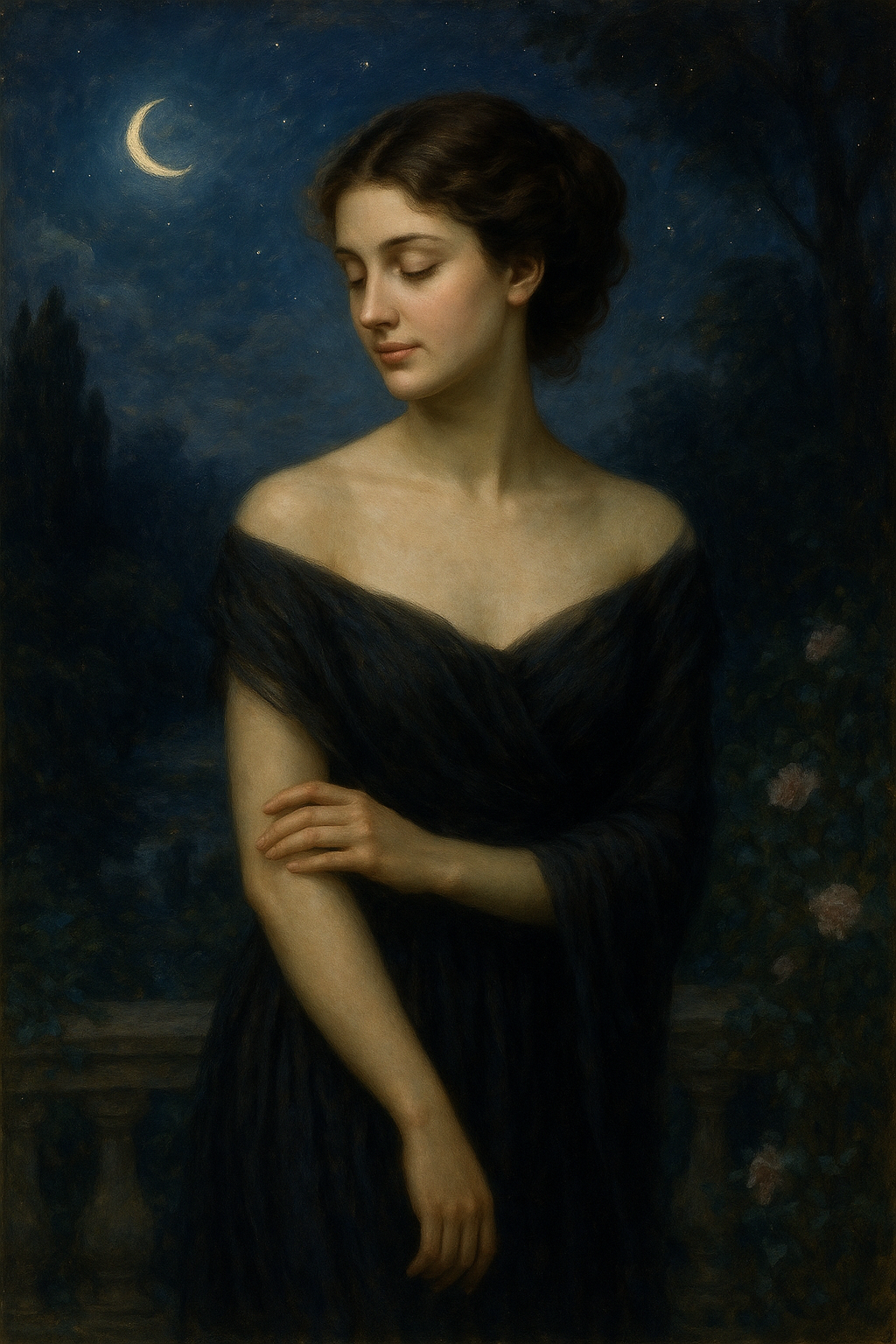
There is one simile used in the opening line of the poem, “She walks in beauty, like the night.” Lord Byron compares the walk of that lady with a dark and clear night which also means that her footsteps are not heard.
2. Metaphor
There are two metaphors in the poem, in lines eleven and twelve. “Where thoughts serenely sweet express / How pure how dear their dwelling place.” Here the poet compares thoughts with people and “dwelling place” with the mind. Similarly, “Raven Trees” represents the dark hair of the lady that adds further to her beauty.
3. Personification
The poet has personified “dwelling place” with the human. He also personifies the lady’s “cheek” and “brow” with persons as if they can speak about the good days.
4. Imagery
Imagery is used to make readers feel things through their five senses along with their Byron has used images appealing to the sense of sight such as, “night”; “starry sky”; “cloudless climes”; “cheek” and “brow.” These images speak for themselves and allow the readers to feel the same beauty that has delighted the poet.
5. Sibilance
It is a device used to stress consonant sounds through their fricative and affricative types coming after each other. The letter “s” is permanent in lines eleven and second that creates a special effect. Check the /s/ sound in these four lines. 6. Assonance Assonance is the repetition of vowel sounds in the same line such as the sound of /a/ in “Had half impaired the nameless grace” and sound of /e/ in “where thoughts serenely sweet express.”
7. Consonance
Consonance is the repetition of consonant sounds such as the sound of /s/ in “where thoughts serenely sweet express” and /c/ sound in “Of cloudless climes and starry skies”.
8. Antithesis
“And all that’s best of dark and light” (line 2) “One shade the more, one ray the less,” (line 7) This combining of opposites in a single line also allows a balance to be struck whilst simultaneously implying that this finely tuned balance only exists because of the innate competition between light and dark.
9. Synecdoche
“Mind” and “Heart” as used in lines 17 and 18 respectively of the poem serve as a part representing the woman.
10. Symbolism “The night” symbolizes the serene and captivating beauty that the woman embodies. “The tender light” represents the harmonious combination of dark and light in the woman’s appearance. “The smiles and tints” symbolize the purity and goodness of the woman’s character.
MOOD/TONE
The speaker expresses a deep admiration for the woman’s beauty and the harmony it embodies. The woman’s appearance reflects a sense of serenity and calmness. The tone is that of excitement and appreciation.
LANGUAGE AND DICTION
The poem employs melodic and pleasing sounds, enhancing the overall aesthetic experience (Euphony). The language is simple yet contrasting. The contrasting adjectives: “Dark and bright, soft and calm, gaudy and tender”— create a sense of balance, equilibrium and beauty. Again, the poet’s choice of words evokes emotions of admiration, tranquility, and innocence.