


THE POEM
The Telephone Call – Fleur Adcock
They asked me ‘Are you sitting down?
Right? This is Universal Lotteries,’
they said. ‘You’ve won the top prize,
the Ultra-super Global Special.
What would you do with a million pounds?
Or, actually, with more than a million—
not that it makes a lot of difference
once you’re a millionaire.’ And they laughed.
‘Are you OK?’ they asked—’Still there?
Come on, now, tell us, how does it feel?’
I said ‘I just . . . I can’t believe it!’
They said ‘That’s what they all say.
What else? Go on, tell us about it.’
I said ‘I feel the top of my head
has floated off, out through the window,
revolving like a flying saucer.’
‘That’s unusual,’ they said. ‘Go on.’
I said ‘I’m finding it hard to talk.
My throat’s gone dry, my nose is tingling.
I think I’m going to sneeze—or cry.’
‘That’s right,’ they said, ‘don’t be ashamed
of giving way to your emotions.
It isn’t every day you hear
you’re going to get a million pounds.
Relax, now, have a little cry;
we’ll give you a moment . . .’ ‘Hang on!’ I said.
‘I haven’t bought a lottery ticket
for years and years. And what did you say
the company’s called?’ They laughed again.
‘Not to worry about a ticket.
We’re Universal. We operate
a Retrospective Chances Module.
Nearly everyone’s bought a ticket
in some lottery or another,
once at least. We buy up the files,
feed the names into our computer,
and see who the lucky person is.’
‘Well, that’s incredible,’ I said.
‘It’s marvellous. I still can’t quite . . .
I’ll believe it when I see the cheque.’
‘Oh,’ they said, ‘there is no cheque.’
‘But the money?’ ‘We don’t deal in money.
Experiences are what we deal in.
You’ve had a great experience, right?
Exciting? Something you’ll remember?
That’s your prize. So congratulations
from all of us at Universal.
Have a nice day!’ And the line went dead.
Inspiration and Background
“The Telephone Call” is a poem by Fleur Adcock, a British poet of New Zealand origin known for her sharp and often witty style, which reflects the complexities of modern life. Adcock’s poetry often addresses themes of identity, human emotions, relationships, and the absurdities of existence, blending irony with humour. This poem was written in a period when Adcock’s work was gaining recognition for its conversational tone and sharp observations. The poem comes from her collection Poems 1860 – 2000, which captures a wide range of her themes and stylistic developments over four decades. The poem focuses on the surreal and somewhat darkly humorous experience of an unexpected lottery win, questioning the nature of luck and reality. The title, “Telephone Call”, immediately suggests the event that frames the entire poem – a call that appears to be life – changing. It hints at a moment of anticipation, excitement, or perhaps a surprise. The title is simple, yet it establishes the medium through which the poem’s central experience unfolds, setting a tone of intimacy and immediacy. The phrase, “telephone call”, is every day and unassuming, contrasting with the extraordinary claim in the poem, thus setting up a juxtaposition between the mundane and the absurd.
SUBJECT MATTER
The poem begins with the poet receiving a call from “Universal Lotteries,” informing her that she is a winner, about to become a millionaire. This is the moment of excitement and anticipation. The representative encourages the poet to express her emotions, which amplifies her sense of elation at the prospect of newfound wealth. As the conversation continues, the poet begins to feel uncertain about the authenticity of the call, questioning when she will receive the money. The representative responds by explaining that the company doesn’t actually deal with money—only with “the experience.” This explanation undermines the excitement and turns the conversation into a mockery. The conversation ends abruptly with the line going dead, leaving the poet to come to terms with the fact that the call was either a scam or a trick, offering no real prize. The poem uses this humorous and ironic situation to explore the themes of false promises, consumerism, and the emptiness of materialism. The poet, initially swept up in the excitement of a potentially life-changing event, is ultimately left disillusioned, reflecting on the hollow nature of such offers. Through this lighthearted yet thought-provoking exchange, Fleur Adcock sheds light on the absurdity of modern consumer culture, where promises of wealth or success often turn out to be shallow and unfulfilling.
STANZA ANALYSIS
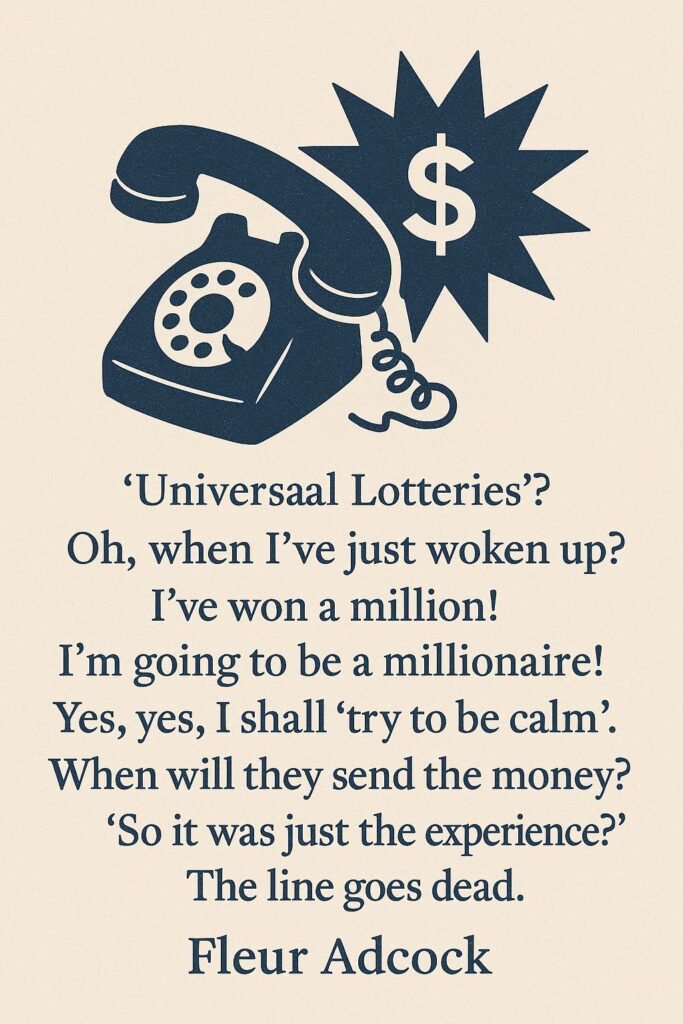
Stanza 1
The opening lines of the poem set the stage for the situation. The speaker is asked, “Are you sitting down? Right? This is Universal Lotteries,” which immediately grabs the reader’s attention. The phrase suggests an exciting announcement is about to follow, creating an atmosphere of anticipation. In the following lines, the speaker explains that the phone call is related to a prize in the “Ultra-super Global Special” lottery, which implies an enormous sum of money—more than a million pounds. However, after this dramatic revelation, the callers sarcastically add, “not that it makes a lot of difference once you’re a millionaire.” They then laugh, which suggests that the announcement is not meant to be taken seriously. The speaker seems to imply that she did not actually win any prize. The sarcastic tone and mocking laughter point to a situation where the lottery call was more about ridicule than an actual reward. The callers’ laughter and their comment about wealth losing significance once someone is already a millionaire highlight the emptiness and irony of the situation. The speaker’s innocence or expectation of a life-changing event is mocked, suggesting a deeper commentary on the way people can be taken advantage of or belittled. This first stanza sets up a sense of disillusionment, as the speaker realizes the lottery call is not a genuine offer but an attempt to mock her. The tone shifts from excitement to sarcasm, suggesting the disparity between expectation and reality.
Stanza Two
The second stanza of “The Telephone Call” begins to reveal the poem’s deeper themes. The tone shifts as the callers ask, “Are you OK? Still there? Come on, now, tell us, how does it feel?” These questions highlight the speaker’s growing sense of confusion and disbelief. The question of “how does it feel?” suggests a disconnection between what the poet expected and the reality of the situation. The first few lines introduce the theme of appearance vs reality, showing the poet’s internal conflict between the illusion of winning a large sum of money and the reality of the situation. The news of the supposed lottery wins triggers feelings of greed within the speaker. This internal struggle is represented by a “nagging and angry child” inside her, symbolizing the overwhelming desire for wealth. The speaker begins to lose control over her thoughts, symbolized by the image of her brain floating “out through the window.” This suggests a sense of detachment from reality and a loss of clarity. The image of her brain floating away like a flying saucer reinforces the sense of absurdity and disorientation, emphasizing how the overwhelming thoughts of wealth have taken her mind elsewhere. This stanza underscores the growing conflict in the poet’s mind, where the illusion of a life-changing prize feeds her desire for wealth, leading to confusion and loss of sense. The image of the flying saucer suggests that her rationality has been overtaken by greed and fantasy.
Stanza Three
In the third stanza of “The Telephone Call,” the poet’s emotions begin to take over her rational mind. The question “That’s unusual” followed by “Go on” from the callers indicates a shift in tone. The speaker is no longer able to remain composed, and her thoughts become dominated by greed and desire. The line “Her throat went dry for the burning greed of her heart” captures the internal struggle the poet faces, as her rational mind is overshadowed by overwhelming emotions. This stanza explores the theme of turbulent human emotions, where the speaker finds it difficult to speak or think clearly due to the intense greed and excitement stirring inside her. Her desire for the lottery prize makes it hard for her to maintain composure. The mention of her throat going dry emphasizes her physical reaction to the overwhelming emotions. The poet’s vulnerability becomes evident as she struggles to control her emotions, symbolizing how greed can strip away a person’s defenses. The callers seem to encourage the poet to abandon her self-control, pushing her towards emotional highs. Their words aim to lead her into a state of unrealistic elation, further highlighting the manipulative nature of the situation. This stanza illustrates how the poet’s emotions overpower her logic, leading to a sense of vulnerability and loss of self-control. The callers play on her emotions, pushing her into a state of euphoric hopefulness, emphasizing the theme of emotional manipulation.
Stanza Four
In the fourth stanza of “The Telephone Call,” the poet begins to emerge from the hallucination-like state she had fallen into. She responds to the callers, telling them that she hasn’t bought any lottery tickets in recent years. The response causes the callers to laugh at her once again, reinforcing the sense of mockery in the conversation. Despite this, they reassure her not to worry about the ticket, claiming that they operate a “Retrospective Chances Module,” which suggests they can retroactively include her in the lottery, regardless of whether she had purchased a ticket. The poet begins to come out of her fantasy-like state, realizing the absurdity of the situation as she recalls that she hasn’t purchased a lottery ticket for years. Upon hearing her response, the callers laugh again, emphasizing the continuing ridicule the poet faces. The mention of a “Retrospective Chances Module” raises questions about the authenticity of the call, suggesting that the whole scenario might be a scam or a fabricated lie. The caller, aware of the doubts this claim might raise, tries to soothe the poet by explaining the process, further manipulating her emotions and drawing her deeper into the illusion. This stanza introduces further doubts about the authenticity of the lottery call. The poet’s return to reality contrasts with the absurd and manipulative claims of the callers, highlighting the theme of deceit and emotional exploitation in the poem.
Stanza Five
In the fifth stanza of “The Telephone Call,” the poet reflects on the common human tendency to rely on luck, as nearly everyone has bought a lottery ticket at some point, hoping for a chance at a windfall. This highlights the widespread belief in chance rather than self-determined success. The poem suggests that the company, Universal Lotteries, acquires old data from other lottery companies and enters it into their system for a new draw. The poet’s name is drawn, though by this point, she is already recovering from her earlier emotional confusion. She responds skeptically, saying she will only believe the win when she sees the cheque. The poet highlights how people often rely on luck to achieve success, as demonstrated by the common practice of buying lottery tickets in hopes of winning. The poem reveals that Universal Lotteries purchases old files from other companies and enters the data into their system for a new draw, raising questions about the legitimacy of the lottery process. The poet, now recovering from her emotional state, expresses skepticism about the authenticity of the lottery win, saying she will only believe it when she sees the cheque. This stanza further explores the theme of human reliance on chance and luck, contrasting the excitement of the lottery with the poet’s growing awareness of the situation’s absurdity and her skepticism toward the authenticity of the win.
Stanza Six
In the final stanza of “The Telephone Call,” the poem takes an unexpected turn that shatters the last remnants of the poet’s greed. When the poet asks about the cheque, the callers inform her that there is no cheque. Instead, they explain that they do not deal with money but rather with “experiences.” This revelation serves as a powerful message, suggesting that memorable experiences are far more valuable than material wealth. The call ends with the poet being congratulated, but without any actual prize, highlighting the emptiness of the entire situation. The twist reveals that the company does not offer money, but rather “experiences” as prizes. This suggests that material wealth is not the ultimate goal, and unforgettable experiences hold more significance. The poet’s greed is ultimately shattered, and she realizes that the whole ordeal was a delusion. The use of the word “dead” in the last line symbolizes the collapse of her unrealistic expectations. The phrase “don’t deal” uses alliteration, which serves to emphasize the stark contrast between the expectations of wealth and the reality of the situation. The poem concludes with the call being abruptly ended, highlighting the futility of the poet’s hopes and the emotional manipulation she experienced. The final stanza delivers a harsh yet profound lesson, illustrating the emptiness of materialism and the fleeting nature of illusions. The poet’s greed is dispelled, and the “experience” she receives becomes her only lasting “prize.” The poem ends with a sense of closure, as the line goes dead, leaving the poet to reflect on the absurdity of the situation.
THEMES IN THE POEM
- The Illusion of Wealth and Materialism
- Absurdity and Surrealism of Modern Life
- Disappointment and Disillusionment
- The Commodification of Human Experience
- Manipulation and Deception
- The Fragility of Human Emotions
- The Role of Chance and Luck
CREDIT TO H.K OCRAN/ LiTTROVE