

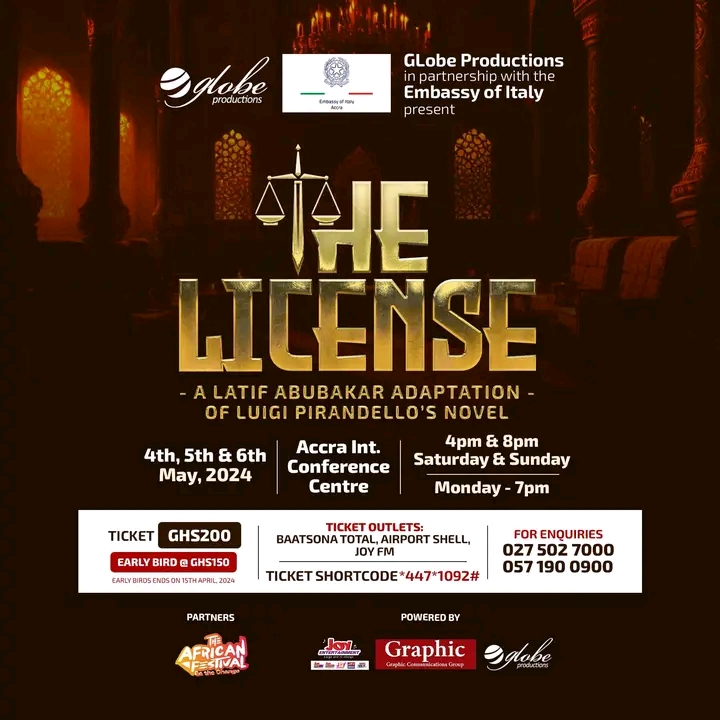
A REVIEW OF LATIF ABUBAKAR’S THE LICENSE, STAGED AT THE ACCRA INTERNATIONAL CONFERENCE CENTRE ON MAY 4TH – 6TH, 2024.
Synopsis
The Play The License is a one-act comedy play written by Latif Abubakar an Astute playwright noted for his captivating dramatic pieces such as Life is A Dream, The Second Coming of Nkrumah, and his Adaptation of Five Hours with Mario. The Play the License revolves around Ademu’s challenge of obtaining a driver’s license. After several struggles and frustration, a connection man helps him to secure one. The license turns out to be fake and this leads to his arrest and arraigned before the Court of Justice. The play also touches on the rippling effect of the acquisition of driving license. Especially in Ghana, people go through cumbersome stress before getting a driver’s license. Many even resort to the “Guru boys ” for easy access and pay at a higher charge.
Issues of Adaptation
The play is an adaptation of Luigi Pirandello’s Novel La Patente which translates as The License. The novel tells the story of Rosario Chiarchiaro, a father, ostracized by society because he has a reactive mask. He loses his job and this leads to an unhappy life. He then seeks justice for his firings, and hopes not to get a conviction.
In the story, Rosario Chiàrchiaro, presents a ridiculous image and appears before Judge D’Andrea in a kind of homemade costume to make him look like what local superstition would define as a jinx. Rosario Chiarchiaro asks the judge to grant him a license to become a professional jinx since the community labelled him as one, . He hopes that he would benefit from it, asking for a legal fee not to use his nefarious power.
Fast Forward Globe Productions partnered with the Italian Embassy , Ghana to adapt the Novel The License into a play and planted it into the Ghanaian soil or setting.
The play was staged at Accra International Conference Centre from May 4th to 6th, 2024. This review captures the only events that took place at the second show at 8 pm Specifically May 5th, 2024. This review will critique the entire performance. Ranging from the acting to the costume, lighting, set design, directing, makeup, sound, and of course the acting and audience participation. Finally, the performance will be scored on a scale of ten.
With the acting, The play began with Efua Dell playing the role of Aisha, setting the comic tone with a hilarious rendition of a Ghanaian gospel song . Two interesting actors namely Efua Dell, who played Aisha, and McPratt Dadzie, who played Ademu carried the play on their shoulders. They maintained consistency with the accent which is very peculiar to the Northern part of Ghana.
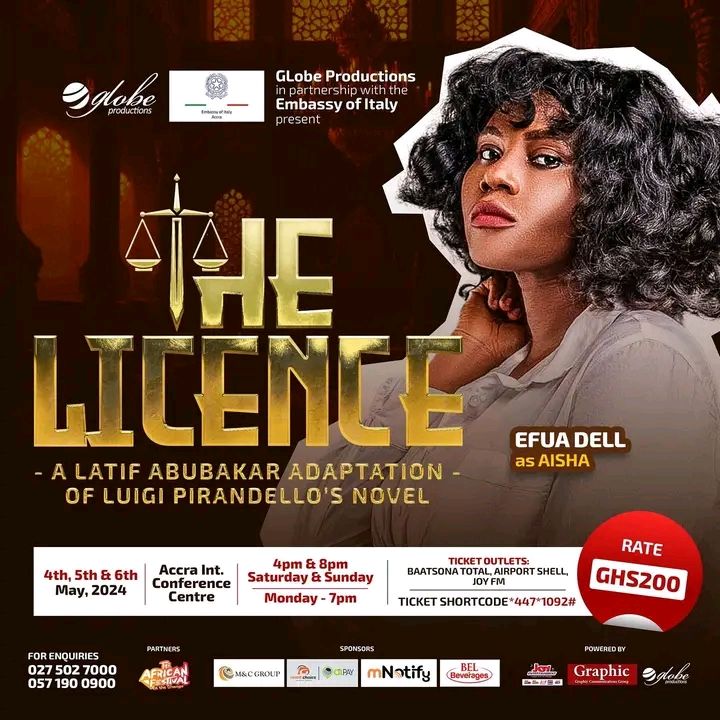
Also as a comic play, these actors treated it as such and showcased comic mannerisms and movements. They were articulate, as we could hear every line of theirs included is their timeless whispering. They really used the stage and complimented the stage setup . The rapport between the two confirmed that they were married or shared a bed together. The believability was there. These two couples really drove the play as the principal characters of the play. One spectacle one cannot forget is the telephone call by McPratt in Scene Two. He did extremely well with his pacing and line pausing. It was so natural and excellently done. My only challenge was that he failed to write down or dial the numbers Latif called out. Nevertheless, he did well to enter those numbers accurately and called Chukwuemeka right away. This may suggest that he is good at memorization. But judging his characterization, I doubt that someone of his caliber could memorize a phone number when called out only once.
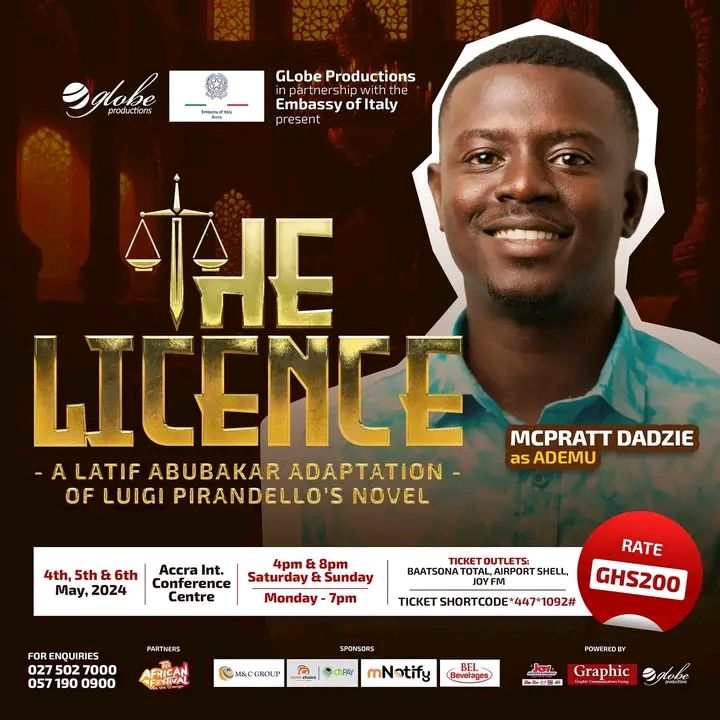
Aside from this, as a husband and wife, their proximity on stage contributed in telling the audience how intimate they are. This credit goes to the director for a meaningful and aesthetic blocking. Except the same brilliance didn’t help with stage balance. For instance, in the first scene ,One side felt crowded and the other side was empty or redundant when they were found together.
Chukwuemeka is also another interesting character worthy of praise . He is the man who orchestrated the license forgery of Ademu. He did extremely well by helping his friend out. Role well executed.

Omar Sheriff Captain also played his role well. He contributed to the character development of both Dell and McPratt. However, his acting was a bit mechanical. His initial entrance on stage in Scene 2, feigning madness and trying to be hilarious was mechanical for me. Those who sat on the right side of the auditorium barely saw his face until he moved to the center stage. This might be a stagehand’s mistake with sightlines, but he could have positioned himself in ¾ for all of us to get a view of his deceptive facial expression.
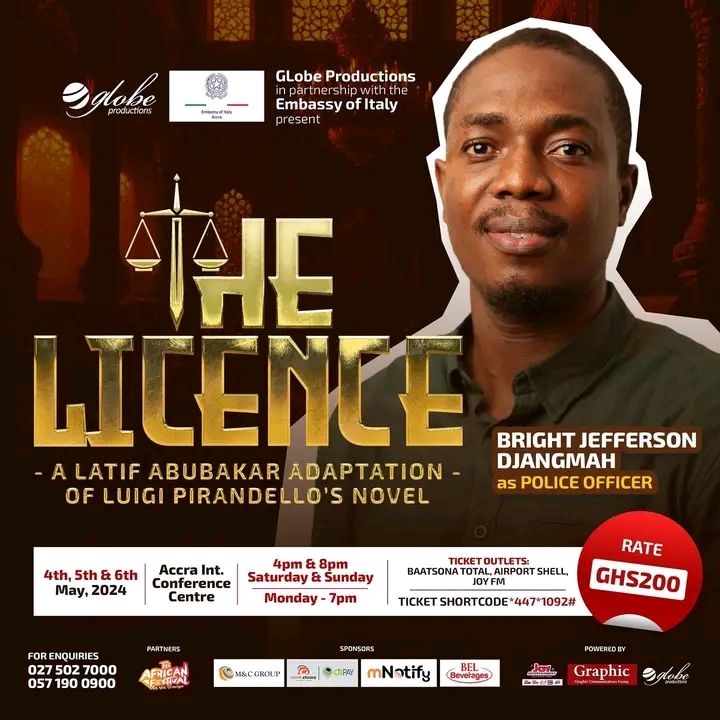
Furthermore, Bright Jefferson Djangman, who played the policeman role killed it. He doesn’t allow his friendship with McPratt to hinder him from arresting him. He seems to suggest that ” Familiarity may not always breed contempt”. He inspected his own friend just as he would have done to anyone.
Again, another phenomenal character is the Judge. Jackie Ankrah as Judge took her time to ensure her education on driving license processes was heard clearly. Her presence was registered as the judge. Her tone, flair, and composure were on point.
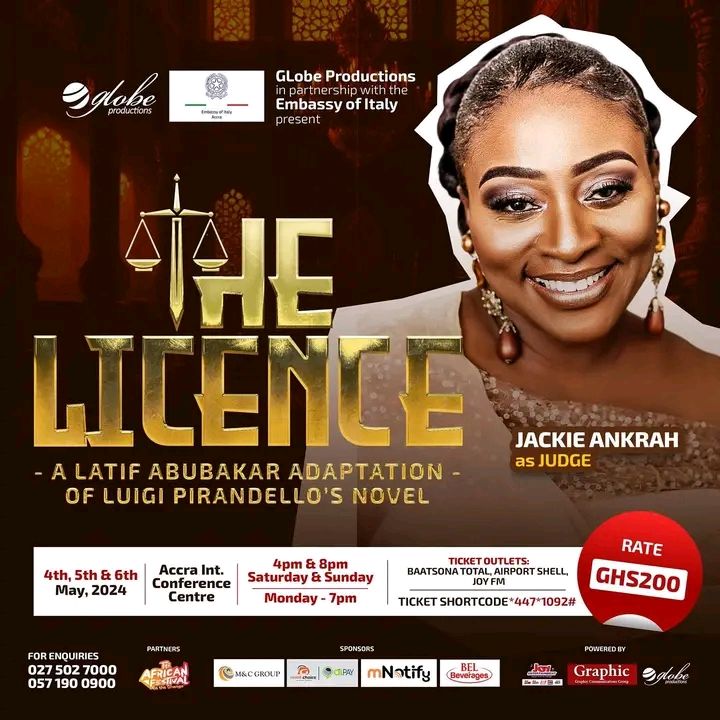
The manner she fled or quivered when threatened by McPratt, was nicely done to communicate her status as a learned Judge.
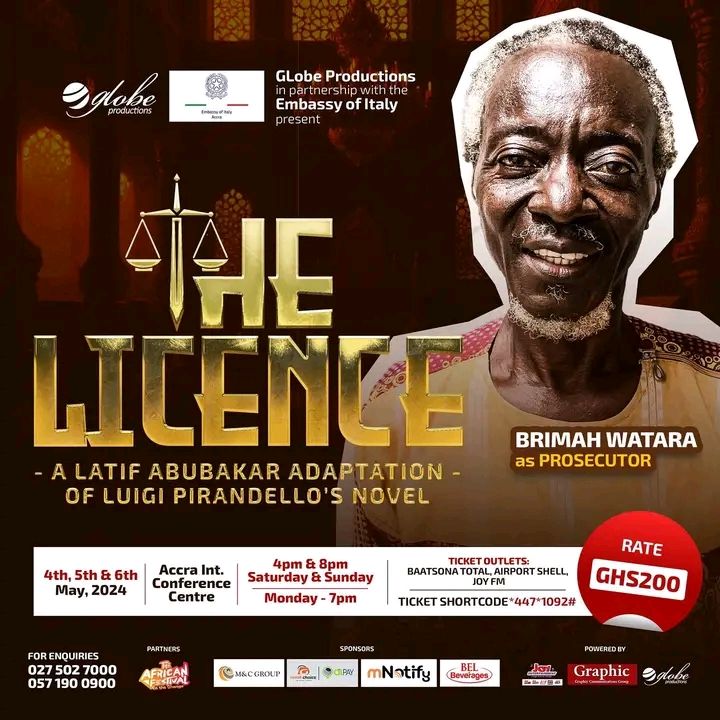
Still in the courtroom, Brimah Watare who played the role of the Prosecutor stayed true to his age with his soft and mild or calm tone. He sat gracefully and embodied someone bestowed with power. He really made the audience believe that he was old. The characterization was good.
Before I forget the audience made the auditorium very lively and reacted when necessary. They were glued to their seats till the end. It was not quite surprising to find them retorting the Judge when she was educating the audience on the process of acquiring the license. I could hear someone shout ” They are all theories”
They enjoyed themselves and applauded the players in almost all the scenes.
Now to the technical elements, With the makeup, I will say it was great. Especially that of the Prosecutor. The makeup projected him as an old person during the court scene in the latter part of the play.
Not forgetting, the costumes. They were well pulled and helped in revealing the religion and social status of characters such as the Judge in robe and the White Wig, Prosecutor, Chukwuemeka, Aisha and Ademu added to their roles. For me, there was a little confusion with the costumes of Ademu and Aisha. They always wore the Islamic cassock in almost all the scenes. This Jalabiya being worn too many times didn’t help in distinguishing the time whether morning, afternoon, or evening. Unless the director seeks to say that Muslims wear the Jalabiya at any time they wish. Again, Aisha often returns from the kitchen as if she had just come home from a function. That is to say, the costume was too beautiful for such a scene.
Now to the sound. The sound played an essential role in the production. The house music was great and the remix of the sound really added to the treatment of the play as comedy. One interesting usage of sound was in the last scene. The thunder sound that accompanied McPratt’s gimmicks tricked everyone into believing that he was genuine. it was later revealed that all he was doing was fake. Great art.
With the Lighting, it was well orchestrated. In the opening scene, the light enhanced the beautiful scenery. Again the light was also deployed to compliment the comic nature of the play.
Before I end, I must draw a line between the original text that is the novel, and the adaptation(play) to ascertain whether the adaptation was a success or a failed attempt. Drawing comparison between the original text by Pirandello and the adaptation by Latif Abubakar, the original focused on conflict between social custom and the law whereas Latif focused more on driving license brouhaha. It is also interesting to note that both the novel and the play dealt with the issue of License. The Novel focused on a license to be recognized as a professional Jinx while play focused on a license to drive.
Also, Latif maintained some key concepts in his adaptation to depict the resemblance to the original text. For instance, the issue of identity was still maintained. This identity was projected with the costumes used. In the Novel, Rosario in Pirandello’s text appears in court dressed as a professional jinx. Similarly, Amedu in Abubakar’s play appeared before the court in a traditional voodoo costume.
Again,the novel was strategically adapted for the stage. One will notice that the original text is very short but the writer expanded it for a two-hour span noted for the average time a play should last. Great technique.
I will admit that the adaptation was a success. Latif planted the play in the Ghanaian setting touching on some recent happenings in Ghana like the license brouhaha. As a play set in the Ghanaian soil, he gives the characters Ghanaian names to confirm their social and cultural milieu.
In all, it’s a masterpiece and well coordinated play, and as a member of the audience, I really enjoyed it to the fullest. It was fun, as well as very educative. They were time-conscious and opened the show at 4 pm.
Having said all this, I rate the production 8/10. It was well coordinated. Great job to the cast and crew.
From your detailed Reviewers (0272138148)